The cover isn’t the only factor in a hardcover book’s printing cost. The cost of printing hard cover books depends on choices such as print quantity, page count, trim size, paper, binding, finishing, and delivery requirements. Pricing is specific to each project and is provided after you request a quote.
It’s natural to want a clear budget before committing to a print run. Understanding the main cost drivers helps you make practical choices while keeping the finished book in mind.
This guide explains how format and materials affect your project, how to prepare print-ready files, and what to consider when planning production and delivery in Johannesburg. You’ll get a clearer brief and a better understanding of the decisions behind a smooth hardcover printing project.
Key Takeaways
- Build your print budget around the choices that shape production, including quantity, page count, materials, finishing and delivery.
- Choose paper and trim sizes to suit the book’s content, feel and intended use.
- Prepare separate, carefully checked interior and cover files, paying particular attention to bleed and layout.
- Plan production and shipping together so your schedule accounts for each stage of the project.
- A clear print brief helps align your design, format and delivery needs with the right book-printing support.
How much does a hardcover book cost to print?
There’s no single price for hardcover printing in Johannesburg. The cost of printing hard cover books depends on quantity, page count, finished dimensions, paper, colour coverage, binding, finishing, and delivery. Include these details in your quote request to understand what shapes the total. Larger quantities may change the per-copy cost because setup is spread across more books, while extra pages use more paper and production time.
Before requesting a quote, define the book’s purpose and production requirements. A full-colour coffee table book, for example, has different paper and image needs from a text-led novel. Specify the quantity and delivery destination too. A clear brief helps make the estimate relevant to the book you want to produce.
Bleed matters on both the interior and cover. If an image or background colour reaches a trimmed edge, extend its artwork beyond the trim line to help prevent unwanted white edges. Keep text and essential details safely inside the finished page area. For the cover, account for the front, spine, back, and wraparound areas. Use the printer’s template, as board thickness and spine width affect case dimensions.
Cover sizes, paper types, and binding options depend on the book’s design and production specifications. You can plan a custom trim size, compare coated or uncoated interior papers, and discuss case-bound construction, a printed case wrap, or a dust jacket.
Hardcover construction combines interior pages with rigid boards, usually covered by printed or wrapped material. The case wrap turns around the boards, while the spine connects the front and back covers. A dust jacket is a separate printed layer that folds over the cover. Include your preferred finish in the quote brief because each option affects production.
Paper choice affects image reproduction, page feel, and overall bulk. Coated stocks can suit photographs and colour illustrations; uncoated stocks often suit novels and books with extensive reading. Paper weight also influences how substantial the pages feel and how thick the finished spine becomes. Match the stock to the book’s purpose and design.
Hardcovers suit books intended for repeated handling, display, or long-term keeping, such as school yearbooks, religious books, recipe books, and coffee table books. Paperbacks have flexible covers and may suit novels or manuals where portability matters. Compare formats based on how the book will be used, its desired shelf presence, durability needs, and budget.
Before choosing a printer, compare how each quote covers quantity, paper, cover construction, file preparation, finishing, and delivery. Request the correct cover template, confirm finished dimensions, and review a proof before production. These steps can help catch layout issues before the print run begins.
For South African orders, account for printing, shipping, applicable VAT, and any other listed charges. A quote for printing hard cover books should show which costs apply to your project and delivery details.
Minimum order quantities vary with production method and setup. A single copy or print-on-demand run may suit a digital workflow, while other methods may suit larger runs. Request a quote for your actual quantity, since setup and binding affect the per-copy cost.
Paper types and weights
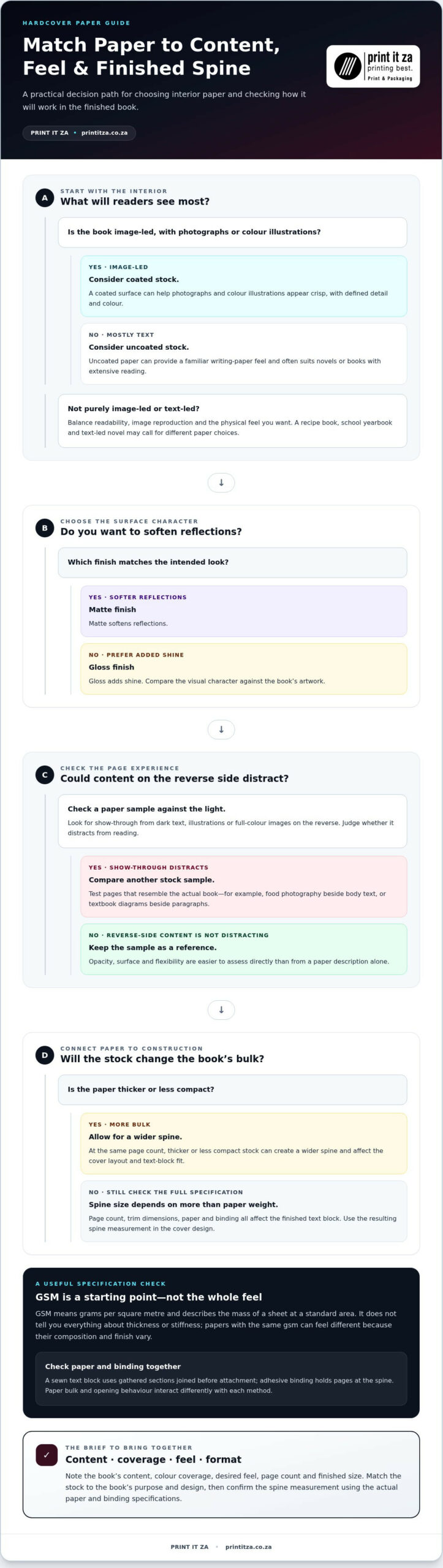
Paper affects how a hardcover book reads, handles, and sits inside its case. Compare the interior’s purpose, image coverage, page count, and finished thickness before selecting a stock. A text-led novel has different requirements from a school yearbook filled with photographs. The right choice balances readability, image reproduction, and the physical feel you want.
Paper weight is commonly expressed in grams per square metre, abbreviated as gsm. It describes the mass of a sheet at a standard area, but doesn’t tell you everything about thickness or stiffness. Two papers with the same gsm can feel different because their composition and finish vary. A paper sample lets you assess opacity, surface, and flexibility directly.
For text-heavy interiors, uncoated stock can provide a familiar writing-paper feel and reduce glare under reading light. For colour photography, a coated surface can help images appear crisp, with defined detail and colour. Matte and gloss finishes also affect the visual character: matte softens reflections, while gloss adds shine. Check sample images that resemble your artwork before deciding.
Consider show-through when pages have dark text, illustrations, or full-colour images on both sides. Hold a sample against the light and check whether the reverse-side content distracts from reading. For a recipe book, test a page with food photography beside body text. For a textbook, compare diagrams, headings, and paragraphs at the intended size.
Paper choice also affects the book’s bulk. A thicker or less compact stock can create a wider spine at the same page count. That affects the cover layout and how the text block fits inside the case. Tell the printer your page count and preferred paper during planning, then use the resulting spine measurement in the cover design.
There’s no universal page-count range for each paper type or hardcover binding. The practical limit depends on sheet thickness, trim dimensions, binding construction, and how the book needs to open. A compact journal and a large-format illustrated book with the same number of pages can have text blocks of different thicknesses. Request specifications for your actual format and stock.
Binding also influences paper choice. A sewn text block uses gathered sections joined before attachment, while adhesive binding holds pages at the spine. Each method interacts differently with paper bulk and opening behaviour. Don’t choose stock by gsm alone; assess the paper, binding, and intended use together.
Prepare a short paper brief before requesting a quote: describe the content, colour coverage, desired feel, page count, and finished size. For example, identify whether the book contains full-bleed photographs or mostly black text. You can also explore hard cover book printing while shaping those production choices.
Preparing interior and cover files
Prepare the interior and cover as separate, print-ready files, using the printer’s production template for final dimensions. For a hardcover project, check page order, fonts, image quality, trim, bleed, and the complete cover layout.
A print-ready PDF is a practical file format for most book projects, but the printer’s specifications determine the final setup. Keep editable source files available in case an approved correction is needed.
Interior File Preparation
The interior file contains the book’s pages in reading order, from the opening pages through the final page. Export a print-ready PDF and inspect it at page size, checking headings, body text, images, and page numbers. For example, confirm that a chapter title hasn’t shifted onto an unintended page after export.
Use the final trim dimensions when setting up the document. Keep text and essential image details away from the trim edge, and extend full-page backgrounds into the bleed area shown in the production template. Embed fonts in the PDF, or outline them if the printer’s workflow requires it. Check that links, comments, and editing marks aren’t visible in the output.
Review the PDF from beginning to end rather than checking only a sample page. Confirm that blank pages are intentional, illustrations appear in the correct sequence, and every spread reads properly. A contents page that names a chapter incorrectly, for instance, can undermine an otherwise polished interior.
Cover Artwork Specifications
Build the cover artwork from the printer’s hardcover template, not a paperback template. A case-bound cover includes the back, spine, front, and wraparound areas; its overall dimensions depend on the book’s finished size and text-block thickness. The template shows where artwork can extend and where important text should stay clear.
Supply the cover as a print-ready PDF unless the printer specifies another format. Use images suitable for the final printed size, prepare colours for the chosen print process, and keep logos and small text sharp. Don’t guess the spine width: it depends on the finished page count and paper stock.
Check the front, spine, and back as one continuous layout. Make sure the title sits on the front, spine text is centred within its panel, and the back-cover copy remains readable. Avoid placing faces, lettering, or key design elements across folds, joints, or turn-in areas marked on the template.
Before exporting, compare both PDFs against the approved trim size and production template. Confirm that the interior page count matches the cover’s spine calculation, then review the final files at actual size. A missing font or misplaced image is easier to correct before production than after printing.
Book trim sizes
Trim size is the finished page size after printed sheets are cut. It influences how a book feels in the hand, how readers view its content, and how the layout uses each page. Choose it early, because changing dimensions can affect page design, paper use, spine width, and the hardcover case.
Start with the book’s purpose. A novel designed for comfortable everyday reading has different needs from a large photography book displaying detailed images. A4 and A5 are familiar size references, while square formats can suit image-led projects. Treat these as starting points, then align the final dimensions with the content and production plan.
Think about how the reader will use the book. A compact format may be easier to carry, while a larger page can give diagrams, maps, or photographs more room. For a cookbook, consider whether recipes and images remain legible on the intended page. For a school yearbook, consider how portraits and group photographs fit without awkward cropping.
Page design should follow the selected trim size. Set up margins, columns, image placement, and type sizes using the final page dimensions. Resizing a finished layout can make text reflow, captions shift, and photographs crop differently. Review representative pages after any format change.
Hardcover construction adds another consideration. The boards and case wrap extend beyond the trimmed pages, so the finished cover is larger than the interior page size. The spine also depends on the text block’s thickness. Give the printer the final trim size, paper choice, and page count so the cover template matches the planned book.
Trim size can affect how much paper each copy uses and how efficiently pages fit production sheets. A format that uses paper efficiently may reduce offcuts, while a custom shape can require different layout planning. Discuss the format alongside quantity and page count, rather than treating size as an isolated design decision.
Before finalising the dimensions, make a simple mock-up using blank paper cut to the proposed size. Add sample text, a typical image, and any tables or diagrams. Hold it as a reader would, then check whether headings, captions, and important details feel comfortable. This can reveal cramped layouts before the artwork is complete.
Record the agreed finished width and height in the project brief, and use those exact dimensions in the interior document. Keep the trim specification consistent across the layout, proof, and cover template. For example, if a designer changes an A5 concept to a square format, update every page and confirm the revised spine calculation before preparing final artwork.
Print production and shipping time
A delivery date depends on more than the press schedule. Hardcover projects move through file approval, printing, binding, finishing, packing, and transport. Each stage must fit the next: a late cover correction can affect case production, while an unapproved proof can hold up the print start. Plan the full process from approved artwork to delivery in Johannesburg.
Start by working backwards from the date you need the books. Allow time for final file checks and proof approval before production begins. Then include printing, drying or setting time where the chosen process requires it, hardcover binding, finishing, packing, and shipping. A launch, school event, or book fair gives you a firm deadline to plan around.
Production timing varies with the job’s specifications. A large print quantity, extensive colour coverage, unusual trim size, or complex finishing may affect scheduling. Hardcover binding also involves making the case and joining it to the text block. Include any dust jacket or special cover treatment in the schedule brief.
Proof approval is a key control point. Review the printed proof for colour, image placement, page order, and legibility before authorising the run. For example, a small caption correction may be straightforward before printing, but changes after production starts can require additional work. Assign one person to consolidate feedback and provide clear approval.
Shipping needs its own place in the plan. The destination, number of cartons, delivery access, and dispatch arrangements affect how books move after packing. For delivery within Johannesburg, provide the complete street address and receiving details. For distribution to several South African locations, identify each destination and quantity separately so packing and dispatch can be planned accurately.
Build a schedule with clear milestones rather than relying on one estimated completion date. Record when final files are due, when proofs need approval, when production is planned, and when delivery is required. Ask the printer to distinguish production time from transit time in the project schedule. This makes it easier to see where a delay could affect the final date.
Before confirming the schedule, settle the artwork, paper choices, quantity, binding, finishing, and delivery details. Changing the paper or page count can affect spine calculations and cover preparation. A complete brief reduces avoidable back-and-forth and helps align production with shipping. If the books are for an event, plan to receive and inspect them before the event date.
Map your milestones and delivery needs into a clear production brief, then plan your book printing and delivery around the date your books must be ready.
Print It ZA print and packaging: Books
Print It ZA produces books for projects that need a clear plan for format, artwork, paper, binding, and delivery. Bring your preferred trim size, page count, paper choice, quantity, and required delivery date into the discussion. These details help shape a practical production brief for your hardcover book.
If you’re developing related printed materials, Print It ZA also produces catalogues, brochures, and retail packaging. A coordinated brief can help keep the look and production requirements aligned across those items.
For a book project in Johannesburg, contact Print It ZA print and packaging to discuss your requirements, or visit printitza.co.za.
Give Your Book a Clear Next Step
A hardcover project starts with more than a finished manuscript. It gives your ideas a physical form readers can keep, share, and return to. As you move from concept to production, consider the experience you want the book to create, from its first impression to the way it sits in a reader’s hands.
That purpose can guide your next conversation about printing hard cover books. Print It ZA produces books, catalogues, and brochures for projects that need a considered approach to print. Bring your creative direction and project requirements together, then take the next step with a clear brief.
Contact Print It ZA print and packaging to discuss your book project. Your idea can become a polished printed piece, ready to make its mark with readers.
Frequently Asked Questions
Can I order samples?
Samples are useful for judging materials and construction before approving a book design. A paper swatch helps you compare surface, colour, and stiffness; a bound dummy gives you a sense of the finished book’s size and feel. Decide what you need the sample to show, such as whether photographs reproduce clearly or the cover feels substantial enough for a keepsake edition.
How Should I Prepare My Print Book Files?
Prepare separate interior and cover PDFs, then check each against the approved production specifications. Use consistent file names, such as “Title_Interior_Final” and “Title_Cover_Final,” to distinguish approved artwork from earlier drafts. Include a brief noting the final page count, trim size, paper choice, and quantity. Before sending files, open the exported PDFs on another device to catch missing fonts, altered images, or accidental edits.
How do I design my files?
Start with the reader’s experience, then build a repeatable layout system. Choose a typeface pairing, heading hierarchy, image style, and page-number position, and apply them consistently. For a recipe book, for example, keep ingredient lists and method steps easy to scan. Leave visual breathing room around captions and diagrams, and review a printed-size mock-up to judge whether the text is comfortable to read.
How do I start an order?
Start by requesting a quote through Print It ZA’s online form or by calling (010) 446 5618. Prepare your project details first: book format, quantity, page count, paper preference, finishing, and delivery address. Once you approve the quote, upload the files for processing. If your project also needs a catalogue or brochure, include those requirements in the same brief.
Where can I print hardcover books in South Africa?
Print It ZA provides book printing for customers in Johannesburg and Gauteng, with delivery across South Africa. This can suit a local author, school, or organisation coordinating a project from the province while distributing copies elsewhere in the country. Include the delivery destination and receiving details in your project brief so production and dispatch planning reflect where the books need to go.
What is the cost to print hardcover books in South Africa?
The cost depends on the project, and a price is provided after you request a quote. Share your quantity, page count, trim size, paper, colour requirements, cover construction, finishing, and delivery destination. A focused brief makes it easier to understand how your choices shape the quote. If the design is still developing, describe the intended use and preferred format to guide the estimate.
What factors affect hardcover book printing prices?
Quantity, page count, paper selection, colour coverage, dimensions, binding, finishing, and delivery all influence the project quote. For example, a photograph-heavy book may need different paper and colour treatment from a text-led edition. Special cover treatments also add production steps. Compare options against your priorities, such as image impact, portability, or formal presentation, rather than changing specifications without considering the finished result.
How long does hardcover book printing and delivery take in South Africa?
Timing depends on the production schedule and delivery destination. Allow for file approval, printing, binding, finishing, packing, and transit when setting your required date. A Johannesburg delivery and a delivery to another province involve different transport routes. Share your target arrival date at the start, and keep artwork and approvals organised to avoid preventable delays between production stages.