Imagine standing in a Sandton boardroom just hours before a major launch, only to realize your company profiles look flimsy because the pages are misaligned or the binding feels amateur. It’s a frustrating reality for many local businesses facing tight deadlines and technical confusion. You want a document that feels substantial and professional, yet the technical requirements of saddle stitch booklet printing Gauteng often feel like a hurdle rather than a help.
We understand that you need more than just a printer; you need a creative partner who ensures your work meets the high standards of the Gauteng business landscape. This 2026 guide promises to help you master both the technical and creative aspects of saddle stitch printing. You’ll gain the confidence to design high-impact booklets that look polished and stay together. We’ll walk you through the essential "multiples of four" rule, explain how to account for paper creep in thicker documents, and help you select finishes that make your brand stand out in a crowded market.
Key Takeaways
- Understand why saddle stitching is the most cost-effective and professional binding method for high-impact business documents in the region.
- Master the technical “multiples of four” rule for saddle stitch booklet printing Gauteng to ensure your page counts are always production-ready.
- Choose the right paper weight (GSM) to balance durability and aesthetics for everything from text-heavy manuals to glossy retail catalogues.
- Learn how to adjust your design margins to account for “booklet creep,” keeping your content perfectly aligned and safe from the trimmer.
- Discover the advantage of partnering with a centrally located Midrand printer to achieve rapid turnaround times for your corporate events.
What is Saddle Stitch Booklet Printing and Why is it Popular in Gauteng?
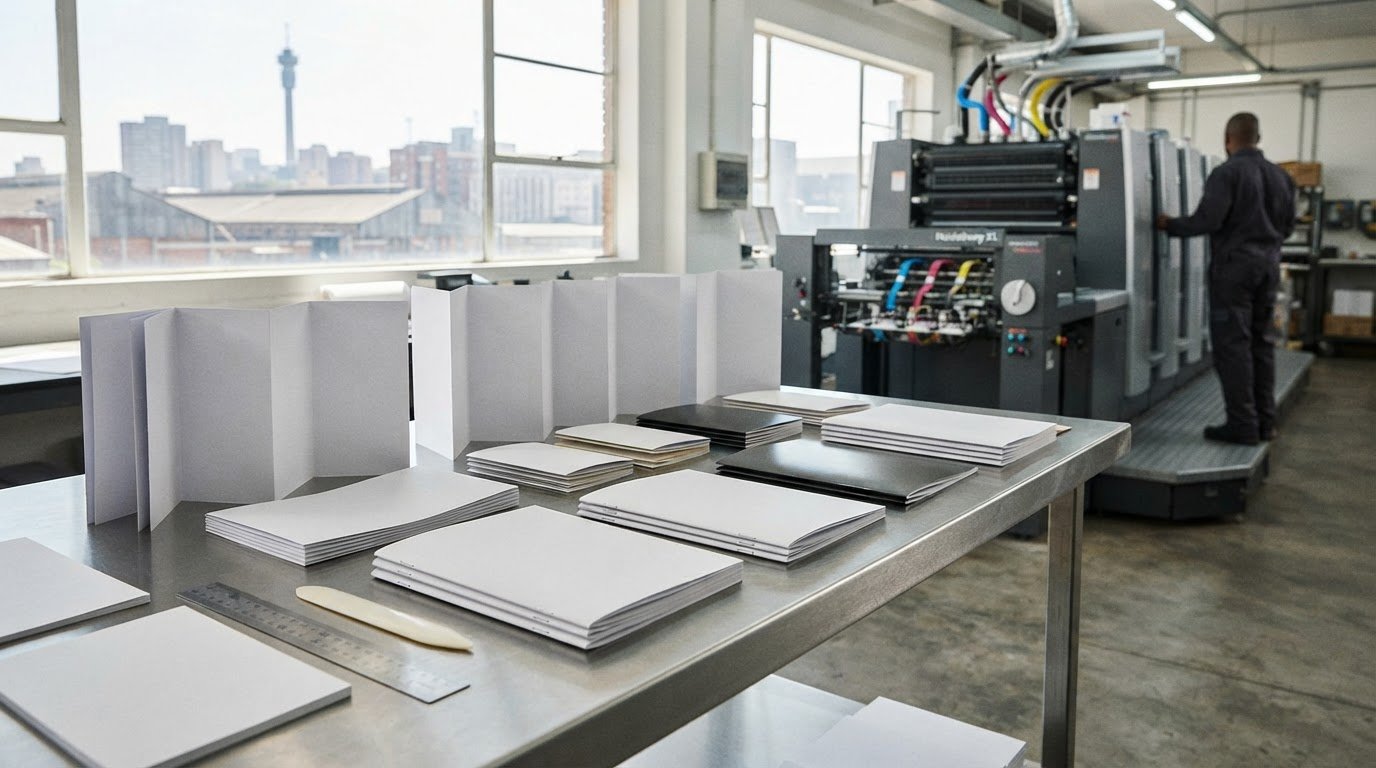
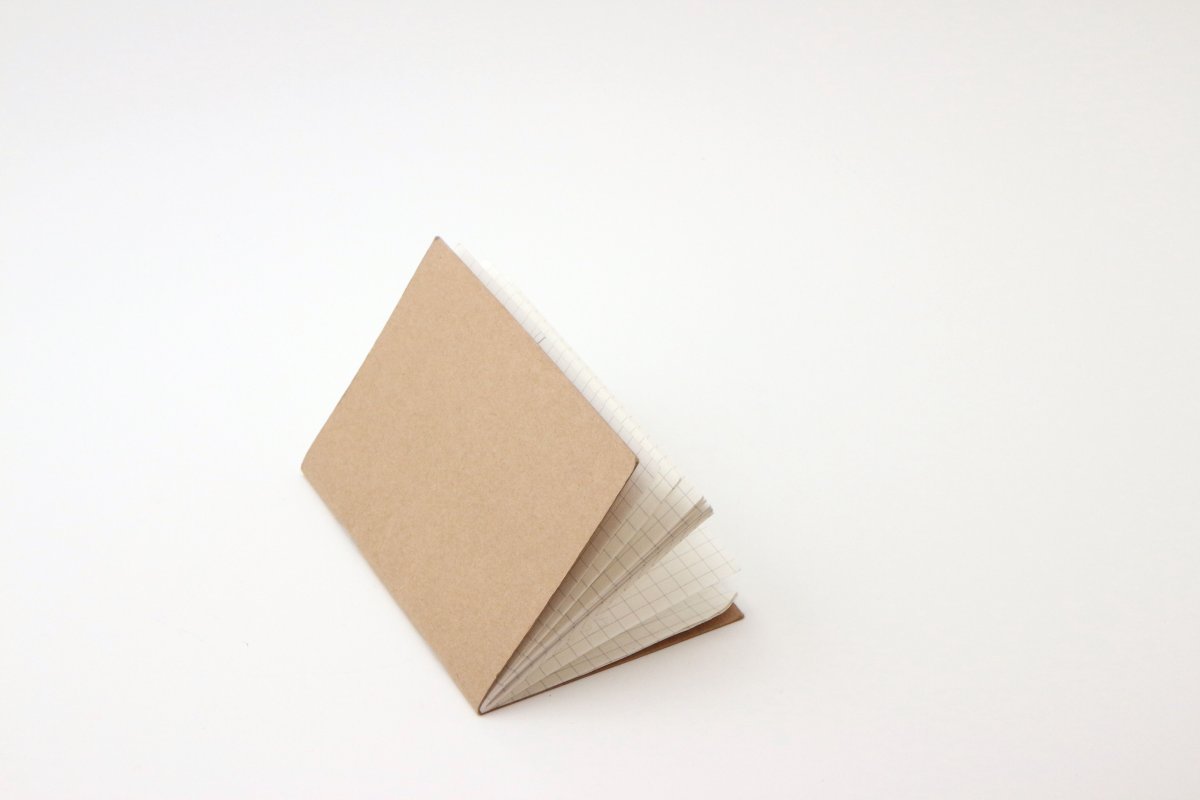
Saddle stitch isn’t just a basic stapling job. It’s a precise method where folded sheets are nested together and secured with industrial wire staples through the center fold line. The name comes from the actual machinery used during the finishing phase. Your pages are draped over a metal frame that resembles a "saddle" before the stitches are driven through the spine. For many local firms, saddle stitch booklet printing Gauteng provides the perfect intersection of speed and professional aesthetics. It’s the primary choice for documents that need to look sharp without the extended lead times or costs associated with glue-based binding.
Unlike other bookbinding methods, saddle stitching allows your booklet to lay almost flat when opened. This is incredibly practical for catalogues or training manuals where the reader needs to see the entire spread at once. In the high-pressure Johannesburg corporate sector, this efficiency is vital. When you’re preparing for a high-stakes meeting or a large-scale event, you need a binding solution that is both durable and quick to produce. It’s affordable. It’s professional. It works.
The Anatomy of a Saddle Stitched Booklet
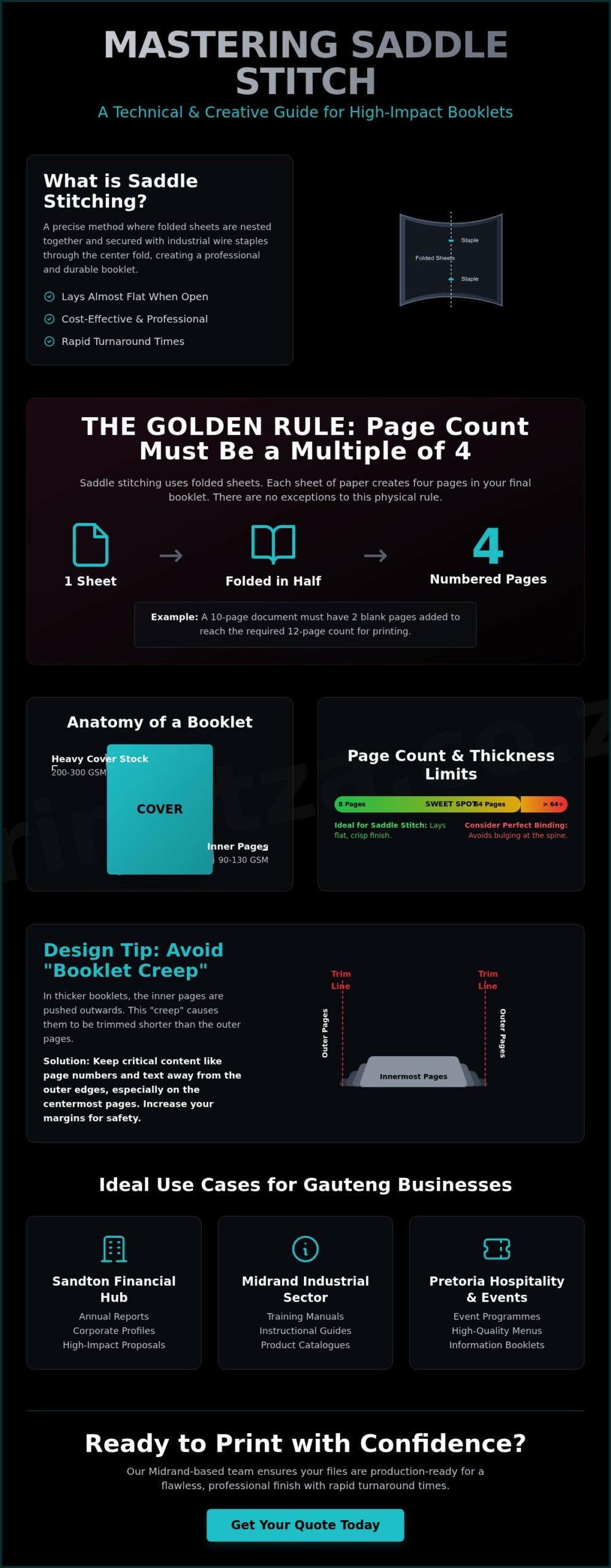
A well-crafted booklet is about balance. We often recommend using a heavier cover stock, typically between 200gsm and 300gsm, to give the document a premium feel. This extra weight protects the inner pages and prevents the staples from pulling through the paper. For the inners, you have the flexibility to choose between 90gsm bond for text-heavy manuals or 130gsm gloss for vibrant, image-led catalogues. The final touch is the industrial-grade wire stitching. These aren’t your standard office staples; they’re designed for maximum durability and a clean, professional finish.
Ideal Use Cases for Gauteng Businesses
Gauteng’s diverse economy demands versatile print solutions. In Sandton’s financial hub, saddle stitching is the standard for annual reports and corporate profiles that need to convey authority. It’s also the preferred format for industrial hubs in Midrand. Companies there use it for training manuals and instructional guides that employees can easily reference on the job. Meanwhile, Pretoria’s hospitality venues frequently use this method for high-quality event programmes and menus. It’s a reliable, high-energy solution that keeps pace with the province’s rapid growth and demanding corporate schedules.
Technical Specifications: Mastering Page Counts and Paper Weights
Every professional print project starts with a clear understanding of the physical limitations of the medium. For saddle stitch booklet printing Gauteng, the most critical rule is the "multiple of four." Because this binding method uses sheets of paper folded in half and stapled, every single physical sheet creates four numbered pages. If your document doesn’t hit a multiple of four, you’ll be left with unexpected blank pages at the back of your booklet. It’s a simple physical reality that often catches designers off guard during the pre-press stage.
Selecting the right weight, or GSM (Grams per Square Metre), is your next priority. For text-heavy training manuals where readability and budget are key, a 90gsm bond is a reliable workhorse. If you’re producing a high-end catalogue, a 130gsm gloss or matt stock provides that tactile, premium feel that customers appreciate. You also need to consider the thickness limit. We generally recommend staying within a 48 to 64-page range for saddle stitching. Anything thicker causes the booklet to bulge or "V" at the spine, which is a clear signal that it’s time to switch to perfect binding for a flatter finish.
Calculating Your Page Count Correctly
Precision matters when you’re mapping out your content. In the print world, every surface is a page. Your front cover is Page 1, the inside of that cover is Page 2, and so on until you reach the very back. If your content only fills 10 pages, you’ll need to add two blank pages or more content to reach the required 12-page signature. Visualising how these sheets nest inside each other helps you understand why your page count must remain divisible by four. If you’re feeling stuck on your layout, you can always consult with our technical team to ensure your file is production-ready.
Selecting Paper Stocks for the Gauteng Climate
Gauteng’s notoriously dry climate can be tough on paper. Low humidity often leads to static build-up and paper curling, especially with lighter stocks. Choosing a slightly heavier cover, known as a "plus-cover" setup, helps keep the booklet flat and professional despite the environmental conditions. Gloss finishes look spectacular for vibrant photography, but they can show fingerprints in high-use environments. For instructional guides or manuals that see a lot of handling, a matt finish or a recycled eco-friendly stock often proves more durable and sustainable for long-term use.
You also have the choice between a self-cover and a plus-cover. A self-cover means the entire booklet uses the same paper weight throughout, which is excellent for lightweight flyers. A plus-cover uses a thicker external wrap, providing a more robust and authoritative feel for your corporate profiles. Making these decisions early ensures your final product isn’t just a document, but a high-impact brand asset.
Saddle Stitching vs. Perfect Binding: Which Should You Choose?
Choosing the right binding method for your project often comes down to a balance between your document’s thickness and your final budget. For most businesses looking for saddle stitch booklet printing Gauteng, the choice is driven by the need for a fast, professional result that doesn’t break the bank. Saddle stitching uses clean, industrial staples that allow the booklet to open nearly flat. This makes it the superior choice for documents meant to be used and referenced frequently. It’s practical. It’s rugged. It’s efficient.
Perfect binding offers a flat, printable spine that looks like a high-end paperback book. While this looks sophisticated on a shelf, it isn’t always the most durable option for high-traffic environments like workshops or training centers. In these settings, staples provide a mechanical grip that keeps pages secure even after months of heavy use. If your document run is under 500 units, saddle stitching is almost always the more cost-effective path because it avoids the complex setup and drying times associated with PUR glues.
Speed is another critical differentiator. Because saddle stitching is a purely mechanical process, the 24/7 facility at Print It ZA print and packaging can turn around urgent orders much faster than perfect-bound projects. There’s no waiting for adhesives to cure. Your booklets move straight from the stitcher to the trimmer and out for delivery across the Johannesburg and Pretoria corridor. This rapid turnaround is a lifesaver for corporate events with tight deadlines.
The Page Count Decision Point
The physical bulk of your paper determines when you should make the switch. Saddle stitching is ideal for booklets ranging from 8 to 52 pages. Once you cross the 60-page threshold, the spine bulk becomes problematic. The "V" shape mentioned earlier in this guide becomes more pronounced, and the booklet won’t stay closed naturally. This is the natural transition point where perfect binding becomes the better aesthetic choice for a professional, flat-back presentation.
Litho vs. Digital Printing for Booklets
Your choice of printing technology depends on your volume and level of customisation. Digital printing is perfect for short-run, personalised booklets for corporate events in Sandton. It allows for quick changes and zero waste. If you’re printing high-volume retail catalogues for national distribution, lithographic printing is the way to go. It ensures the lowest possible unit cost while maintaining incredible colour consistency. We make sure your brand colours remain identical whether we’re using a digital press for 50 copies or a litho press for 50,000 units.
Designing for Success: Pre-Press Tips to Avoid "Creep"
Technical precision in the design phase is what separates a "cheap" looking document from a high-impact corporate asset. One of the most overlooked challenges in saddle stitch booklet printing Gauteng is a phenomenon known as booklet creep. As you nest folded sheets of paper inside one another, the thickness of the paper physically pushes the inner pages further away from the spine. When the final booklet is trimmed to size, these inner pages lose more of their outer margin than the pages closer to the cover. If your design doesn’t account for this, your page numbers or edge-aligned text might end up on the cutting room floor.
To prevent this, you must adjust your margins and safe zones. We recommend keeping all critical information at least 5mm away from the trim edge. This safe zone ensures your content stays centered even as the paper shifts during the binding process. Standard 3mm bleed is also a non-negotiable requirement. Bleed allows your background colours or images to extend past the trim line, ensuring no white edges appear if the cutting blade deviates by even a fraction of a millimeter. These small adjustments guarantee a professional, seamless result for your Gauteng-based business.
Preparing Your Print-Ready PDF
Your printer needs a specific file format to ensure a smooth production run. Always export your final design as "Pages" rather than "Spreads" in a single PDF document. This allows our pre-press software to automatically arrange the pages in the correct order for the stitching machine. You should also ensure the following technical standards are met:
- Embed all fonts: This prevents text from reflowing or characters from disappearing.
- High-resolution imagery: Use 300 DPI images to avoid pixelation on high-quality presses.
- CMYK colour profiles: Convert all RGB elements to CMYK to match the high-standard corporate print requirements common in Johannesburg.
Cover Design Considerations
The cover is your brand’s first impression. When designing across the fold, ensure that any elements spanning the spine align perfectly. This is particularly important for logos or heavy graphic lines. To elevate the final look, consider a professional lamination. Gloss lamination makes colours pop, while Matt provides a sophisticated, non-reflective finish. For a truly premium Gauteng executive feel, Soft-touch lamination offers a velvet-like texture that demands attention. Lamination provides a protective barrier against moisture and oils from skin, ensuring your booklet remains pristine during repeated use. Before you finalize your layout, submit your design for a technical review to ensure every margin is perfect.
Premium Saddle Stitch Printing in Midrand: The Print It ZA print and packaging Advantage
Print It ZA print and packaging isn’t just another print shop. We’re your creative partner right in the heart of Midrand. Our location is strategic, allowing us to serve the entire Johannesburg and Pretoria corridor with unmatched speed. When you choose us for saddle stitch booklet printing Gauteng, you’re tapping into a 24/7 print operational powerhouse. We don’t stop when the sun goes down, meaning your urgent event programmes or annual reports move through production while the rest of the city sleeps. We value your time and your vision above all else.
The in-house design team acts as your technical mentor. While we’ve already explored the complexities of page counts and creep compensation in this guide, our experts take those practical worries off your plate. We review your files to ensure the math adds up and the margins are safe before the first sheet is folded. Once the ink is dry and the staples are set, our seamless delivery logistics take over. We get your documents from our facility straight to your office or Sandton event venue without a hitch. It’s a streamlined process designed for the fast-paced Gauteng business environment.
Why Local Gauteng Businesses Trust Us
We take immense pride in our regional roots. This commitment to high standards has made us a dependable choice for the province’s most demanding sectors. We have extensive experience providing high-volume book printing services for large corporate clients who cannot afford delays. Our approach is never transactional; we build partnerships to ensure the final product exceeds your expectations every single time. It’s about reliability you can feel.
Get Started with Your Booklet Project
Ready to see your brand in print? Starting is simple. Reach out with your page count, preferred paper weights, and finishing choices. We’ll provide an accurate quote that respects your budget and timeline. If you’re unsure about paper textures, we offer sampling so you can feel the difference between matt and gloss or see how your colours look on different stocks before we run the full order. Contact Print It ZA print and packaging for a professional booklet quote today and let’s get your project moving at the speed of business.
Elevate Your Brand with Professional Booklet Binding
Mastering the technical details of your print project is the first step toward creating a document that truly resonates with your audience. You now understand the essential "multiples of four" rule and how to design with "creep" in mind to keep your content perfectly aligned. For businesses looking for high-impact results, saddle stitch booklet printing Gauteng offers a versatile and cost-effective solution that doesn’t compromise on aesthetic quality. It’s the perfect way to present your brand with authority and clarity.
At Print It ZA print and packaging, we back your vision with regional printing expertise and a 24/7 print production facility in Midrand. Our state-of-the-art Litho and Digital equipment ensures that every staple is precise and every colour is vibrant. We don’t just print pages; we build reliable creative partnerships that help your business grow in the heart of South Africa’s economic hub. Our team ensures your technical specs are met with precision every time.
Don’t leave your professional reputation to chance. Request a Custom Saddle Stitch Booklet Quote from Print It ZA print and packaging today and let’s bring your next project to life. We’re ready to help you create something exceptional.
Frequently Asked Questions
What is the minimum and maximum page count for saddle stitch booklets?
The minimum page count for a saddle-stitched booklet is 8 pages, while the maximum typically ranges between 48 and 64 pages. This limit depends heavily on your chosen paper weight. If your document exceeds this, the booklet may bulge or fail to stay closed naturally. For projects with higher page counts, we suggest transitioning to perfect binding to maintain a flat and professional spine.
Can I use different paper for the cover and the inside pages?
You can absolutely use a different, heavier paper for your cover to create a premium "plus-cover" booklet. We often recommend a 250gsm or 300gsm cover paired with 130gsm inner pages for a high-quality feel. This combination adds durability and a professional weight to your document. Alternatively, you can choose a "self-cover" where the entire booklet uses the same paper weight throughout for a more lightweight, cost-effective result.
How do I calculate the "multiples of four" for my booklet?
Calculating the "multiples of four" is simple when you remember that every physical sheet of paper in your booklet creates four numbered pages once folded and stapled. If your content only fills 10 pages, you must add two blank pages to reach the required 12-page total. This rule is a physical requirement of the binding process. Always count every surface, including the inside and outside covers, to ensure your final file is production-ready.
What is the fastest turnaround time for booklet printing in Gauteng?
Our 24/7 production facility in Midrand allows us to offer some of the fastest turnaround times for saddle stitch booklet printing Gauteng. Many standard projects can be completed and ready for delivery within 2 to 5 days of artwork approval. Because we’re centrally located, we can quickly dispatch your order to Sandton, Johannesburg, or Pretoria. This speed ensures you never miss a deadline for your corporate events or product launches.
Is saddle stitching durable enough for a training manual that will be used daily?
Saddle stitching is exceptionally durable and well-suited for training manuals that require daily handling. The industrial wire staples provide a strong mechanical bind that keeps pages secure even with frequent use. Unlike glue-based methods that can crack over time, staples allow the booklet to lay nearly flat, making it easier for users to read and reference. It’s a rugged, reliable choice for high-traffic instructional environments.
Do I need to design my booklet in spreads or single pages?
You should always export your print-ready PDF as single pages rather than spreads. Our pre-press software automatically handles the "imposition" process, which arranges your pages in the correct sequence for the stitching machine. Sending files as single pages, starting from the front cover and ending with the back cover, prevents errors in the final layout. This ensures your content flows correctly and aligns perfectly across every fold.
What is the difference between saddle stitch and stapled booklets?
There is no functional difference between saddle stitching and stapling; saddle stitch is simply the professional industry term for the process. The name comes from the "saddle" on the machine where the folded sheets are draped before being secured with wire staples. While it sounds technical, it refers to the clean, industrial-grade binding you see on magazines and high-quality brochures. It provides a much more robust finish than a standard office stapler could achieve.
Can Print It ZA help with the layout of my booklet if I only have the text?
Our in-house design team is ready to assist if you only have your text and images ready. We can help you navigate the layout process, ensuring your document hits the required page counts and accounts for booklet creep. We act as your creative partner, transforming your raw content into a polished, professional document. This collaborative approach helps you achieve a high-impact result without the stress of managing complex technical specifications yourself.
Contact Print It ZA today, for a Free Quote and Speedy Service.
Print It ZA print and packaging, we deliver Printing Best!