The most impressive hardback isn’t automatically the right one for your book. A heavyweight paper or elaborate cover finish may add cost and complexity without improving the reading experience if the specifications don’t suit the content or audience. Successful hardback printing starts with a clear brief, not a default spec.
It’s easy to feel unsure about paper, format and finish, or wonder whether your artwork is ready for production. Comparing quotes can be just as difficult when each printer is pricing a different set of specifications. Define what your book needs before you assess options.
This guide will help you compare choices, prepare a complete print-ready brief and choose a printer with confidence. You’ll learn what to confirm, including artwork requirements, production method, binding and finishing options. Print It ZA print and packaging’s in-house design team and support from design through delivery can help clarify those decisions, so you and your printer share an understanding of the finished book.
Key Takeaways
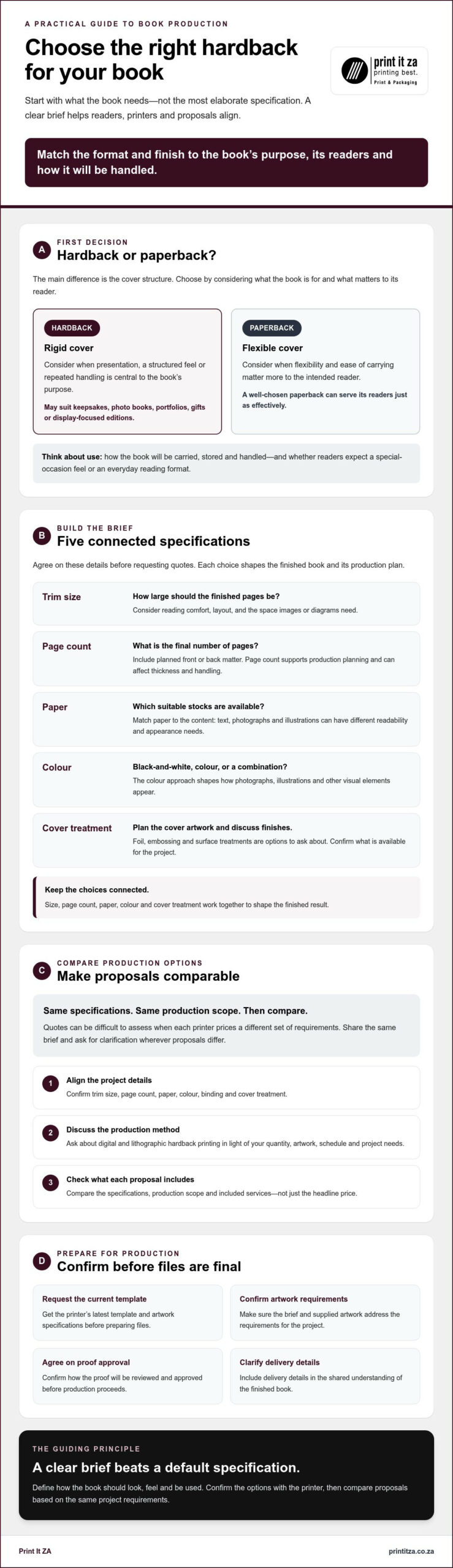
- Match a hardback’s format and finish to how readers will use and experience the book.
- Compare trim size, page count, paper, colour and cover treatment as connected choices that affect the finished result.
- Discuss digital and lithographic hardback printing with your printer, based on your quantity, artwork, schedule and project needs.
- Before preparing files, request the printer’s current template and artwork specifications, then confirm proof approval and delivery details.
- Compare printer proposals using the same specifications, production scope and included services. Ask for clarification where they differ.
Is hardback printing right for your book and its readers?
Hardback printing produces a book with a rigid cover, rather than the flexible cover used for a paperback. That firm outer cover gives the book a distinct structure and presentation, but the right format depends on what the book is for. For an overview of the format and its construction, see Hardcover book.
Quick decision rule: Choose a hardback when presentation, a structured feel or repeated handling is central to the book’s purpose. Consider a paperback when flexibility and ease of carrying matter more. Think about the intended reader and use before deciding, rather than treating either format as the automatic choice.
Which projects benefit from a hardback format?
A keepsake, photo book or portfolio may be intended to make a strong impression or be revisited over time, so a rigid cover may suit its presentation goals. A novel could work in either format: a hardback may suit a gift or display-focused edition, while a paperback may better suit readers who want a flexible book to carry. Recipe books and other frequently consulted titles may be handled often. Consider how readers will use the book, then ask the printer which binding options suit the project.
Audience expectations matter too. A book for a special occasion or one showcasing visual work may call for a different feel from a book designed for everyday reading. Weigh presentation against practical considerations, such as how the book will be carried, stored and handled.
Hardback or paperback: what should guide the choice?
The main difference is the cover structure: a hardback has a rigid cover, while a paperback has a flexible one. That affects how each feels in the hand and how it presents on a shelf or as a gift. It doesn’t make one format universally better. A well-chosen paperback can serve its readers just as effectively as a hardback.
Let the project’s purpose and expected handling guide the format choice, then check that the presentation fits your readers’ preferences. If you’re still weighing book formats, the existing guide, Book Printing in Johannesburg: A Complete Guide (2026), offers a broader starting point.
Once you’ve settled on a format, add it to a clear brief. For hardback printing, confirm the binding and finishing options available for your specific project before finalising the specification. That way, the format supports the book’s purpose rather than being chosen by default.
Which hardback printing specifications shape the finished book?
Agree on the specifications before requesting quotes. Trim size, page count, paper, colour and cover treatment all affect the finished book and its production plan. Proposals are comparable only when they describe the same requirements.
Use this table to shape your brief. Treat it as a discussion guide, not a list of standard options. Confirm available stocks, finishes and binding details with your chosen printer.
| Specification | What to consider | Why it matters |
|---|---|---|
| Trim size | How large the finished pages should be | Influences reading comfort, layout and how images or diagrams fit. |
| Page count | The final number of pages, including any planned front or back matter | Helps with production planning and can affect the book’s thickness and handling. |
| Paper | Which suitable paper stocks are available for your content | Text, photographs and illustrations can have different needs for readability and appearance. |
| Colour | Whether pages use black-and-white printing, colour, or a combination | Shapes how photographs, illustrations and other visual elements appear. |
| Cover treatment | The printed cover artwork and any finishing options to discuss | Influences the book’s presentation and needs to be planned with the cover design. |
How do size, page count and paper affect the book?
Choose a size that suits the content and feels comfortable for the intended reader. A photo-led layout may need room for its images, while a text-heavy book has different layout priorities. Confirm the page count once the content is organised, then ask the printer which paper options are available and appropriate for your mix of text, photography, illustrations and colour.
What should you know about the cover and finishing?
The rigid cover is separate from the printed pages inside the book, so plan and approve each part as its own element. Finishes such as foil, embossing or a particular surface treatment are options to ask about.
Before design sign-off, check the printer’s current artwork specifications, cover template and spine requirements. Spine setup depends on project details, so don’t finalise it based on an assumption. For clearer hardback printing quotes, send every printer the same confirmed brief. You can also discuss your book specifications with a printer before locking in your design.
How do you compare hardback printing options without overlooking the details?
A quote is useful only when you can see what it covers. For hardback printing, a lower total may reflect different paper, quantity, cover treatment or included services, rather than a better deal on the same job. Give each printer the same project brief, then compare the proposed method and scope of work.
When should you discuss digital or lithographic printing?
Digital and lithographic printing use different production workflows. Neither is automatically right for every hardback project. The best fit depends on your quantity, artwork, schedule and other requirements, so ask the printer to review the full brief before recommending an approach. Avoid relying on a general run-size rule without confirming how it applies to your book.
Print It ZA offers both digital and lithographic printing. Ask the production team to explain which method they propose for your project and what it means for the finished book. If printers recommend different methods, first check that their format, paper, colour, cover treatment and finishing scope match. Otherwise, you may be comparing different specifications, not just different production approaches.
What makes a printer’s quote useful and comparable?
Keep the project details consistent across every request. Each proposal should state the same format, page count, paper, colour requirements and quantity. Clarify what’s included beyond printing as well. Design support, finishing, quality checks and delivery arrangements can affect the overall scope, so ask for details rather than assuming each provider handles them in the same way.
- Book details: Are the format, page count and quantity identical?
- Materials and appearance: Do paper, colour and cover requirements match?
- Production: Is the proposed method stated, with any differences explained?
- Included services: Are design support, finishing and quality checks specified?
- Delivery: Are the arrangements and any related requirements clear?
Use this checklist to spot gaps and request clarification before choosing. A printer’s willingness to explain differences can help you assess how well they understand the brief. For a broader look at print planning, see Professional Printing Services in Johannesburg: The 2026 Guide to Quality & Scale. With a shared specification and clear scope, you can compare proposals on their actual merits and move into file preparation with fewer unanswered questions.
How should you prepare files and a brief for hardback printing?
A clear brief gives the printer the information needed to assess your project and flag questions before production. Start by describing the book, then follow the printer’s own file setup instructions. Templates and artwork requirements can vary, so request the current template and specifications before exporting final files. Don’t rely on another printer’s measurements.
What information belongs in a hardback print brief?
Record the book’s purpose and audience, format, confirmed page count, colour needs, quantity and desired delivery location. Note your preferred paper and cover finishing, but mark undecided choices clearly so the printer can advise. Attach draft artwork and list questions that need production guidance, such as which binding or finishing options are available for your project.
How can you reduce artwork and approval problems?
Use the printer’s current instructions to prepare the interior and cover. Check page order, image resolution, font handling and cover-spine layout with the production team rather than assuming one workflow applies everywhere. If a sample or proof is available, confirm how it will be reviewed and approved before production proceeds.
Use this workflow to keep the project moving:
- Define the brief. Document the purpose, audience, format, page count, colour requirements, quantity and delivery location. Separate confirmed choices from items where you want advice.
- Share draft material. Send the current manuscript and cover artwork, and flag any images, fonts or layout elements that may need checking.
- Request production guidance. Ask for the printer’s latest template and artwork specifications. Confirm page sequence, image requirements, spine setup, binding and available finishing options before preparing final files.
- Prepare and check files. Follow the supplied instructions. Review the page order, images, fonts and cover artwork, then check that the files match the agreed brief.
- Review the proof. If a proof or sample is available, confirm the review process. Check text, images, colours and finishing details, and raise corrections before approving the final version.
- Confirm delivery. Agree on the delivery location and arrangements, then make sure the final approved specifications are reflected in the project details.
Print It ZA’s in-house design team can help clarify a print brief and coordinate support through delivery. Get help preparing your book-printing brief before final files are exported.
How do you choose a hardback printer and move your project forward?
Choose a printer who can explain how your brief will be handled, not just provide a total. For hardback printing, compare proposals against the same project details, then clarify any differences in specifications, production scope or delivery before making a decision.
What should you ask a hardback printing partner?
Use a short checklist to understand what’s confirmed and where you’ll need guidance. Ask how the printer will coordinate questions, approvals and production updates, and make sure the answers are clear enough to compare with other proposals.
- Relevant book experience: Ask about their experience with books similar in purpose or format to yours.
- Confirmed specifications: Which format, paper, binding and finishing details are settled, and which need production-team advice?
- Production scope: What’s included in the proposal, such as design support, file checks, proofing and finishing? Confirm how any sample or proof will be reviewed, if available.
- Communication: Who will coordinate design questions and share production updates?
- File handover and delivery: What artwork requirements should you follow, and what delivery arrangements are included?
If proposals differ, ask each printer to explain the gap in writing. A quote that excludes design support or delivery, for example, isn’t directly comparable with one that includes those elements. Consider the complete scope and how clearly the printer answers your questions, rather than choosing on price alone.
What happens when you request a quote from Print It ZA?
Prepare your project brief, draft files, required quantity and delivery destination before getting in touch. Include the specifications you’ve decided on and note where you’d like advice. Print It ZA provides book printing using digital and lithographic methods, with in-house design support and assistance through final delivery. The team can review project details and help clarify the print setup. Confirm the specific binding, finishing, artwork and delivery arrangements for your book.
A clear starting brief makes it easier to discuss your project’s needs and receive a proposal based on those details. Discuss your hardback book printing project and request a tailored quote from Print It ZA.
Turn your book brief into a confident next step
The right hardback starts with choices that fit the book’s purpose and readers, not a default format. Settle key specifications before comparing quotes so each printer is pricing the same project. Then request the printer’s current artwork requirements, prepare your files to match, and clarify proofing and delivery before approving production.
A capable print partner can help you work through the details. Print It ZA provides book printing using lithographic and digital printing, with in-house design support and assistance through final delivery. Nationwide delivery and international export support are also available, so you can discuss where your finished books need to go as part of the project brief.
Have your draft files, quantity, preferred specifications and delivery destination ready. Then discuss your hardback book printing project with Print It ZA and request a tailored quote. If you’re planning a book project in Gauteng or Johannesburg, share your brief and delivery requirements with the team to discuss the next steps.
Frequently Asked Questions
What is hardback printing, and how is it different from hardcover printing?
Hardback printing produces a book with a rigid cover. “Hardback” and “hardcover” are generally two terms for the same format, rather than separate types of book. The cover structure distinguishes both from a paperback, which has a flexible cover. If you’re requesting a quote, describe the format as a hardback or hardcover and confirm the specific binding and finishing options available for your project.
Is hardback printing better than paperback printing for a novel?
Neither format is automatically better for a novel. A hardback may suit a gift, a keepsake edition or a book intended to make a strong presentation. A paperback may be more practical for readers who want a flexible book to carry. Consider your audience, how the novel will be sold or shared, and the experience you want readers to have, then ask your printer to compare suitable options.
What information do I need to request a hardback printing quote?
Prepare the book’s purpose, audience, format, page count, colour requirements, quantity and delivery destination. Include your paper and cover preferences, but mark undecided choices so the printer can advise. Share draft artwork if available, and ask which binding, finishing and production options can be confirmed for your project. Providing the same details to printers in Gauteng or elsewhere helps you compare proposals on an equivalent basis.
How should I prepare artwork for a hardback book?
Request the printer’s current artwork specifications and templates before exporting final files. Check the page sequence, text, images and fonts, and confirm how the cover and spine artwork should be set up. Requirements can differ between printers, so don’t rely on measurements from another provider. Ask whether a proof or sample is available and review the content and appearance before approving the final files for production.
Can hardback books be printed in small quantities?
Small-quantity production may be possible, but availability depends on the printer, project specifications and suitable binding options. Digital printing is one method to discuss, not a guarantee that every hardback format is available for a particular quantity. Share your required quantity, page count and artwork with the printer, then ask which production approach and binding options they can offer for your book.
How do I choose paper for a hardback book?
Choose paper to suit the content and reading experience. A text-led novel has different needs from a photo book or a title with detailed illustrations and colour. Think about readability, image appearance and how the book should feel in the hand, then ask the printer which stocks are available and suitable. Confirm the selected paper as part of the quote so proposals reflect the same specification.
How long does hardback book printing take in South Africa?
There isn’t one reliable timeline for every hardback project. Production timing depends on details such as quantity, artwork readiness, selected materials, finishing requirements, proof approval and delivery arrangements. Ask your printer for a project-specific estimate after sharing your brief, and confirm when the schedule begins, including any approval steps. If delivery is to Johannesburg or elsewhere in South Africa, provide the destination when requesting the estimate.
Contact Print It ZA today, fir a Free Quote and Speedy Service.
Print It ZA, we deliver Printing Best!
Print It ZA print and packaging, South Africa/ ZA.