
The binding colour is part of the finished piece, not just a small production detail. For wire-o binding services in Johannesburg, the available colours, lettering choices and lead time depend on the options selected and the job’s specifications.
It’s natural to want a binding that suits your design and a clear idea of when your documents will be ready. This article covers the colour and lettering choices to consider, along with the practical factors that shape turnaround, so you can plan your project with fewer surprises.
You’ll also see what information helps a professional printer prepare your job, why print readiness and project scope matter to scheduling, and how to match the binding finish to the purpose of your document. Whether you’re producing a manual, presentation document or another bound piece, the aim is a polished result that fits your brief and timeline.
Key Takeaways
- Plan your schedule around the job’s scope and production requirements, which influence turnaround time.
- Explore binding colour and lettering choices to find a finish that suits your document’s design.
- Match the document’s format, paper stock and page count to the intended use of the finished piece.
- Prepare artwork with the binding layout in mind so the finished pages remain clear and usable.
- Use the article’s provider and service-area guidance to plan production for your Johannesburg project.
Estimated completion time
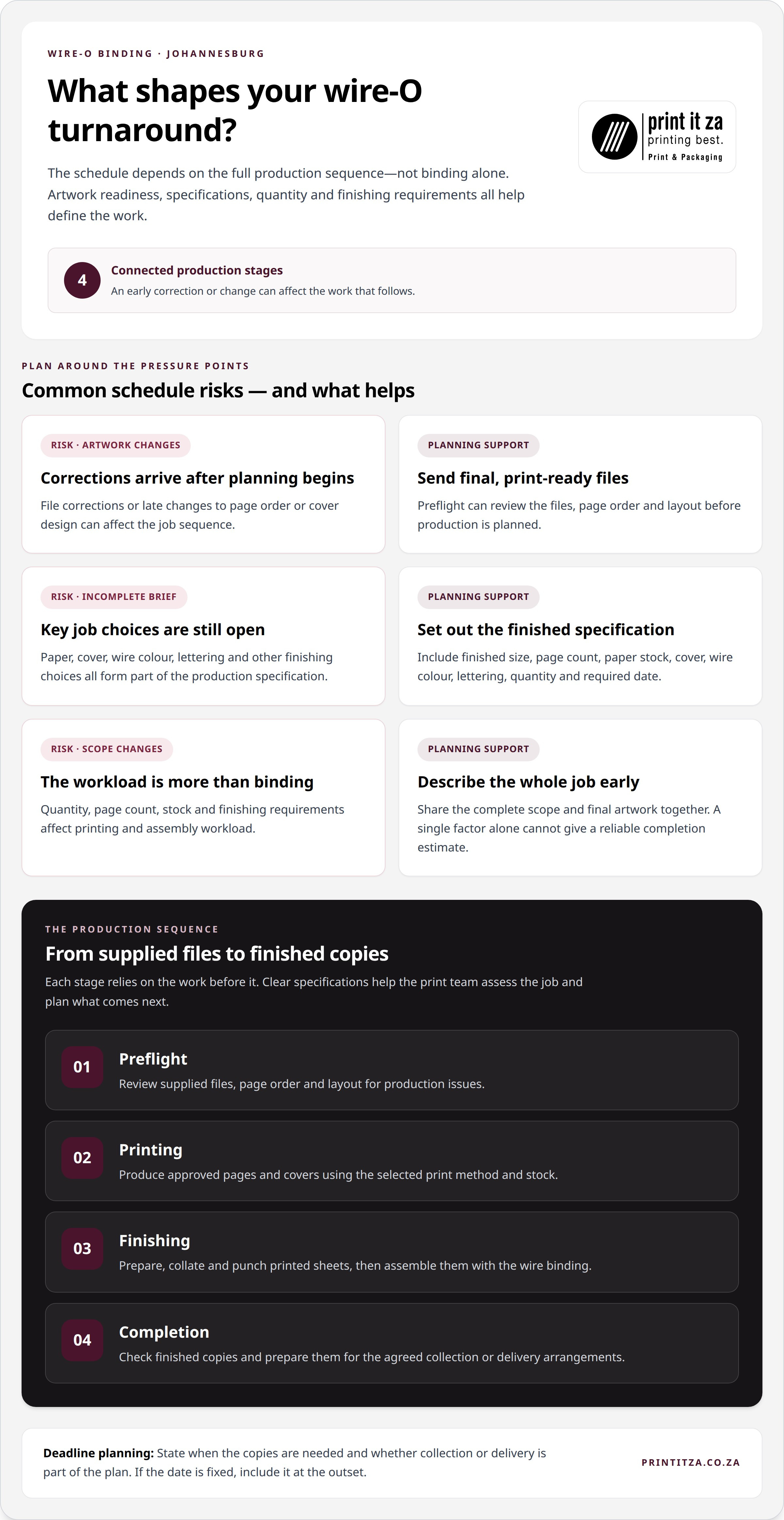
Wire-o binding turnaround depends on the full production sequence, not binding alone. The schedule takes shape around the print-ready artwork, paper and cover choices, quantity, binding finish and other finishing requirements. Each detail can affect when the finished copies are ready.
Start with a production brief that specifies the finished size, page count, paper stock, cover, wire colour, lettering, quantity and required delivery date. A short manual with approved artwork, for example, has a different scope from a large catalogue that needs layout changes and several finishing steps.
Artwork approval is a key scheduling point. If a file needs corrections, production planning must account for them before printing. A late change to page order or cover design can also affect the job sequence. Clear, final files help the print team assess the work and plan the next production stages.
The workflow generally moves through these stages:
- Preflight: The print team reviews the supplied files, page order, and layout for production issues.
- Printing: Approved pages and covers are produced using the selected print method and stock.
- Finishing: Printed sheets are prepared, collated, punched, and assembled with the wire binding.
- Completion: Finished copies are checked and prepared for collection or delivery arrangements.
Production stages are connected, so an early delay can affect the work that follows. A file correction, change in paper selection or revised quantity may require the schedule to be adjusted. Wire colour and lettering are also part of the job specification, not details to leave until assembly.
Quantity matters because printing and assembly involve different workloads. A single presentation copy and a large training-manual run require different handling. Page count and stock affect the printed set, while the cover and wire choice shape the finishing work. Together, these factors inform the production plan, but none alone provides a reliable completion estimate.
For a useful deadline, provide the finished specification and final artwork together. State when the copies are needed and whether collection or delivery is part of the plan. In Johannesburg, a professional printer can then consider the complete job scope and production sequence before setting the expected completion date. If your date is fixed, mention it at the outset, not after artwork approval. That gives the schedule a clear target and makes any production dependencies visible early.
Which print shops offer wire-o binding services in Johannesburg?
Johannesburg print providers differ in the work they handle. Digital print shops often focus on shorter runs and straightforward setup. Commercial printers may manage larger quantities and several production stages, while specialist finishers focus on binding and other post-print work. These categories can help narrow your search, but the provider’s actual service scope matters more than its label.
For a wire-o job, look for a printer that coordinates printing and binding in one workflow. This matters for a training document with a printed cover or a catalogue where page order and finish need close attention. When printing and binding are handled separately, coordination and handover become additional parts of the job to plan.
Compare providers against the needs of your project. A manual, presentation document and retail catalogue may each require different print and finishing work. Use these points to identify a suitable provider:
- Relevant examples: Look for completed bound documents similar to yours, such as manuals or catalogues.
- Production scope: Establish whether the shop handles printing, binding and finishing within its workflow.
- Specification clarity: A useful production discussion covers format, paper, page count, cover, wire colour and lettering.
- Schedule planning: The expected completion date should account for artwork readiness and each production stage.
These details show whether the printer understands the whole job, not just the final binding step. A document with a coloured cover and a particular lettering treatment, for example, needs those choices recorded in its production specification. Clear details also help the print team explain how the job will move from approved artwork to finished copies.
Johannesburg businesses should also plan how finished copies will reach their destination. A job for an office, training venue or retail location may need a different delivery arrangement. Include the destination and required date in the project brief. Print It ZA delivers door-to-door across South Africa, including Gauteng, so these details help shape a practical production and delivery plan.
Use this approach to compare providers on relevant capability, workflow and communication, rather than relying on a broad claim such as “full-service printing.” A clear brief gives a Johannesburg print team a concrete basis for assessing the work. For related printing project options, consider how the printed document fits into your wider business materials.
What are the addresses and service areas of Johannesburg wire-o binding providers?
A street address and a service area are different things. An address identifies a business location; a service area describes where it handles delivery or other arrangements. For a Johannesburg print project, record where files, printed materials and finished copies need to go.
Use a provider’s own published details to identify its location. A location name alone may not give you a collection point. An address with a street or building detail, suburb and Johannesburg or Gauteng reference helps distinguish a production site from an office or dispatch location.
Define the delivery destination clearly. A provider may accept work from clients across Johannesburg without delivering to every address. Some jobs may involve collection, while others use a delivery arrangement. Destination, quantity and handling needs all shape the practical plan. Print It ZA offers door-to-door delivery across South Africa, including Gauteng.
For a workplace project, record the delivery destination alongside the job details. A training manual may be needed at an office, while a retail document may need to reach a store. These destinations affect how copies are received and distributed. A building reception, loading area or event venue may also need specific handover instructions.
Use these details to assess location and coverage information:
- Business address: Note the full street address and suburb, not only “Johannesburg.”
- Production or collection point: Distinguish where work is produced from where finished copies are collected.
- Delivery destination: Record the complete destination, including the relevant suburb or venue.
- Handover needs: Include access instructions, receiving hours, or a named department where relevant.
For a multi-site order, list each destination separately. A head office and a branch store are distinct handover points, even when both are in Johannesburg. This keeps distribution clear and helps avoid confusion when the copies are ready.
Distance is only one planning factor. The completion date, packaging, quantity and destination handling can also influence delivery arrangements. Include the full address and intended handover method in your brief, and keep these details with the approved project specification so the production plan and destination stay aligned.
When comparing Johannesburg providers, look for precise location details and a clearly described approach to completed-job handover. Treat a listed address as a location, not proof of coverage across Gauteng. That distinction helps you plan a realistic route for your documents without assuming a service area that the published details don’t establish.
What sizes, paper stocks, and page counts can be wire-o bound?
Wire-o binding can suit different document formats, but size, paper and page count work together. A compact instruction booklet has different handling needs from a wide presentation document. The finished specification helps the print team assess how the pages and binding will work as one practical piece.
Define the closed size in millimetres (mm), the page orientation, such as portrait or landscape, and any required finished trim. A landscape training handout, for example, may need a layout that leaves clear space beside the wire. Page edge and binding position affect how comfortably readers can turn each sheet.
Paper stock also shapes the finished document. Lightweight text paper keeps a large manual easier to handle, while heavier pages can add stiffness and bulk. The cover may use a different stock from the inside pages. That combination can suit a presentation document, but the total thickness still needs to work with the chosen wire and punching process.
Page count means more than the number of numbered pages. The print team needs to know what the complete set includes, such as covers, blank pages, inserts and foldouts. An unnumbered title page in a manual still counts as a sheet in production. Page order matters too, because the finished document must open and read in sequence.
Before production, the print team can assess these connected details:
- Finished format: Record the width, height, and orientation in mm.
- Page construction: Identify the inside-page count, cover arrangement, and any inserts.
- Stock choices: Specify paper type separately for the cover and interior.
- Document use: Explain whether it is a frequently handled manual or a presentation piece.
- Binding clearance: Keep text, page numbers, and key graphics clear of the punched edge.
These points help the production team assess combined thickness and handling. A high page count on heavier stock creates a different finished block from the same count on lighter paper. Foldouts or unusually wide pages can also affect how the document sits and turns. Allow for binding space in the design, rather than placing important content close to the wire edge.
Send the final page sequence, finished dimensions in mm, stock choices and cover details together. If the document is still being designed, explain its purpose and intended format before the layout is final. This gives the print team practical information to assess the binding setup and flag design adjustments before production.
What file formats and artwork specifications are required for wire-o binding
A print-ready PDF helps preserve page layout, fonts and image placement, making it easier for the production team to review the document as designed. Editable files, such as Adobe InDesign files, can support revisions when artwork needs changes. Include linked images and fonts when supplying working files.
Page order matters. Export pages as single pages in reading sequence, not as printer spreads. If the document starts with a cover, for example, show it first, followed by the inside pages. The print team can then impose the pages for production. Keep blank pages in their correct positions.
Wire-o artwork needs clearance at the binding edge. Keep text, page numbers, logos and important images away from the punched edge. A tight margin can make content difficult to read after binding. The required clearance depends on the finished format and production setup, so follow the print team’s layout guidance rather than guessing.
If the cover is separate, clearly identify the front, back and any wrap elements. Wire-o binding does not have a conventional glued spine, so don’t design important text as though it will run across one. A clearly identified front and back cover make the file structure easier to follow.
Before production, the print team can review these file details:
- File type: Supply a print-ready PDF, or editable source files when revisions are needed.
- Page sequence: Keep each page in reading order, including intentional blanks.
- Trim size: Set the document dimensions to the agreed finished size in mm.
- Binding margin: Leave clear space beside the punched edge for readable content.
- Images and fonts: Embed fonts in the PDF, and provide linked assets with editable files.
- Colour and cover: Identify cover artwork separately and make colour choices consistent.
Low-resolution images can look soft in print, even when they appear clear on screen. A production review can identify image quality, missing fonts, incorrect page dimensions and layout issues before printing. It can also reveal whether page numbers or graphics sit too close to the binding edge.
Send one clearly named final file, such as “Manual_Final.pdf,” and mark earlier versions as obsolete. Include the finished size, page count, cover arrangement, and selected wire finish in the job details. To move your document toward print production, prepare your artwork for printing with the finished layout and binding requirements in mind.
Print It ZA print and packaging
Print It ZA brings printed projects together, from a clear brief to a finished piece. For wire-o-bound materials, the format, artwork, paper choices and intended use all help define the production requirements. Print It ZA’s in-house services include printing and binding.
Print It ZA prints books, catalogues and brochures, as well as retail packaging. These products support different business communication needs, whether you’re preparing customer information, organising a catalogue or developing materials for retail. A clear specification helps align the format and finish with the project’s purpose.
Share your project details and intended outcome to discuss the right direction for your print requirements. Contact Print It ZA print and packaging to talk through your project.
Shape your next print project
Choose a finish that suits how people will use and handle the document. A well-planned binding can complement your wider print identity, helping a manual, presentation piece or customer-facing publication feel considered from cover to final page. The same design approach can carry across books, catalogues and brochures for a cohesive set of materials.
If you’re planning wire-o binding services in Johannesburg, bring your project goals and preferred finish together before production begins. Print It ZA print and packaging can help you consider how the printed piece fits your broader requirements. Contact Print It ZA print and packaging to discuss your project and take the next step with confidence.
Frequently Asked Questions
What are the turnaround times for wire-o binding in Johannesburg?
Turnaround depends on the job’s production requirements, so there is no single timeline for every Johannesburg order. A project with final artwork and a straightforward specification may move differently from one needing design changes or complex finishing. Quantity, page construction, paper selection and the production schedule all affect completion. Include your required date in the brief so the schedule can be planned around it.
Do Johannesburg providers offer same-day or urgent wire-o binding?
Same-day or urgent completion depends on whether the production schedule can accommodate every stage. Artwork review, printing, page preparation, punching, binding and finishing all form part of the workflow. A print-ready file and clear specification can reduce delays caused by revisions, but they do not remove the production stages. For an urgent project, state the deadline and provide the complete job details at the outset.