
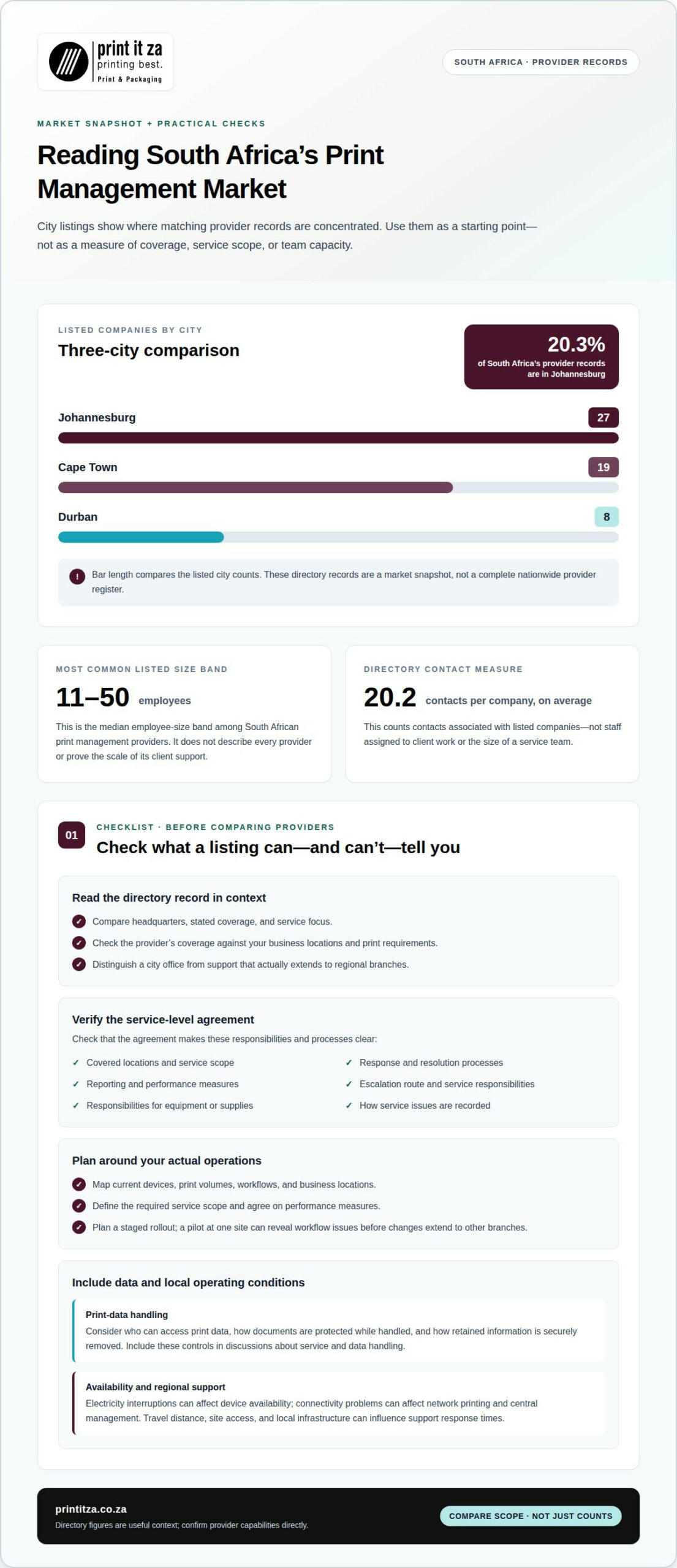
Johannesburg accounts for 20.3% of South Africa’s print management provider records, making it the country’s largest-city concentration. For businesses assessing Total Print Management in South Africa, that gives a useful starting point, but the wider market picture also depends on where providers are based and how large their teams are.
It’s useful to look beyond the number of providers. A company’s location and employee-size range can help you understand the market and identify what matters to your organisation. This article examines available company records for Johannesburg, Cape Town and Durban, then outlines the employee-size band most commonly listed among South African providers.
You’ll get a practical view of the market, including what the city-level figures do and don’t tell you about provider coverage. From there, you can better understand how print management connects to the production needs of South African businesses.
Key Takeaways
- Use provider location and employee-size ranges to build a clearer picture of South Africa’s print management market.
- Understand which services a total print management contract may cover and how its scope can vary between businesses.
- Assess managed print costs by looking at the work involved, service scope and your organisation’s print requirements.
- Build a useful savings calculation by comparing print spending before and after changes, using consistent measures.
- Compare providers by their fit with your requirements, the services they cover and the scale of support they can offer.
How many print management service providers are there based in South Africa?
South African directory records show 27 print management service-provider companies in Johannesburg, 19 in Cape Town and 8 in Durban. These city figures offer a practical view of where matching businesses are concentrated, rather than a count of every provider nationwide. Records can reflect a search category, so treat them as a market snapshot, not a complete register.
Johannesburg has the largest listed group among these three cities. Cape Town follows, while Durban has fewer matching records. These differences help businesses map provider locations, but they do not show the number of service points, each provider’s coverage area or the scope of its work. A provider’s headquarters may differ from its regional support footprint.
The median employee-size band among South African print management providers is 11-50 employees. That band gives a useful sense of the typical listed company’s scale, but it doesn’t describe every provider. A directory entry also won’t show whether a team handles one site, several branches or a national operation.
To assess a directory listing, compare each company’s headquarters, stated coverage and service focus. Then match those details to your locations and print requirements. For example, a Johannesburg business with regional branches should distinguish a Johannesburg office from support that extends to those branches. Apply the same check when operations span Cape Town, Durban and other areas.
When reviewing a service-level agreement, check the covered locations, service scope, response and resolution processes, reporting, escalation route, and responsibilities for equipment or supplies. Confirm how the agreement measures performance and records service issues. These details make provider commitments easier to evaluate against your business needs.
To assess and implement total print management in South Africa, start by mapping current devices, print volumes, workflows and business locations. Define the required service scope, agree on performance measures and plan a staged rollout. A pilot at one site can expose workflow issues before changes extend to other branches.
Managed printing can expose personal or confidential information through print jobs, stored documents, user access and device disposal. To manage POPIA-related risks, assess who can access print data, how documents are protected during handling, and how retained information is securely removed. Include these controls in discussions about the service and data handling.
Electricity interruptions can disrupt device availability, while connectivity problems can affect network printing and central management. Regional support matters because travel distance, site access and local infrastructure can influence response times. Include these operating conditions when defining support coverage for Johannesburg and other locations.
Another useful directory measure is that the South African print management provider list averaged 20.2 contacts per company. This is a count of contacts associated with listed companies, not a measure of staff assigned to client work or the size of a service team. Use it as a reference point when reviewing directory coverage, and confirm directly which contact handles sales, support and account coordination. A larger contact count alone does not establish broader geographic coverage, faster response or a wider service scope.
What services are included in a total print management contract?
A total print management contract brings agreed print-related tasks under one service arrangement. Its scope depends on the organisation’s equipment, locations and workflows. One contract might cover device monitoring and maintenance, while another may also coordinate supplies, print access and reporting. The written scope matters more than the label: it shows which tasks the provider handles, which remain with your team, and how performance is reviewed.
A needs assessment establishes the starting point. It can map printers and multifunction devices, user groups, print volumes, recurring issues and business-critical workflows. For example, a team handling confidential documents may need clear access controls, while a branch network may need consistent procedures across locations. This assessment helps define a service that fits, rather than assuming every office needs the same setup.
Depending on the agreement, service components may include:
- Fleet oversight: device inventory, usage monitoring and recommendations about placement or capacity.
- Maintenance coordination: fault reporting, repair processes, escalation routes and responsibilities for replacement parts.
- Supplies management: agreed processes for ordering, replenishment and tracking consumables.
- Print access and workflow: user permissions, document routing and processes for shared or sensitive jobs.
- Usage reporting: reports that show activity by device, team, department or location, where agreed.
- Procurement support: coordination of print-related purchasing against the organisation’s approval process.
Do not assume these items are included. The contract should state whether each is included, optional or excluded. It should identify covered equipment and sites, how to log faults, support hours, response targets and escalation contacts. For supplies, specify which items are covered and who approves orders. For reporting, agree on what information is provided and how often it is reviewed.
Operational responsibilities need equal clarity. A business may retain user onboarding, document approval or internal communications, even when a provider manages device support. The contract can also explain how new locations or equipment changes are handled. During implementation, the provider and business can agree on an inventory, confirm access requirements, test workflows and set a reporting baseline. This creates a practical reference for later service reviews.
For a separate print-production requirement, define the item, format, run size and intended use before discussing the project through print production planning. Keeping production work distinct from device management helps each scope stay clear.
How much does managed print services cost in South Africa?
Managed print services do not have one standard price across South Africa. The cost depends on equipment, print volume, service scope and contract structure. A Johannesburg office with a small device fleet has different requirements from a multi-site organisation with varied workflows. To understand a proposal, separate fixed charges from usage-based charges and identify what each covers.
Providers may structure charges as a monthly service fee, a cost per printed page, equipment leasing, or a combination. A page-based model can distinguish colour from monochrome output. A fixed fee may include defined support tasks, while other agreements bill them separately. The contract should explain how each charge is calculated and which activities trigger additional billing.
Several details can change the total:
- Device mix: printer type, capacity, age and whether equipment is leased or already owned.
- Print profile: page volumes, colour use, paper formats and printing on both sides.
- Service coverage: maintenance, parts, consumables, software and support across locations.
- Workflow requirements: secure release, user permissions, reporting and integration with existing systems.
- Contract terms: agreement length, included allowances, excess-use charges and exit conditions.
For a clear comparison, prepare the same operating profile for each proposal. Include device models, locations, typical print jobs, colour requirements and support expectations. Ask each provider to specify included services, exclusions, billing units and how usage above agreed levels is handled. This reveals differences without relying on the headline fee alone.
Review the full service scope. A proposal may include routine maintenance but exclude replacement equipment or certain supplies. Another may cover reporting while charging separately for software or additional site support. These distinctions affect overall value, even when proposals appear to cover similar devices.
South African operating conditions also shape service scope. A business with branches across regions may need support arrangements suited to each site. Electricity interruptions or unstable connectivity can affect device availability and remote monitoring. Clarify how these events affect service responsibilities, reporting and any usage-based charges.
To assess value, compare the full contract with current print-related spending. Include equipment, consumables, repairs, internal administration and avoidable reprints where records support them. Use the same reporting period and print categories for both views. Then consider how changes in volume, colour use or site coverage would affect the proposed charges. This gives decision-makers a practical basis for judging fit, rather than choosing by fee structure alone.
How do South African businesses calculate savings from print management
Start with a reliable baseline, then compare it with spending after the changes take effect. Use the same reporting period, locations and print categories in both views to keep the comparison fair. For example, a Johannesburg office should include the same devices and departments before and after implementation.
Gather records for equipment, consumables, maintenance and print-related administration. Include invoices, device reports and staff time spent resolving print issues. Separate colour and monochrome output where records allow. If branches report differently, standardise the categories before combining their figures.
Build the baseline from relevant cost areas, such as:
- Equipment purchases, leases or service agreements.
- Paper, toner and other print supplies.
- Repairs, maintenance and replacement parts.
- Staff time spent ordering supplies or handling faults.
- Waste from errors, duplicate jobs and avoidable reprints.
Next, calculate the equivalent costs under the proposed service. Include managed service charges and any internal tasks your organisation retains. A contract may shift maintenance or supply coordination, but your business could still manage approvals or user support. Count both sides so transferred work is not mistaken for eliminated work.
Use a simple comparison: baseline print-related spend minus post-change print-related spend equals net savings for the period. To express the result as a percentage, divide net savings by baseline spend, then multiply by one hundred. Keep the calculation consistent, and do not compare a full-year baseline with a shorter rollout period.
Account for changes in print activity. If a team prints fewer colour pages after changing document workflows, compare output levels alongside spending. A lower bill caused by reduced business activity does not necessarily indicate better management. Note changes in headcount, branch operations or document requirements that could affect volume.
Track operational measures alongside financial results. Useful indicators include device-level page counts, colour share, reprint frequency, unresolved faults and staff time spent on print administration. Fewer repeat jobs, for example, can reduce waste, while improved reporting can show which departments drive usage. These measures help explain changes in the totals.
Finally, review results regularly using the same categories and reporting method. Separate one-off transition work from recurring operating costs. Record assumptions, exclusions and missing records so decision-makers understand the calculation. A clear baseline, consistent tracking and transparent categories make savings easier to evaluate and help identify where further print changes may be worthwhile.
Record assumptions, exclusions and the source of each figure so a later review can reproduce the comparison. Where published business research informs an interpretation, keep that material distinct from the company’s own cost records. The South African Journal of Business Management has 337 published content items, 6823 Crossref citations and 4874649 total downloads. Its print ISSN is 2078-5585, and its online ISSN is 2078-5976. Articles published in the South African Journal of Business Management are licensed under the Creative Commons Attribution 4.0 International licence unless otherwise stated. These publication details do not replace invoices, device records or service charges; the savings estimate should remain traceable to the business’s own baseline and post-change evidence.
Top Print Management Providers in South Africa Compared
Provider comparisons work best when they distinguish service models instead of treating every printing business as interchangeable. A managed print provider typically focuses on workplace devices, usage oversight and related support. A print-production business produces items such as books, brochures or catalogues. Some organisations need one model; others need both for different requirements.
Compare each provider with the work your organisation needs covered. A device-focused provider may suit an office seeking fleet oversight and maintenance coordination. A production-focused supplier may suit a business ordering printed materials for campaigns, training or retail. These roles can overlap, so compare the actual scope rather than relying on the category label.
- Device and workflow coverage: Identify which equipment, locations, users and print processes the provider supports.
- Production capability: Check whether the requirement involves repeat office output or a defined printed item, such as a catalogue.
- Support model: Compare service hours, fault escalation, reporting and regional coverage stated in the proposal.
- Data handling: Review how print jobs, access permissions and stored information are managed.
- Commercial structure: Compare included work, exclusions, usage measures and contract conditions side by side.
A Johannesburg company with several branches, for example, should distinguish centralised reporting from local support. A provider may monitor devices centrally, while repair arrangements depend on site coverage. Ask how faults are logged, how service issues are escalated and what each location can expect. The same questions apply to businesses operating in Cape Town, Durban or other regions.
Build a comparison matrix before deciding. Use one row per provider and one column for each requirement, including covered sites, supported devices, consumables, reporting, security controls and contract terms. Mark each item as included, excluded or separately scoped. This makes gaps visible without relying on broad claims such as “end-to-end” or “nationwide”.
Then test the proposals against a real workflow. For a finance team, examine secure document release and access controls. For a marketing department, distinguish routine office printing from campaign materials with specific formats and deadlines. One supplier may not cover both needs under the same service arrangement, so define the requirements separately where necessary.
Print It ZA print and packaging belongs to the production side of this comparison, not the device-management category. If your requirement is printed business material rather than workplace fleet support, discuss your print production requirements. Matching the provider’s work to the actual task keeps the comparison fair and useful.
Print It ZA print and packaging: Book printers
Print It ZA print and packaging is a print and packaging company that produces books and other printed materials. Turn to its specialized book production service when you need a finished book for readers, customers or internal use. For other communication needs, Print It ZA print and packaging also produces catalogues and brochures.
Clear project details help shape the production brief. Set out the format, content, intended audience and use of the finished material. A product catalogue and an informational brochure, for example, serve different purposes, so their content and presentation should reflect their goals.
Workplace device management and print production are distinct needs. If your next project involves bound publications, catalogues or brochures, contact Print It ZA print and packaging to discuss the printing requirements.
Turn your print priorities into a clear next step
Make your next decision practical: identify the print outcome your team needs, who is responsible and how you will measure progress. For organisations considering total print management in South Africa, clear ownership turns a broad objective into manageable actions. Set priorities around workflow, quality, access or production requirements, then agree how progress will be reviewed.
Keep the next conversation focused on the work itself. A defined brief can explain the intended audience, use and format of a printed project, helping shape a relevant production discussion. For print work such as books, catalogues or brochures, Print It ZA print and packaging can help you move from an idea to a clear project brief.
Contact Print It ZA print and packaging to discuss your print project and take the next step with confidence.
Frequently Asked Questions
What is total print management and how does it work in South Africa?
Total print management coordinates an organisation’s workplace printing through an agreed service scope. In South Africa, a business can define responsibilities for devices, print workflows, support and reporting across its offices. For example, a company with teams in different provinces can set consistent processes while accounting for each site’s connectivity and operating needs. The agreement should clarify responsibilities between the provider and the organisation.
Which total print management providers operate in South Africa?
South Africa has providers focused on managing workplace print environments, as well as commercial printers producing finished materials. Print It ZA is a commercial print and packaging company offering books, catalogues and brochures. Its services suit organisations commissioning printed products and are distinct from managing office devices and print workflows. Match the provider’s role to your requirement, especially if your organisation needs both device support and production printing.