

A logo alone won’t make a presentation feel like your brand. Branded presentation material works best when fonts, colours, logos and layouts work together consistently, giving every page a clear, recognisable identity.
You already know that professional-looking materials matter when you’re presenting a campaign, sharing a plan or introducing your business. The challenge is making each element feel connected while keeping the content easy to follow. This guide explains how brand choices shape presentation materials and what to consider when preparing them for print.
You’ll also explore marketing presentation types and examples, from brand guidelines and marketing plans to social media campaigns, mood boards and storyboards. See how a well-structured layout can support the message, make information easier to understand and help your materials look polished and cohesive.
Key Takeaways
- Use consistent fonts, colours, logos and layouts to make presentation materials recognisable and easy to follow.
- Choose a marketing presentation format that supports its purpose, from sharing a marketing plan to setting a creative direction.
- Consider how a presentation folder’s material and finish will affect its appearance and the impression it creates.
- Professional design brings brand assets and information together so the finished materials reflect your corporate identity.
- Print It ZA print and packaging offers presentation folders for businesses preparing polished materials to share.
Brand fonts, colours, logos and layouts
Consistent typography, colour, logo placement and page structure make business presentations recognisable. A professional applies these elements across each printed piece while keeping information readable.
Applying Brand Colours and Logos
Brand guidelines provide the starting point for colour values, logo versions and clear-space rules. Apply those choices to covers, title pages, section dividers and supporting graphics. For example, use a primary colour to highlight headings and neutral backgrounds to keep body text legible. Keep logo size and placement consistent, with enough surrounding space to avoid crowding.
For print, the provider prepares colours for the selected production process and checks them against the supplied brand references. Minimum order quantities and turnaround depend on format, print run, finishing and how quickly artwork is approved. Those project details shape the production schedule.
Matching Corporate Identity
Begin with the organisation’s brand guidelines, logo files and approved fonts. Carry those elements into a clear visual system, including heading styles, image treatment, margins and page hierarchy. A corporate proposal, for example, may use restrained layouts and strong section labels, while a campaign presentation can give photography more space.
To choose sustainable materials, a professional can compare recycled content, responsible sourcing, recyclability and expected durability. The right balance depends on the folder’s purpose, how often it will be handled and the finish required.
Before proof approval, the print provider should check spelling, page order, image placement, logo proportions, colour consistency and trim or fold alignment. A proof review also confirms that important text stays clear of folds and edges. These checks help catch layout issues before production.
Typography needs a clear hierarchy. Use distinct styles for titles, section headings and body text. For example, repeat the same heading treatment across a presentation with several sections so readers can scan each topic quickly. Choose typefaces that remain legible at the final printed size.
Layouts guide attention through the material. A strong title page identifies the presentation, while consistent margins and spacing make later pages feel connected. Give charts, captions and callouts defined positions so they don’t compete with the main message. Adapt these elements to the content and format.
- Supply current logo artwork and brand guidelines to establish accurate references.
- Keep colour use and typography consistent across covers, dividers and content pages.
- Review the proof for text, image, colour and finishing alignment before approval.
When these design decisions work together, presentation materials communicate the organisation’s identity without distracting from its message. Consistent examples, such as a cover, section divider and chart style, help create a cohesive result.
Marketing presentation types and examples
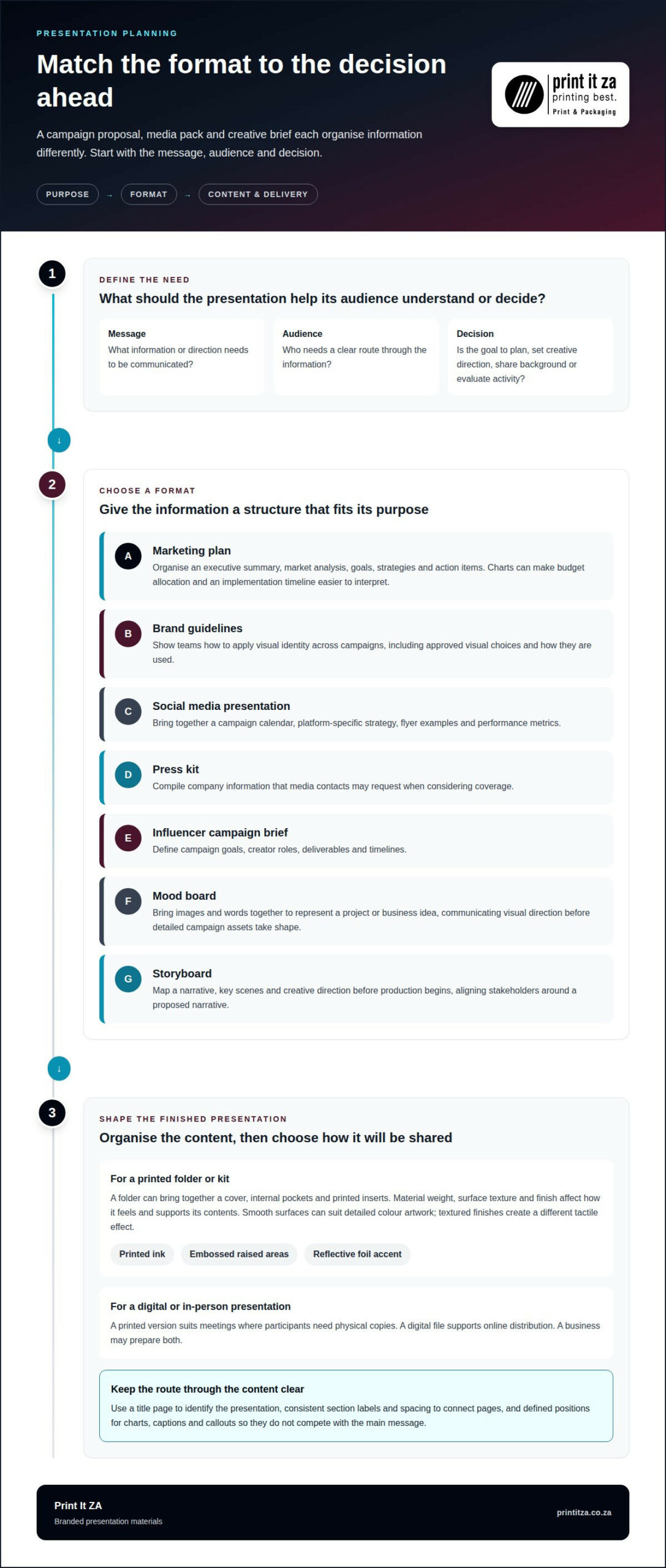
The right format depends on the message, audience and decision ahead. A campaign proposal, media pack and creative brief each organise information differently.
Printed presentation materials use ink to reproduce text, images and colour on a surface. Embossing raises selected areas, such as a logo, while foil branding adds a reflective accent. For a company folder, provide the business name, approved logo, contact details, brand guidelines and intended contents. These details help shape the design and print proof.
Folder and Kit Materials
A folder or presentation kit can bring together a cover, internal pockets and printed inserts. Material weight, surface texture and finish affect how the folder feels and supports its contents. A smooth surface can suit detailed colour artwork, while a textured finish creates a different tactile effect. Choose according to the presentation’s purpose and the impression it needs to make.
A marketing plan presentation can organise an executive summary, market analysis, goals, strategies and action items. Charts can make budget allocation and an implementation timeline easier to interpret. For a Johannesburg business pitching a campaign, this structure connects the proposed direction with the work needed to deliver it.
Marketing Presentation Examples
A brand guidelines presentation shows teams how to apply visual identity across campaigns. A social media presentation can bring together a campaign calendar, platform-specific strategy, flyer examples and performance metrics. Each format gives its audience a clear route through the information, from creative direction to planned activity and evaluation.
Other useful formats support specific stages of marketing work:
- Press kit: Compiles company information that media contacts may request when considering coverage.
- Influencer campaign brief: Defines campaign goals, creator roles, deliverables and timelines.
- Mood board: Brings images and words together to represent a project or business idea.
- Storyboard: Maps a narrative, key scenes and creative direction before production begins.
These examples serve different needs. A press kit organises background information, while a storyboard aligns stakeholders around a proposed narrative. A mood board communicates visual direction before detailed campaign assets take shape. Choose a format based on the decision the audience needs to make.
Presentation content can also be shared online or downloaded as a PDF. A printed version suits meetings where participants need physical copies, while a digital file supports online distribution. A business may prepare both, adapting page structure and image resolution to each output instead of treating one file as suitable for every use.
For a printed format, explore presentation print options that can bring campaign information together in a professional handout.
Charts can visualise budgets and timelines in a marketing plan presentation. They keep these elements visible alongside the plan’s goals, strategies and action items, helping the audience consider the proposed direction and the work required to carry it out.
A storyboard presentation can map narrative arcs, visualize key scenes, define creative direction and align stakeholders before production. It can give participants a shared reference for the story and the scenes under consideration, while clarifying the creative direction they are being asked to review before production begins.
Which South African suppliers offer branded presentation materials?
South African businesses can source presentation print through commercial printers, design agencies, print management companies and promotional branding suppliers. Each handles different parts of a project. A Johannesburg organisation planning branded presentation material may need artwork, folder production, coordinated inserts or support with multiple printed formats. Define the work first, then identify the supplier role that fits it.
Commercial printers produce physical items such as folders, brochures and booklets. Production methods may include digital or litho printing, depending on the project. For example, a sales pack could combine printed folder covers with supporting inserts. The production brief should explain whether the artwork is ready for print or needs design development.
Design agencies focus on visual planning and artwork. They can organise a company’s brand assets and presentation content into a designed layout, which a printer then produces. This arrangement can suit a business with a print production plan that needs creative development. Clear artwork specifications help keep the handover organised.
Promotional branding suppliers can coordinate printed materials alongside branded items for campaigns or events. A print management company may organise requirements across different formats. For instance, a product launch might call for presentation folders, a catalogue and event handouts. Coordination can help keep the materials aligned as one project.
Compare supplier roles against the practical needs of the job:
- Artwork: Establish whether layouts are being designed or supplied print-ready.
- Formats: List the required folders, brochures, booklets or other printed pieces.
- Finishing: Specify relevant details, such as folding or binding.
- Coordination: Identify who manages separate items and their matching artwork.
- Proofing: Understand how the final design is reviewed before production.
These distinctions clarify the work involved in branded presentation material. A design agency may focus on creative development, while a commercial printer handles physical production. A print manager may coordinate multiple formats. The right arrangement depends on whether the project’s main need is design, printing or coordination.
For businesses in Johannesburg and Gauteng, start with the presentation’s audience, contents and use. A client proposal, internal training pack and product launch folder each serve a different purpose. Provide the supplier with those requirements and relevant brand assets. A clear brief helps align design, print format and production expectations for branded presentation material.
What are the best materials and finishes for branded folders and presentation kits?
The right choice depends on what the folder must hold, how often it will be handled and the impression it should create. A sales folder carrying a proposal and brochure, for example, needs different support from a lightweight event handout. Match the folder structure and surface to its contents and intended use.
Paperboard is a common option for presentation folders because it supports printed graphics and can be folded into a useful format. A heavier board can give a folder a more substantial feel, while a lighter option suits materials distributed at an event. The printer can advise how the selected board works with the design, folds and pockets.
Recycled paperboard can suit businesses seeking to include recycled content in their printed materials. Ask for details about the stock options available for the project, then weigh those against appearance, durability and the folder’s purpose. A folder used repeatedly for client meetings may need a different balance than a single-use campaign pack.
Surface finishes change both appearance and handling. A matt finish gives artwork a less reflective look, while gloss creates a brighter sheen. Lamination adds a layer over the printed sheet. Choose according to the design: a photograph-led cover may benefit from a different treatment than a text-heavy proposal.
Special finishes can draw attention to selected details. Embossing raises a logo or motif, creating texture without relying only on colour. Foil adds a reflective accent to an area such as a title. Use these effects selectively. For example, a foil logo on a restrained cover can stand out without competing with the presentation’s main information.
Folder construction matters as much as the outer surface. Internal pockets keep loose pages together, while a slot can hold a business card. A presentation kit may pair the folder with a brochure, proposal or instruction booklet. Leave enough space for each piece to fit neatly without bending or obscuring important content.
- Client proposal: Choose a supportive folder with pockets for the proposal and brochure.
- Event handout: Prioritise a practical format that is easy to distribute.
- Premium presentation: Consider a tactile finish or restrained foil detail.
- Reusable meeting pack: Match the board and finish to frequent handling.
Before production, review the chosen stock, artwork, folds and finishing together. A proof can show whether the logo stands out clearly, pocket folds interfere with content, or colours suit the selected surface. Share the intended contents and use case early to give the production team practical context for selecting a suitable combination.
How do professionals design branded presentation materials that match your corporate identity?
A well-planned print design connects your brand identity with your communication goal. For branded presentation material, consider not only how each page looks, but also how the finished piece will be handled and used. A client proposal, for example, may need a clear contents page and space for supporting documents, while an event pack may prioritise quick access to key information.
Begin by reviewing your brand guidelines, approved artwork, final copy and intended audience. Identify the content that needs emphasis and organise it into a practical sequence. A proposal might open with a brief introduction, then move into the offer, supporting evidence and next steps. This content plan gives the visual design a clear purpose.
Next, develop a layout system for the format. Decide how section breaks, page numbers, captions and supporting graphics will guide the reader. If a presentation includes complex information, charts and data visualisations can make relationships easier to follow. Place these elements where they support the explanation rather than interrupting it.
- Review the brief: Confirm the audience, purpose, format and final content.
- Plan the sequence: Arrange information so each section leads naturally to the next.
- Build the layout: Set consistent styles for headings, body copy and supporting visuals.
- Prepare print artwork: Adapt the design to the selected format and production requirements.
- Review the proof: Check content, alignment, page order and artwork before approval.
Format affects design decisions. A folder, for example, may have pockets or folds that influence where text and important graphics go. Account for those structural features so key information remains visible when the piece is assembled. A well-planned branded presentation material design also considers how inserts fit and how readers will move between them.
During proofing, check the complete artwork against the brief. Review spelling, image placement, logo proportions, page sequence and whether text remains clear around folds or edges. Reviewing all pages together helps catch inconsistencies between the cover and inserts before production.
Provide the design team with your brand assets, approved copy and intended use. These inputs help shape a coherent result for your business. Discuss your presentation design and print project.
Print It ZA print and packaging: Presentation Folders
Print It ZA print and packaging produces presentation folders for businesses preparing branded materials for meetings, proposals or campaigns. A well-planned folder keeps key documents together and gives printed content a consistent place to sit.
Share your approved artwork, brand guidelines and the documents the folder needs to hold. These details help shape a practical design for your presentation. If the project includes supporting print marketing material, books or catalogues, consider how each piece will work together in the finished pack.
Presentation folders suit businesses that want to organise printed information for clients, colleagues or event audiences. The format can support a proposal or campaign handout without distracting from the information inside.
Contact Print It ZA print and packaging to discuss presentation folders for your business.
Make your next presentation work harder
Use your next project to connect the printed piece with the experience around it. A presentation folder can support a sales conversation, introduce a proposal or organise materials for an event. Consider what the audience should understand or do after opening it. That purpose can guide decisions about content, format and how the pieces fit together.
Branded presentation material is most effective when it supports a clear business goal, not just a visual identity. Consider how the folder will work alongside other communications, such as books, catalogues or brochures. A joined-up print approach can help your materials feel like parts of the same conversation.
With a clear purpose and the right brand assets ready, you can move from planning to production. Discuss your presentation project with Print It ZA print and packaging, and take the next step towards materials that represent your business with care.
Frequently Asked Questions
What makes presentation materials branded?
Branded presentation material is a printed business piece that carries an organisation’s visual identity and communication style. It can help make a proposal, event handout or company information pack feel connected to the business presenting it. For example, a folder prepared for a client meeting can identify the organisation and keep relevant documents together. Its content and format should suit the audience and the purpose of the presentation.
What types of branded presentation materials are available?
Options include presentation folders, brochures, catalogues and books, depending on the information you need to share. A folder can organise meeting documents, while a catalogue can present products in a structured format. Branded presentation material may also form part of a broader pack, with printed pieces chosen to support a specific event or conversation. Select formats according to the content and how recipients will use them.


