
In a market where digital noise is relentless, a well-produced print catalogue still cuts through. For South African retailers, wholesalers, and B2B businesses, a professionally printed catalogue remains one of the most effective tools for showcasing a product range, communicating pricing, and putting your brand directly into the hands of buyers and decision-makers.
But not all catalogue printing is equal. The difference between a catalogue that gets kept, referenced, and shared and one that ends up in the recycling bin often comes down to decisions made before a single page goes to press: the right paper stock, the right binding, the right file preparation, and the right print partner.
This guide covers everything South African businesses need to know before commissioning a product catalogue, from format and size options to binding methods, artwork preparation, pricing factors, and turnaround times.
Why Printed Catalogues Still Deliver Results for South African Businesses
The argument that print is dead does not hold up in practice. For product-led businesses, retailers, distributors, manufacturers, and trade suppliers, a physical catalogue serves functions that digital channels simply cannot replicate.
A printed catalogue is a persistent sales tool. It sits on a buyer’s desk, gets passed around a team, and gets pulled out at the point of ordering. Unlike an email that disappears or a website that requires a device and a connection, a catalogue is always available. Research consistently shows that print catalogues drive higher average order values than digital equivalents, particularly in B2B and wholesale contexts where buyers are selecting from large product ranges.
For retail businesses, a well-designed catalogue creates a curated brand experience that a product listing page rarely achieves. It allows you to control how products are presented, group related items, tell a brand story, and create aspirational imagery that influences purchasing decisions. Fashion brands, homeware retailers, gift wholesalers, and food and beverage suppliers all rely heavily on printed catalogues as a core part of their sales cycle.
In the South African B2B context, printed catalogues are particularly effective at trade shows, client meetings, and in industries where buyers are not always desk-based. A well-produced catalogue left behind after a sales visit often does more work than a follow-up email.
Catalogue Formats, Sizes, and Page Count Options
One of the first decisions to make when planning a catalogue print run is the physical format. The right choice depends on how the catalogue will be used, how it will be distributed, and how much content it needs to carry.
Common catalogue sizes
A4 (210 x 297mm) is by far the most popular catalogue format in South Africa. It is familiar, easy to file and store, and provides generous space for product imagery and descriptive copy. A5 (148 x 210mm) is a practical choice for smaller product ranges or when postability and portability matter, it fits in a standard envelope and a coat pocket. DL (99 x 210mm, the size of a standard business envelope) works well for slim, focused catalogues of 8 to 16 pages. Square formats and non-standard sizes are available and can create a distinctive shelf presence, though they generally cost more to produce.
Page counts and binding compatibility
Page count drives both the binding method and the unit cost, so it pays to think about this carefully before briefing your print supplier. As a practical guide: catalogues of 8 to 64 pages are typically saddle-stitched; 40 pages and above can also be perfect-bound; catalogues of 100 pages or more are almost always perfect-bound or case-bound. Note that saddle-stitched catalogues must have a page count that is a multiple of four, since each sheet produces four pages when folded.
Binding Methods: Saddle Stitching, Perfect Binding, and When to Use Each
The binding method affects how the catalogue looks, how it opens, how long it lasts, and how much it costs. For most South African businesses, the choice comes down to saddle stitching or perfect binding.
Saddle stitching
Saddle stitching staples folded sheets through the spine. It is the most cost-effective binding method for shorter catalogues and produces a clean, flat result that lies open easily. It is the standard choice for catalogues up to around 64 pages and is particularly common in retail, FMCG, and event contexts where a large quantity is needed at a competitive unit price. The main limitation is that saddle-stitched catalogues do not have a printed spine, which reduces shelf visibility.
Perfect binding
Perfect binding glues pages into a square spine, producing the book-style finish associated with glossy consumer magazines and professional product catalogues. It is suited to catalogues of 40 pages and above and creates a significantly more premium feel than saddle stitching. The printed spine also allows for branding, which matters when catalogues are stored on shelves in showrooms, stockrooms, or offices. Perfect binding is the preferred choice for high-value B2B catalogues, fashion lookbooks, and annual product ranges.
Spiral and ring binding
For catalogues that need to lie completely flat when open, such as price lists, technical specification guides, or catalogues used at point-of-sale, spiral or ring binding offers practical advantages. It is less common for consumer-facing catalogues but works well in trade and B2B environments.
Paper Stock, Cover Options, and Finishing: What Makes the Difference
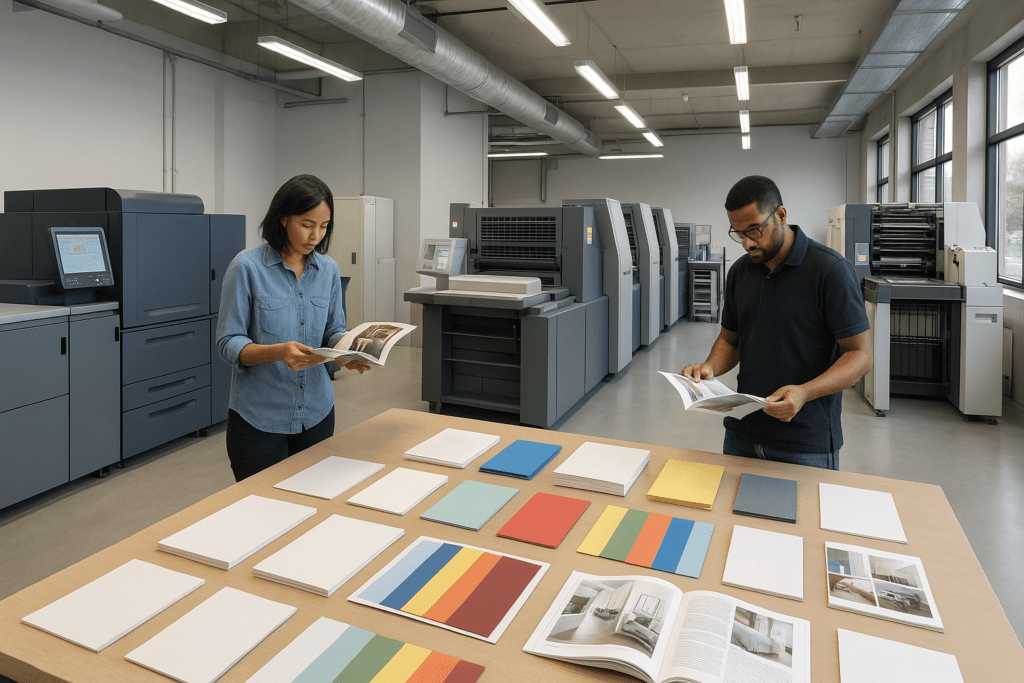
The paper stock and finishing choices you make have a direct impact on how your catalogue is perceived. A product photographed beautifully on screen will look very different printed on the wrong stock. Getting this right is one of the areas where working with an experienced print partner pays dividends.
Internal pages
For catalogues where print quality and colour reproduction matter, which is most catalogues, coated stock is the standard choice. Gloss coated paper at 115gsm to 150gsm produces vivid colours and sharp images, making it ideal for product photography. Silk coated stock at the same weights gives a softer finish that reduces glare and is easier to read under artificial lighting, making it popular for text-heavy catalogues and corporate publications. Uncoated stock is occasionally used for a more tactile, artisan feel but is generally less suitable for full-colour product imagery.
Covers
Catalogue covers are typically printed on heavier stock, 250gsm to 350gsm, to provide rigidity and protect the internal pages. A laminated cover is strongly recommended for any catalogue that will be handled frequently, posted, or displayed. Gloss lamination is the most popular choice and gives a bright, vibrant finish. Matt lamination produces a more sophisticated, premium look and is increasingly preferred by fashion, lifestyle, and high-end B2B brands. Soft-touch matt lamination takes this a step further, creating a velvety texture that genuinely differentiates the piece in the hand.
Special finishes
Spot UV coating can be applied selectively to highlight specific elements, a logo, a product image, or a headline, creating a contrast between gloss and matt surfaces that catches the eye and adds tactile interest. Foil blocking is available for premium applications where a metallic or holographic finish is required. These finishes add cost but can significantly elevate the perceived value of the catalogue, which is worth considering for high-value product ranges or key accounts.
How to Prepare Your Catalogue Artwork for Print
Catalogue files are more complex than single-page documents, and artwork errors are the most common cause of reprints, delays, and unexpected costs. Following these guidelines before submitting your files will save time and money:
1. Submit as a print-ready PDF with facing pages. For saddle-stitched catalogues, supply pages in sequential order as single pages, not reader spreads. For perfect-bound catalogues, the cover should be supplied as a separate file from the internal pages. Include 3mm bleed on all edges and embed all fonts.
2. Use CMYK colour mode throughout. All images, graphics, and colour elements must be in CMYK. RGB images can shift significantly in print, particularly in reds, blues, and skin tones. This is especially important for product photography, where colour accuracy affects purchasing decisions.
3. Set all images to a minimum of 300 DPI. Catalogue images that look sharp on screen at 72 DPI will print softly or blurrily. All product photography, lifestyle images, and illustrations should be at least 300 dots per inch at the size they appear in the layout.
4. Maintain a 3 to 5mm safe zone for text and key graphics. Keep all text, logos, and critical visual elements at least 3 to 5mm from the trim edge. This prevents content from being cut off during the trimming process.
5. Double-check page count and order. Confirm that your total page count is correct and that pages are in the right sequence before submitting. For saddle-stitched catalogues, ensure your page count is a multiple of four. Errors in page order are time-consuming and costly to correct after printing has begun.
If your catalogue content exists in a Word document, PowerPoint, or another non-print-ready format, Print It ZA’s design team can reformat and prepare it for press. We recommend raising this at the quoting stage so design time can be factored into your timeline.
Catalogue Printing Costs in South Africa: What to Expect
Catalogue printing costs are driven by four main variables: quantity, page count, paper and cover stock, and binding method. As with most print products, higher quantities reduce the unit cost substantially, the setup and pre-press costs are spread across more copies, making larger runs increasingly economical per unit.
Print It ZA provides detailed, no-obligation quotes typically within one business day of receiving your brief.
Turnaround Times and Delivery Across South Africa
Standard production turnaround at Print It ZA is 5 to 7 business days from artwork approval for most catalogue specifications. Perfect-bound catalogues with higher page counts may require 7 to 10 business days due to the additional binding process. Express turnaround is available for urgent projects, contact us before placing your order to confirm availability and lead time.
The single most important factor in meeting your deadline is submitting print-ready artwork on time. Catalogues that require significant artwork corrections or redesign add days to the timeline. If you are working to a fixed event date, a trade show, a product launch, or a seasonal promotion, we strongly recommend building in at least two to three days of buffer between your proof approval and the date you need the catalogues in hand.
We deliver nationwide across South Africa via reliable courier partners. Delivery to major centres including Johannesburg, Cape Town, Durban, Pretoria, and Port Elizabeth typically takes one to two business days after dispatch. For large or heavy print runs, we can arrange pallet delivery or in-store drop-off by prior arrangement.
How to Place Your Catalogue Printing Order with Print It ZA
Getting your catalogue to press is a straightforward process. Here is how it works:
6. Request a quote. Contact us with your specifications: size, page count, quantity, paper stock, cover weight, binding method, and any special finishes. The more detail you provide, the faster and more accurate your quote will be.
7. Submit your artwork. Upload your print-ready PDF or brief our design team if you need layout or formatting assistance. We accept files via our website, email, or WeTransfer for large files.
8. Approve your digital proof. We send a digital proof for your review and sign-off before production begins. Check all page order, content, and colour carefully at this stage, changes after approval may incur additional costs.
9. Print and delivery. Once approved, your catalogue goes into production. You will receive tracking information as soon as your order ships.
For large corporate orders or repeat runs, we can set up a standing account with preferred pricing and priority scheduling. Contact us to discuss your requirements.
Frequently Asked Questions About Catalogue Printing
What is the minimum order quantity for catalogue printing?
Our minimum order quantity for catalogues is 50 copies. Short runs of 50 to 250 copies are common for product launches, trade show preparation, and key account mailings. Larger runs of 500 to 5,000 copies are typical for seasonal promotions and wide distribution. The unit cost drops significantly as quantities increase, so it is worth printing slightly more than you think you need if budget allows.
What is the difference between saddle-stitching and perfect binding for catalogues?
Saddle stitching staples folded sheets through the spine and is cost-effective for catalogues of up to around 64 pages. Perfect binding glues pages into a square, printed spine — the finish you see on magazines and softcover books. Perfect binding is better suited to catalogues of 40 pages or more where a more premium, shelf-worthy result is needed. For most retail and B2B product catalogues, perfect binding is the preferred choice.
Can you print catalogues from a Word or PowerPoint file?
We recommend submitting a print-ready PDF rather than a native Word or PowerPoint file, as these formats can reflow or change appearance depending on the software version. If your content is only available in these formats, our design team can reformat it into a properly prepared print file. Raise this at the quoting stage so we can factor in the additional design time.
How far in advance should I order catalogues for a trade show or event?
We recommend placing your order at least three weeks before your event date. This allows time for artwork review and corrections, proof approval, production (5 to 10 business days depending on specification), and delivery. If you are working with a tighter timeline, contact us as early as possible, express production is available but is subject to capacity.
What paper stock do you recommend for a retail product catalogue?
For most retail product catalogues, we recommend 150gsm silk coated stock for internal pages with a 300gsm silk or gloss laminated cover. This combination produces excellent colour reproduction, a professional feel, and good durability without excessive weight or cost. For premium ranges or lifestyle-oriented brands, 170gsm silk internal with a 350gsm soft-touch matt laminated cover creates a noticeably more upmarket result.
Do you offer design services for catalogues?
Yes. Our in-house design team can design your catalogue from scratch, reformat existing content, or refine a layout that you have started. Catalogue design is quoted separately based on the number of pages and the complexity of the work. We provide proof for approval before any artwork goes to press, and we work to your brand guidelines to ensure a consistent result.
Ready to print your next catalogue? Get a fast, no-obligation quote from Print It ZA. Visit printitza.co.za, email our team, or call us directly. Professional catalogue printing delivered anywhere in South Africa — quality that represents your brand the way it deserves.
Contact Print It ZA today, for a Free quote and Speedy service.
Print It ZA, we deliver Printing Best!