
What is Continuous Form Printing and Why Does it Dominate in 2026?
In an increasingly digital world, the resilience of paper-based systems can seem surprising. Yet, for thousands of businesses across Johannesburg and South Africa, continuous forms remain an indispensable operational tool. So, what exactly are they? Continuous form printing involves producing fan-folded or rolled paper with perforated edges and tractor-feed holes, specifically designed for use with high-speed impact printers like dot matrix or line printers.
The true game-changer in this industry was the invention of "No Carbon Required" (NCR) paper. This technology uses paper coated with micro-encapsulated dye or ink. When pressure is applied by a pen or a printer pin, these capsules rupture and react with a clay coating on the sheet below, creating an instant, clean, and precise copy without the mess of traditional carbon paper. This innovation revolutionised how businesses create multi-part documents like invoices, delivery notes, and purchase orders.
For many South African businesses, especially in logistics, manufacturing, and retail, the choice to stick with physical forms over purely digital solutions is a strategic one. A signed physical Proof of Delivery (POD) is an unalterable, legally binding document that provides immediate confirmation. In warehouse environments where dust, grime, and high-volume transactions are the norm, rugged impact printers and continuous forms offer a level of reliability that more sensitive digital hardware often can’t match.
The Anatomy of a Continuous Form
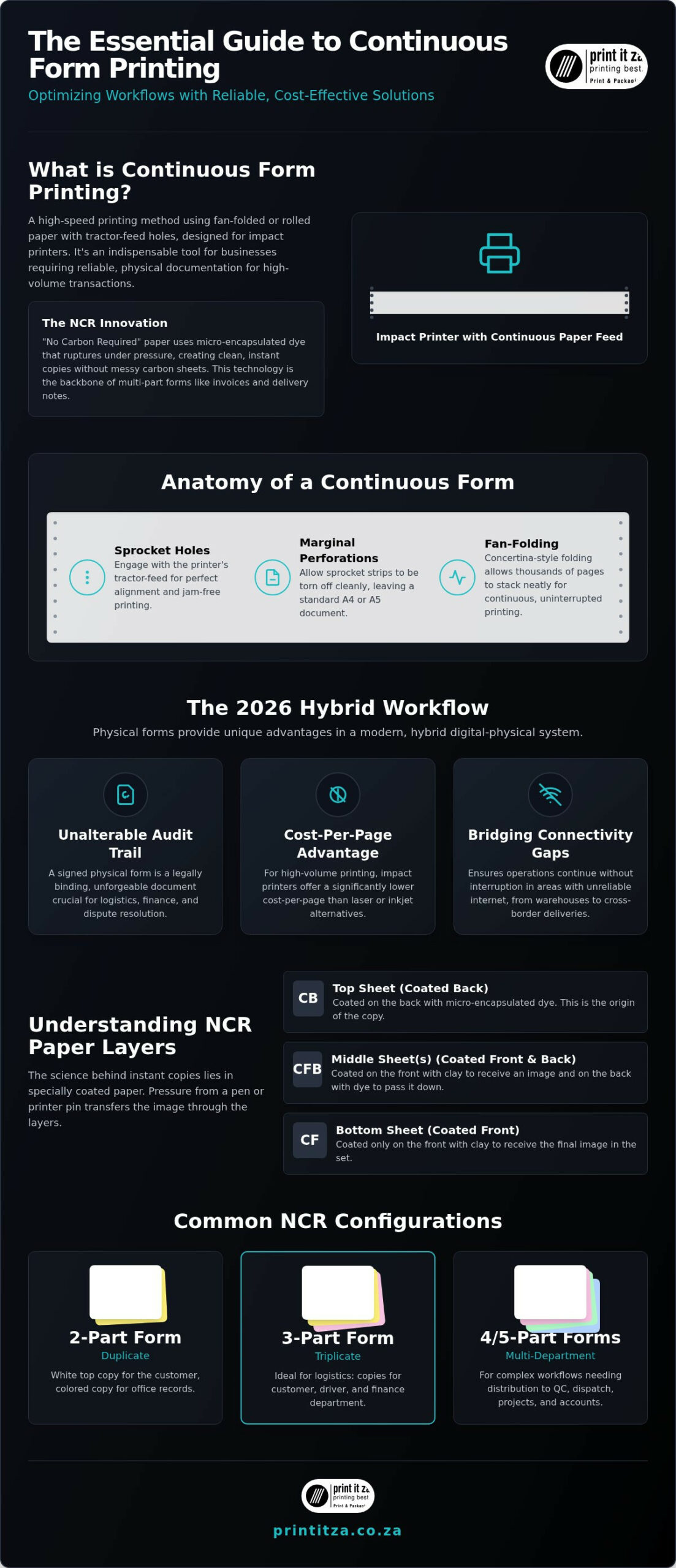
Understanding the components of a continuous form helps in specifying the perfect product for your business needs:
- Sprocket Holes: These are the holes running down the left and right margins of the paper. They engage with the tractor-feed mechanism of an impact printer, ensuring perfect alignment and preventing paper jams during long, unattended print runs.
- Marginal Perforations: These run parallel to the sprocket holes, allowing the perforated strips to be torn off cleanly after printing, leaving a standard-sized document (e.g., A4 or A5).
- Fan-Folding: The paper is folded back and forth in a concertina style, allowing thousands of pages to be stacked neatly in a box. This "fan-fold" design enables a continuous, uninterrupted feed into the printer, maximising uptime and efficiency.
- Single-part vs. Multi-part: A single-part form is a simple continuous feed of paper, often used for data logging or reports where only one copy is needed. Multi-part NCR forms consist of two or more layers, creating instant duplicates, triplicates, or more for different departments or stakeholders.
Digital vs. Physical: The 2026 Hybrid Workflow
The debate isn’t about choosing one system over the other; it’s about creating a seamless hybrid workflow where each excels. By 2026, savvy South African businesses are integrating both to create robust and resilient operational processes.
- Unalterable Audit Trail: In sectors like logistics and finance, a physical, signed form provides a powerful, unforgeable audit trail. This is crucial for dispute resolution and legal compliance in the South African market.
- Cost-Per-Page Advantage: For high-volume tasks like printing thousands of invoices or statements daily, the cost-per-page of an impact printer using continuous forms is significantly lower than that of laser or inkjet printers. The ribbons are inexpensive, and the printers are built for millions of impressions.
- Bridging Connectivity Gaps: In many parts of South Africa and across SADC borders, reliable internet connectivity is not a guarantee. Continuous forms ensure that a delivery can be signed for, an invoice issued, or a job card completed, regardless of network availability. The paper form can then be returned to head office for digital capture.
Understanding NCR Layers: Configurations and Customisation
The magic of continuous forms lies in their multi-part NCR capabilities. Getting the configuration right is key to a streamlined workflow. This involves understanding the "Part" system, colour conventions, and the technical composition of the paper itself.
Each sheet in an NCR set has a specific coating to enable the transfer of information. The terminology is straightforward:
- CB (Coated Back): The top sheet is coated on the back with the micro-encapsulated dye.
- CFB (Coated Front and Back): The middle sheets (in a set of 3 or more parts) are coated on the front with the clay reactant and on the back with the dye capsules. This allows them to receive an image from the sheet above and transfer it to the sheet below.
- CF (Coated Front): The final sheet in the set is coated on the front with the clay reactant to receive the image from the sheet above it.
- Paper Weights: The weight of the paper, measured in grams per square metre (GSM), affects the legibility of the final copy. A heavier top sheet might feel more premium, but using paper that is too thick can result in faint impressions on the bottom layers. We help you find the perfect balance for clarity across all parts.
Common NCR Layer Standards
While fully customisable, most business needs fall into standard configurations, often distinguished by a conventional colour code for easy identification and filing.
- The 2-Part Form (Duplicate): The most common setup. Typically a white top copy for the customer and a yellow, pink, or blue second copy for office records.
- The 3-Part Form (Triplicate): Ideal for logistics. This usually includes a white top copy for the customer, a second copy for the delivery driver or logistics partner, and a third copy that remains in the book or returns to the finance department.
- Specialised 4-Part and 5-Part Forms: Used in more complex workflows, such as manufacturing, healthcare, or engineering. These forms allow for copies to be distributed to quality control, dispatch, project management, and accounts simultaneously, ensuring every department has the same information.
Advanced Customisation Features
Modern continuous form printing goes far beyond basic duplication. We offer a range of features to enhance security, branding, and functionality.
- Desensitising Ink: Need to hide sensitive information like pricing or personal details on certain copies? A special desensitising ink can be printed on specific areas of a layer, preventing the chemical reaction and keeping that data from transferring to the sheets below.
- Sequential Numbering: For secure tracking, auditing, and invoicing, each multi-part form can be printed with a unique, sequential number in one or more positions. This is critical for preventing fraud and maintaining a clear financial record.
- Multi-Colour Printing: Your top sheet doesn’t have to be a simple black-and-white document. We can incorporate your full-colour company logo and branding, ensuring your invoices and delivery notes look professional and are instantly recognisable.
Essential Industry Applications in Johannesburg and Gauteng
As the economic engine of South Africa, Gauteng’s industries rely on efficiency, accuracy, and reliability. Continuous forms are the unsung heroes in the supply chains and administrative backbones of the province’s key sectors.
- Logistics and Transport: From the bustling freight corridors of Kempton Park to the distribution centres in the south of Johannesburg, physical Proof of Delivery documents are non-negotiable. Continuous forms are used for waybills, freight manifests, and PODs that travel with drivers across the country, many of whom rely on Palisa Energy for the bulk fuel and lubricants required for long-haul transport.
- Manufacturing and Warehousing: In the industrial zones of Johannesburg, continuous forms are essential for managing inventory, creating job cards, tracking production stages, and generating pick slips. Their durability makes them ideal for the demanding environment of a factory floor.
- Retail and Wholesale: High-volume Fast-Moving Consumer Goods (FMCG) distributors and wholesalers use continuous forms to generate thousands of invoices and statements daily. The speed and low cost of impact printing make it the most viable solution for this scale of operation.
- Healthcare and Laboratories: Secure and accurate record-keeping is paramount. Multi-part forms are used for patient records, lab requisitions, and sample tracking, providing instant physical copies for the patient, the lab, and the administrative office.
Proof of Delivery (POD) Excellence
For South African transport companies, a clear, signed POD is as good as cash. It is the final, crucial step in the billing cycle. We help design POD forms that are not just functional but resilient.
- The Gold Standard: A physical signature on a multi-part NCR form is immediate, verifiable proof that a consignment was received. It eliminates disputes over delivery times and conditions, providing legal protection for both the sender and the recipient.
- Designed for the Road: We help you design forms with logical layouts, clear fields for signatures and timestamps, and checkboxes for noting package conditions. We can also recommend durable paper weights that can withstand the rigours of long-haul trucking.
- Ensuring Legibility: The ultimate test of a POD is whether the signature and details on the bottom copy are as clear as on the top. We use high-quality NCR paper and printing techniques to ensure crisp, legible transfers every time.
Invoicing and Statements at Scale
When your business issues hundreds or thousands of invoices a day, efficiency is everything. Continuous feed printing is built for this exact purpose, automating high-volume billing cycles with unmatched reliability.
- Automated Billing Runs: Line printers can run for hours, printing thousands of multi-part invoices from a single box of fan-folded paper without intervention. This allows your finance team to focus on more critical tasks.
- Integrating Modern Tech: Traditional paper forms can easily be integrated with modern logistics systems. We can print barcodes or QR codes directly onto your forms, allowing for easy scanning and digital data capture when the form returns to the office.
- Comprehensive Documentation: For complex jobs, businesses often need more than just forms. Our capabilities extend to producing all necessary documentation, including detailed instruction booklets and training manual printing in Johannesburg, ensuring your team has all the resources for a successful workflow.
Choosing the Right Specifications: A Procurement Checklist
Ordering custom continuous forms requires attention to detail. As a procurement manager or business owner, asking the right questions ensures you get a product that works flawlessly with your existing hardware and processes. Use this checklist as a guide.
- Size: While A4 is the most common, we can produce forms in A5, A3, or any bespoke dimension required to fit your specific printer or to align with your filing systems.
- Perforation Styles: Do you need a clean, sharp edge after tearing? Micro-perforations are ideal. If you need the tractor-feed strips to be removed quickly and easily, a standard perforation might be better. We can also add horizontal perforations for tear-off remittance slips.
- Printer Compatibility: It is crucial to match the paper weight (GSM) and the number of parts to your printer’s specifications. A 9-pin dot matrix printer may struggle with a 5-part form, while a heavy-duty line printer can handle it with ease. We can advise on the best materials for your hardware.
- Printing Method: For shorter, more complex runs, digital printing may be suitable. However, for high-volume orders, lithographic (litho) printing offers superior quality and a significantly lower cost-per-unit, making it the standard for large-scale continuous form production.
Technical Specifications to Consider
Beyond the basics, these technical details can make a significant difference in the quality and longevity of your forms.
- Carbonless Paper Quality: Lower-grade NCR paper can suffer from "ghosting" (premature image development) or may lose its chemical potency over time, especially if stored improperly. We source high-quality paper to ensure a long shelf life and clear, lasting impressions.
- Crimp vs. Glue: The layers of a multi-part form need to be held together. Crimping is a mechanical process that locks the sheets together, offering a very strong bond that is ideal for the most demanding printer feeds. Gluing is also a reliable method, often used for standard applications.
- Environmental Impact: Sustainability is a growing concern for South African businesses. We can source Forest Stewardship Council (FSC) certified carbonless paper, ensuring that your paper-based systems are managed responsibly.
Ordering for Efficiency
Smart ordering can save you time and money. Planning your procurement strategically ensures you have a consistent supply without overstocking.
- Lead Times: Custom form printing, especially for large runs, requires planning. We provide clear lead times for production and delivery within the Gauteng region and nationwide, helping you manage your inventory effectively.
- Bulk Ordering: The primary setup cost for a custom print job is in the initial plate-making and machine configuration. By ordering in bulk, you drastically reduce the cost-per-unit and ensure you have a consistent supply of forms for months to come.
The Print It ZA Advantage: Your Gauteng Partner for Continuous Forms
Choosing a printing partner is about more than just price; it’s about finding a reliable expert who understands the critical role these documents play in your operations. At Print It ZA, we’ve built our reputation on quality, speed, and a deep understanding of the needs of Johannesburg businesses.
- Uninterrupted Production: Our facility operates on a continuous schedule, giving us the flexibility and capacity to meet your most demanding deadlines without compromising on quality.
- Litho and Digital Expertise: We have the right technology for your job. For massive runs, our high-speed litho presses provide unmatched cost-efficiency and quality. For smaller, specialised orders, our digital capabilities offer flexibility.
- Strategic Gauteng Location: Our production hub is perfectly positioned for efficient distribution across Johannesburg, Pretoria, and the entire region, ensuring your forms get to you quickly.
- Expert Design Support: An effective form is an easy-to-use form. Our in-house design team can help you optimise your layout for clarity, data capture accuracy, and brand consistency.
Nationwide Distribution and Logistics
Our service doesn’t end when the printing is done. We offer a complete solution, managing the logistics of getting your essential documents where they need to be, on time.
- End-to-End Management: From our Johannesburg distribution centre to your head office or satellite branches, we can manage the entire distribution process for you.
- Cross-Border Expertise: For businesses operating across SADC borders, we provide reliable export services, ensuring your branches in neighbouring countries have the same high-quality operational documents.
- Contact Print It ZA today for a bespoke continuous form quote.
Frequently Asked Questions (FAQs)
What is the standard size for continuous forms in South Africa?
The most common size is A4 (210mm x 297mm after the perforated edges are removed). However, forms can be fully customised to any size, including A5 or landscape orientations, to suit specific printers or business processes.
Can I print continuous forms on a standard inkjet or laser printer?
No. Continuous forms are designed exclusively for impact printers (dot matrix or line printers) that use a tractor-feed mechanism to pull the paper through. Inkjet and laser printers use sheet-fed trays and are not compatible with the sprocketed, fan-folded paper.
How many parts or layers can a continuous NCR form have?
Standard configurations are typically 2, 3, 4, or 5 parts. It is technically possible to have more, but the legibility on the bottom-most copies can decrease significantly. We can advise on the optimal number of parts and paper weight for your specific printer to ensure clarity.
What is the difference between carbon and carbonless continuous forms?
Carbon forms use a separate sheet of carbon paper between the pages to create copies, which can be messy. Carbonless (NCR) forms have a chemical coating directly on the paper that reacts to pressure, creating a cleaner, more professional copy without the extra carbon sheet.
Is it possible to include my company logo and branding on continuous forms?
Absolutely. We can print your logo, contact details, and other branding elements on the top sheet (and other sheets if required) in single or multiple colours to ensure your business documents are professional and consistent with your brand identity.
How should I store my NCR forms to ensure the chemical coating remains effective?
Store the boxes of forms in a cool, dry place away from direct sunlight and high humidity. Keep them in their original packaging until ready for use. Proper storage can ensure the NCR paper remains effective for several years.
What is the minimum order quantity for custom continuous form printing?
The minimum order quantity can vary depending on the complexity of the job. However, due to the setup costs of litho printing, it is most cost-effective to order in larger quantities (e.g., several boxes at a time). Please contact us for a quote specific to your needs.
How does sequential numbering work on multi-part forms?
A special numbering box is used on the printing press to stamp a unique, sequential number onto each form set. This number is applied with enough impact to transfer through all layers of the NCR paper, ensuring every copy of a specific form has the exact same reference number for perfect auditing.
Contact Print It ZA today, for a Free Quote and Speedy Service.
Print It ZA print and packaging, South Africa/ ZA.