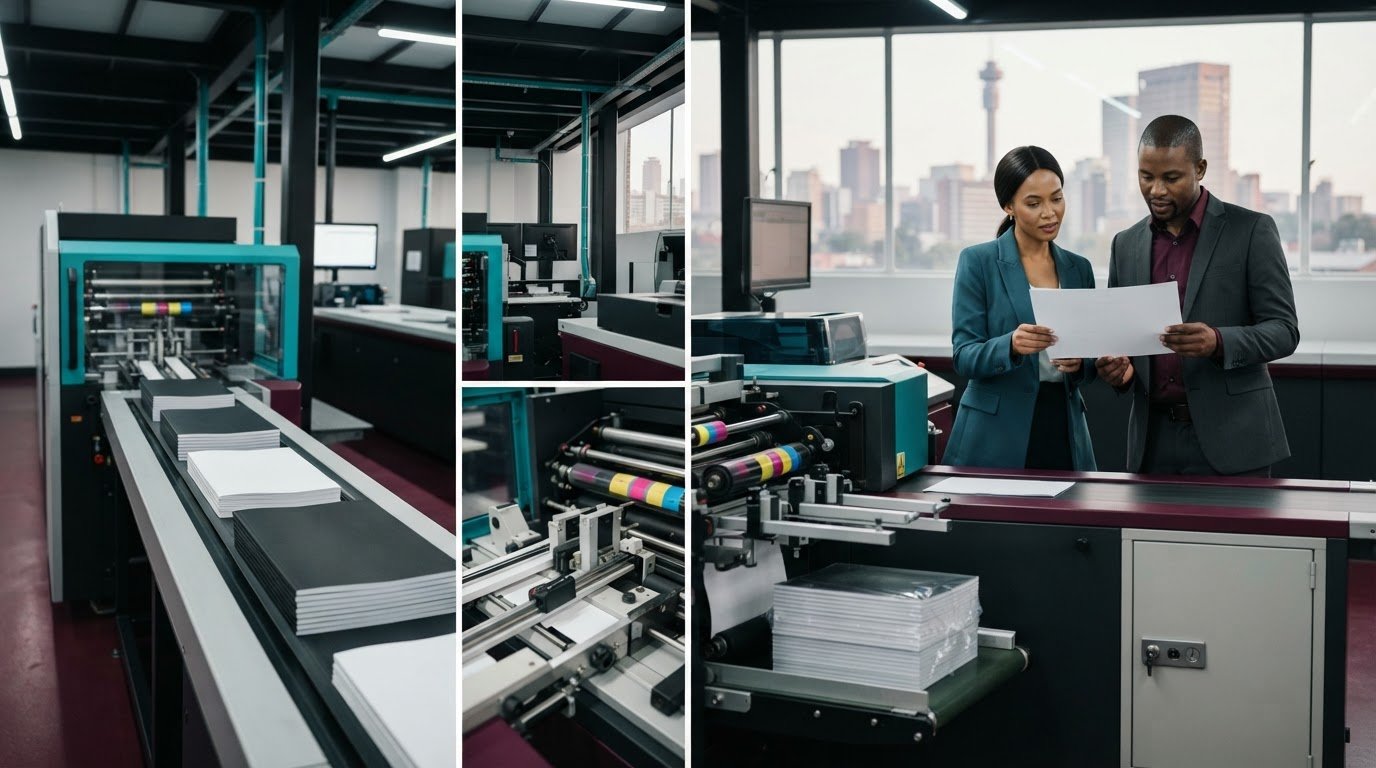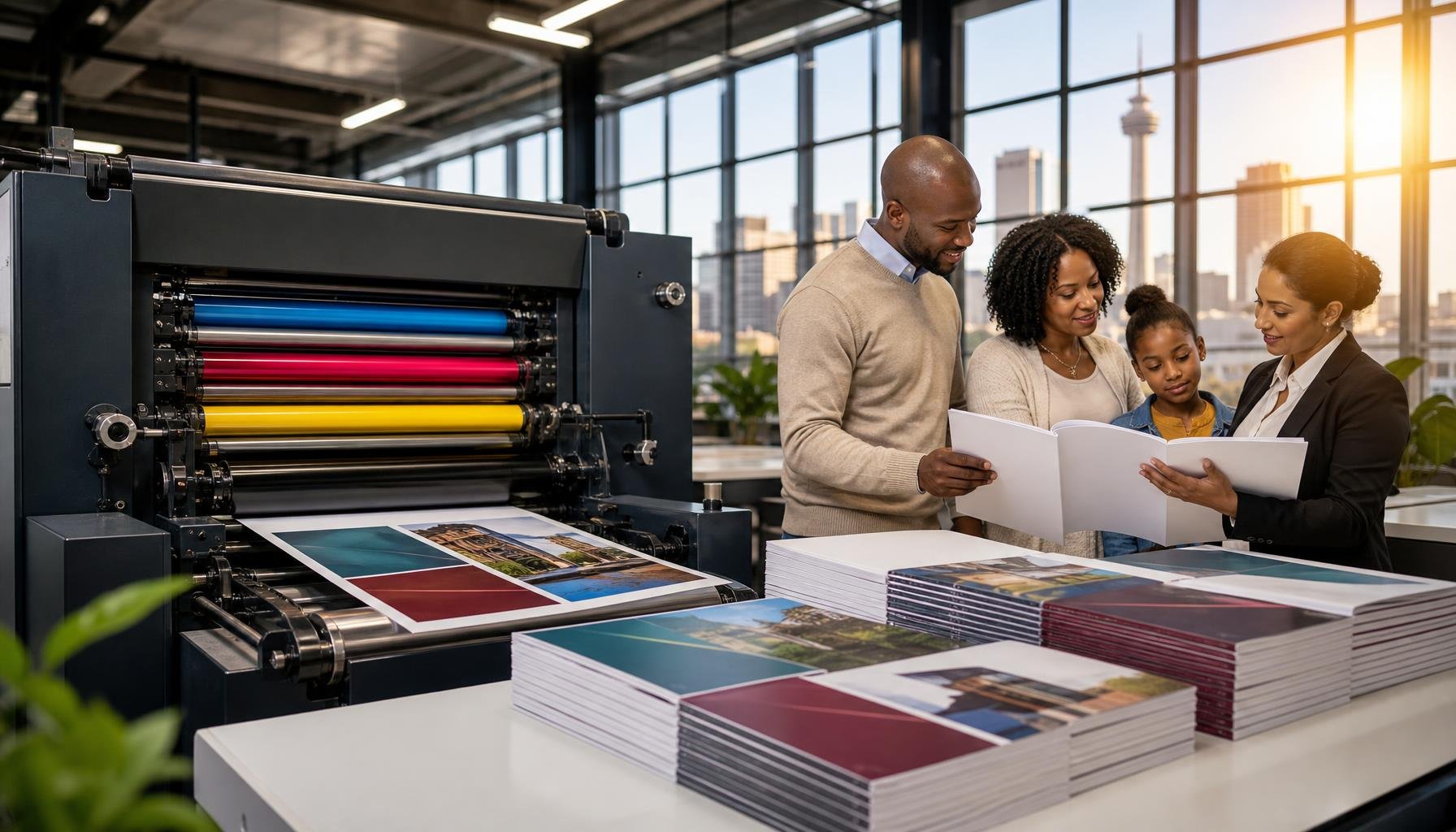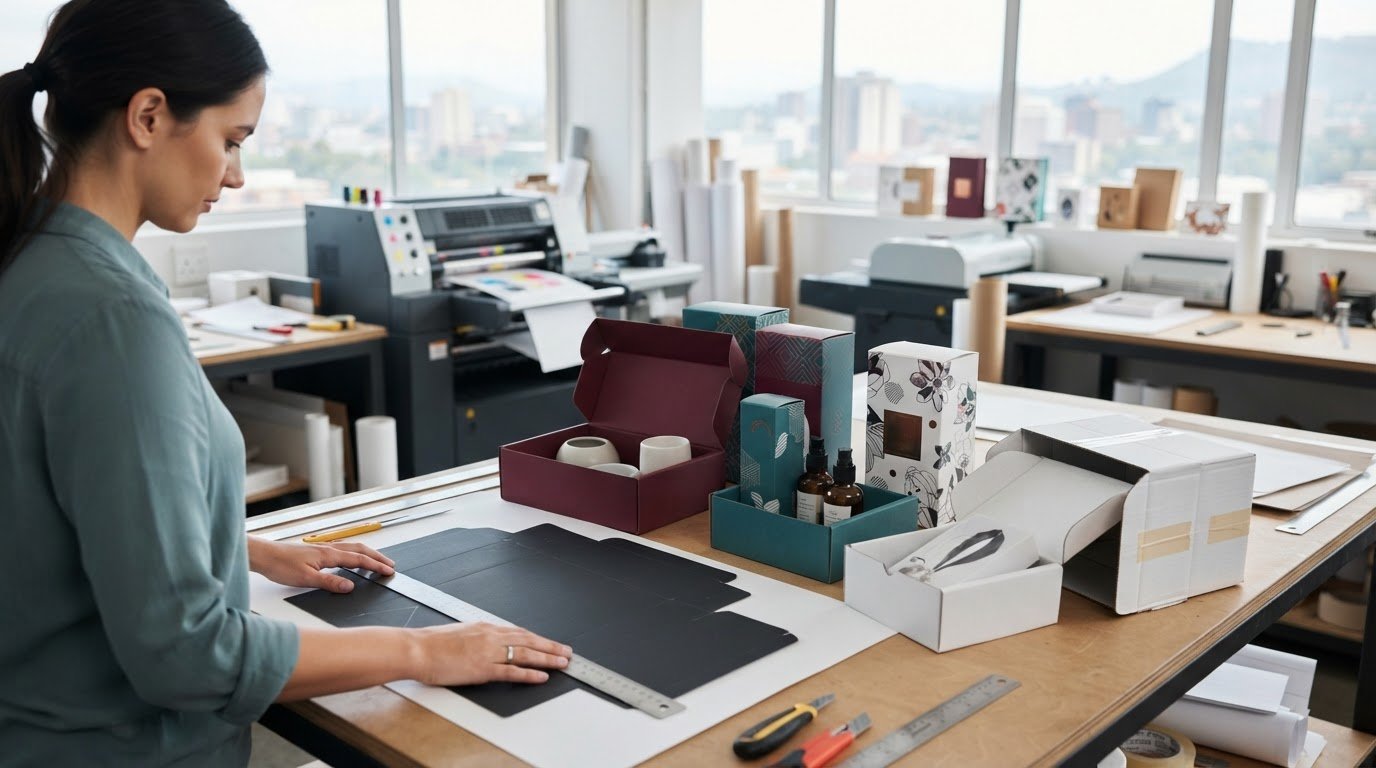

Print marketing commands an impressive 78% brand recall rate compared to just 46% for digital media, yet executive leadership often dismisses physical collateral as an unnecessary operational expense. If you are currently wondering how to convince my boss we need better brochures to win enterprise bids, you aren’t fighting an isolated battle. Field sales reps across South Africa routinely struggle to command attention during high-stakes corporate meetings when equipped with flimsy, uninspired paper handouts that undervalue high-ticket solutions.
You already know that tactile, premium collateral anchors client trust and leaves a lasting impression that another digital PDF simply can’t replicate. Even so, proposing a budget upgrade without clear pipeline forecasts is intimidating. In this guide, you will learn how to build an airtight business case that proves upgraded print brochures drive tangible sales and measurable ROI. We will unpack the commercial economics of volume procurement, examine sensory buying psychology, and hand you a proven pitch framework to secure swift executive sign-off.
Key Takeaways
- Discover how flimsy paper stock silently sabotages corporate credibility during high-value sales pitches and RFP presentations.
- Master the exact commercial arguments for how to convince my boss we need better brochures by linking tactile assets directly to customer acquisition and pipeline velocity.
- Follow a step-by-step executive pitch strategy that reframes print upgrades from aesthetic design costs into frontline sales enablement tools.
- Learn the technical paper grammage, binding, and finishing specifications needed to defend your marketing budget line items with confidence.
- Eliminate leadership hesitation by leveraging physical proof packs and partnering with an established commercial print specialist.
Audit the Damage: Why Flimsy Brochures Silently Kill Corporate Sales
Enterprises invest hundreds of thousands of rands refining service offerings, preparing pitch presentations, and deploying experienced executives to lead meetings. Yet, during board-level discussions, sales teams routinely slide curling, transparent sheets across the conference table. Poor paper stock instantly degrades high-ticket credibility. B2B buyers subconsciously equate lightweight print collateral with cut-rate operations, stalling sales momentum before commercial negotiations even begin. When determining how to convince my boss we need better brochures, auditing this hidden reputational damage gives you undeniable commercial leverage.
The Tactile Perception Gap in B2B Buyer Psychology
Haptic brand perception in corporate sales is the subconscious evaluation of a company’s operational capability and trustworthiness based purely on physical touch. Sensory marketing studies show haptic weight directly influences corporate trust. While a brochure is a promotional document created to introduce an organisation and its products, physical execution determines how that information is valued. Thin, flimsy paper feels disposable, encouraging prospective buyers to discard collateral quickly. In contrast, rigid, textured stocks introduce physical presence into the meeting room, commanding sustained attention and anchoring long-term brand recall long after reps pack up their laptops.
The Hidden Commercial Cost of Cheap Collateral
Cutting corners on print production carries a steep downstream cost that rarely shows up on standard marketing expense reports:
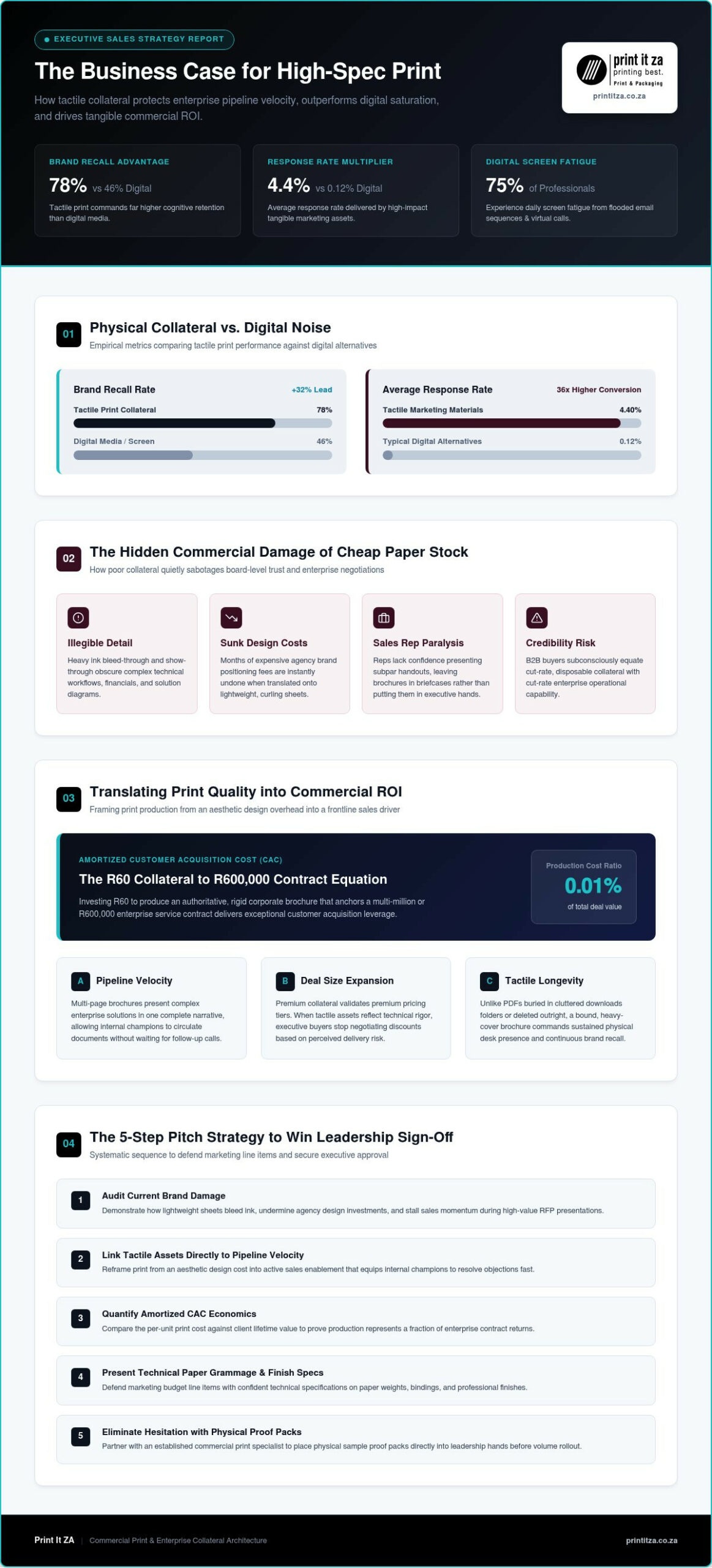
- Illegible technical detail: Lightweight stocks suffer from heavy ink bleed-through and show-through, making fine diagrams, financials, and solution workflows hard to read.
- Sunk design investments: An inferior physical handout completely undermines months of agency fees spent establishing premium brand positioning.
- Sales enablement paralysis: Field sales representatives quickly lose confidence presenting collateral that feels subpar, choosing to leave brochures in their briefcases rather than hand them to executive buyers.
Losing a multi-million Rand enterprise contract because physical collateral looked amateurish dwarfs the modest investment of a high-spec print run. Proving how to convince my boss we need better brochures starts by framing print quality not as an aesthetic preference, but as vital revenue protection for your frontline sales pipeline.
Build the Business Case: Translating Print Quality into Commercial ROI
Chief Financial Officers don’t approve budgets for vanity projects; they release capital for measurable revenue drivers. If you want to know how to convince my boss we need better brochures, translate paper quality into commercial pipeline returns. Shifting executive perception requires moving the conversation away from visual design and grounding it in customer acquisition cost (CAC), win rates, and contract values.
Key Financial Metrics Executive Leadership Cares About
Presenting upgraded collateral as a frontline sales enablement tool shifts the budgetary narrative from an overhead cost to an active investment:
- Accelerated pipeline velocity: Multi-page corporate brochures outline complex enterprise solutions in one structured narrative. Internal champions can circulate a physical document to boardroom stakeholders, resolving objections faster without waiting for follow-up virtual calls.
- Amortized customer acquisition cost: Frame production costs against client lifetime value. Spending R60 to produce an authoritative corporate brochure that anchors a R600,000 service contract is an exceptional sales acquisition investment.
- Higher average deal size: Premium collateral validates premium pricing tiers. When your tangible materials reflect technical excellence, buyers stop negotiating discounts based on perceived risk.
Physical Collateral Longevity vs Digital Fatigue
Enterprise buyers are inundated with electronic noise. Roughly 75% of business professionals experience daily screen fatigue from endless email sequences and virtual presentations. A digital PDF is easily forgotten in a congested downloads folder or deleted outright. In contrast, tactile marketing materials boast an average response rate of 4.4%, compared to just 0.12% for typical digital alternatives.
A beautifully bound, heavy-cover corporate brochure sits directly on an executive’s desk for weeks. It acts as an ongoing physical reminder of your capabilities throughout lengthy procurement reviews. Modern print also integrates seamlessly with enterprise reporting. By adding personalized campaign URLs and scannable QR codes, sales teams can track physical collateral engagement straight into CRM dashboards.
To deliver this level of finish and impact, consult with specialists providing professional printing services in Johannesburg. Reviewing commercial sample stocks with an experienced print partner like Print It ZA gives you the concrete cost projections and tactile proofs needed to make your pitch undeniable.
The 5-Step Pitch Strategy to Win Your Boss’s Approval
Subjective appeals about modern design or brand aesthetics rarely sway executive leadership. To succeed, anchor your presentation strictly in commercial enablement. If you are preparing how to convince my boss we need better brochures, executing a structured, five-step persuasion strategy dismantles financial pushback before it surfaces.
Step 1 & 2: Collect Field Evidence and Benchmark Competitors
Begin by gathering direct feedback from your front lines. Interview sales reps to identify where existing collateral falls short during pitches. Ask pointed questions: Did a client question our operational scale? Did a sales representative leave brochures in the car because they looked cheap?
Next, gather intelligence from the field. Collect competitor brochures distributed at Johannesburg trade shows or industry symposiums. Place your company’s current thin, curling flyer directly next to a competitor’s heavyweight, soft-touch booklet. This sharp visual and tactile contrast demonstrates the credibility gap to your manager immediately, making the problem impossible to dismiss.
Step 3 & 4: Frame the Revenue Solution and Pre-empt Objections
Position the upgrade as sales enablement infrastructure rather than discretionary marketing overhead. When managers raise the standard objection ("Why spend on print when we can email a PDF?"), address it directly with commercial reality:
- The In-Person Reality: Explain that 82% of consumers trust print advertisements most when making purchasing decisions, while PDFs often trigger digital inbox fatigue.
- Procurement Longevity: Highlight that physical collateral stays inside client boardrooms during closed-door vendor evaluations where sales reps aren’t present.
- Volume Efficiency: Show that unit economics improve dramatically at higher volumes, reducing long-term spend through strategic print runs.
Step 5: Propose a Phased Pilot Run with Clear Milestones
Executives often hesitate because large print runs feel like permanent, irreversible commitments. De-risk the decision by proposing a controlled pilot run for your highest-value enterprise accounts. Request an initial, targeted run dedicated to a specific corporate sales division or an upcoming submission.
To eliminate operational doubts, source physical sample packs ahead of your pitch. Collaborating early with a trusted print shop allows you to lay tangible paper swatches, spot varnishes, and dummy mockups right on your boss’s desk. Demonstrating physical production feasibility alongside clear conversion milestones transforms an abstract budget request into an actionable commercial rollout.
Specifying the Upgrade: Paper Stocks, Finishes, and Production Economics
Walking into a budget review without detailed production specs invites immediate managerial rejection. When you show your financial directors that you understand grammage, finishing processes, and volume break-points, you change the dynamic. Defending your pitch for how to convince my boss we need better brochures comes down to demonstrating that every production rand delivers maximum sensory impact without unnecessary waste.
Choosing Paper Stocks and Grammage That Signal Authority
Paper weight forms the structural backbone of physical communication. Standard corporate office sheets hover around 80 to 90 GSM, which feels flimsy, curls easily, and lacks rigidity. For high-stakes enterprise sales assets, upgrade text pages to a substantial 130 to 170 GSM, paired with a robust 300 to 350 GSM cover stock.
Texture choices also dictate brand perception. Smooth silk stocks provide glare-free readability for data-heavy charts, while high-gloss finishes deliver rich colour vibrancy for visual product photography. To protect this investment, professional printers ensure correct paper grain alignment and precision scoring along folds, eliminating the unsightly spine cracking that ruins cheap leaflets.
High-Impact Finishes That Do Not Break the Budget
You don’t need an exorbitant budget to create an executive-grade tactile experience. Strategic, selective embellishments transform baseline printing into an interactive presentation:
- Soft-Touch Lamination: Applies a protective, velvety matte coating across the cover, creating an instant sensation of warmth and luxury the second a prospective buyer picks it up.
- Spot UV Varnish: Adds a high-gloss liquid polymer over specific elements, such as your corporate logo, headline typography, or technical schematics, making them pop against a matte background.
- Embossing and Foil Stamping: Raises typography or stamps metallic accents onto key covers, visually validating your market leadership during formal tender submissions.
Litho vs Digital: Scaling Volume for Financial Efficiency
Understanding machine setup economics helps you protect profit margins. Digital printing requires zero plate setup, making it the most cost-effective route for agile short runs, regional pilot tests, or hyper-targeted account presentations. You produce only what you need without holding excess inventory.
When rolling collateral out to nationwide sales teams, commercial litho printing unlocks massive volume savings. Once lithographic plates are imaged and mounted, the marginal cost per printed page drops substantially. Ordering in smart, consolidated batches lowers unit acquisition expenses significantly over the course of the fiscal year.
Ready to structure exact specifications and unit savings for your executive presentation? Partner with the manufacturing team at Print It ZA for commercial brochure printing solutions that turn technical specs into undeniable boardroom pitches.
Executing the Rollout: Partnering with a Commercial Print Specialist
Securing executive sign-off requires proving that production execution will be seamless. Even an airtight business case fails if leadership fears operational delays, inconsistent colour matching, or delivery bottlenecks. When structuring your final argument for how to convince my boss we need better brochures, bringing a vetted, industrial-grade manufacturing partner to the table removes operational risk from the equation.
Securing Physical Proofs and Mockups for Final Sign-Off
Never rely on on-screen digital renders to win executive approval. Digital monitors misrepresent how ink interacts with textured fibers, coated boards, and spot finishes. Request physical wet proofs and unprinted paper dummies from your print partner instead.
Handing your manager a bound, physical mock-up transforms abstract budget requests into a tactile, finished reality. They can feel the heft of a 350 GSM cover, examine the opening lay of the spine, and experience the smooth finish of soft-touch lamination firsthand. You can also show how the updated design coordinates seamlessly with existing corporate collateral, such as matching premium business cards, creating a cohesive, professional suite of touchpoints that reinforces market authority.
Streamlining Production and Distribution Across Gauteng and Nationwide
Executive leadership prioritizes vendor reliability, especially when preparing collateral for strict corporate deadlines like shareholder meetings, industry expos, or major tender submission dates. Partnering with Print It ZA gives leadership confidence through proven operational infrastructure:
- Responsive manufacturing: Print It ZA provides rapid press runs and agile turnaround times when critical commercial deadlines leave zero room for error.
- End-to-end press capabilities: Complete in-house digital, lithographic, and luxury embellishment equipment ensures strict quality control under a single roof.
- National logistics and kitting: Streamlined packing and distribution networks deliver collateral directly to regional sales branches across Johannesburg, Gauteng, and nationwide.
- Integrated enterprise branding: Easily extend your print specifications across related corporate assets, combining brochure rollouts with custom packaging solutions for VIP client gift sets.
When you present both the financial ROI and an established, dependable print specialist ready to execute, executive buy-in shifts from a hesitant compromise to an easy strategic decision.
Transform Your Next Executive Review into an Easy Approval
Winning budget sign-off doesn’t require complex corporate politics; it requires clear commercial alignment. High-impact collateral commands executive attention, shortens enterprise sales cycles, and protects brand credibility during in-person pitches. Mastering how to convince my boss we need better brochures comes down to framing paper quality as frontline sales enablement rather than discretionary marketing overhead.
Take the guesswork out of your proposal by partnering with proven manufacturing experts. Operating an industrial printing and finishing facility in Gauteng, Print It ZA team and partners combine state-of-the-art lithographic and high-definition digital printing machinery with a dedicated in-house team managing prepress, luxury finishing, and nationwide logistics. Request a physical sample pack and corporate quote from Print It ZA to place undeniable tactile proof on your manager’s desk. With a structured commercial business case and finished paper dummies in hand, securing executive approval is well within your reach.
Frequently Asked Questions
How do I convince my boss to spend more money on marketing collateral?
Frame the expenditure around revenue acceleration, sales enablement, and win rates rather than design aesthetics. When determining how to convince my boss we need better brochures, demonstrate how high-spec collateral supports field reps during high-stakes presentations. Highlight how tangible touchpoints amortize cleanly across multi-million Rand contracts, and present physical samples alongside competitor collateral to show leadership the tangible credibility gap firsthand.
Why are physical printed brochures still relevant in a digital-first market?
Physical collateral cuts through severe digital inbox fatigue and screen saturation. B2B decision-makers routinely ignore promotional emails and slide decks, but a substantial print piece commands physical presence on an executive desk for weeks. Tactile collateral fosters subconscious trust and drives significantly higher brand recall during internal procurement reviews, ensuring your business stays top-of-mind long after the initial meeting concludes.
What is the best paper weight (GSM) for corporate sales brochures?
For executive corporate brochures, pairing a sturdy 300 to 350 GSM cover with 150 to 170 GSM interior text pages delivers ideal stiffness and durability. Standard copy paper sits below 100 GSM, which feels flimsy and tears easily. Investing in heavier grammage prevents see-through pages, preserves sharp typographic rendering, and immediately communicates enterprise-level stability when prospective clients hold your materials.
Can we test upgraded brochures on a small budget before committing?
Yes, you can launch a short-run digital print pilot before committing to full-scale commercial litho volumes. Running a targeted batch for a specific sales team or upcoming industry tender keeps initial capital expenditure low while validating performance. This phased rollout gives your executive team concrete conversion data, making it far simpler to secure broad sign-off for consolidated, high-volume lithographic runs later.
How do high-end finishes like soft-touch lamination impact brochure cost?
Applying selective finishes like soft-touch lamination, Spot UV, or foil stamping introduces a minor marginal production cost, especially on consolidated runs. However, the perceived commercial value increases dramatically. These treatments protect covers against fingerprints, scuffing, and moisture during transit across Gauteng sales meetings, extending the usable shelf life of your collateral while creating an unforgettable tactile impression on prospective buyers.
What happens if our sales team prefers sending digital PDF brochures?
Digital PDFs work well for remote initial outreach, but they easily get lost in cluttered download folders. When solving how to convince my boss we need better brochures, advocate for an integrated hybrid model. Sales reps can present physical, luxury brochures during face-to-face meetings, utilizing integrated QR codes and tracking URLs that seamlessly guide prospects back to digital whitepapers, calculators, and proposals.
How long does professional commercial brochure printing take from sign-off?
Turnaround times usually take between five working days once proofs receive final sign-off, depending on run volume and custom embellishments. Production capabilities accommodate urgent corporate timelines, ensuring swift turnaround, rigorous in-house quality inspection, and dependable logistics distribution across South Africa when executive deadlines are non-negotiable.
Contact Print It ZA today, for a Free Quote and Speedy Service.
Print It ZA, we deliver Printing Best!