
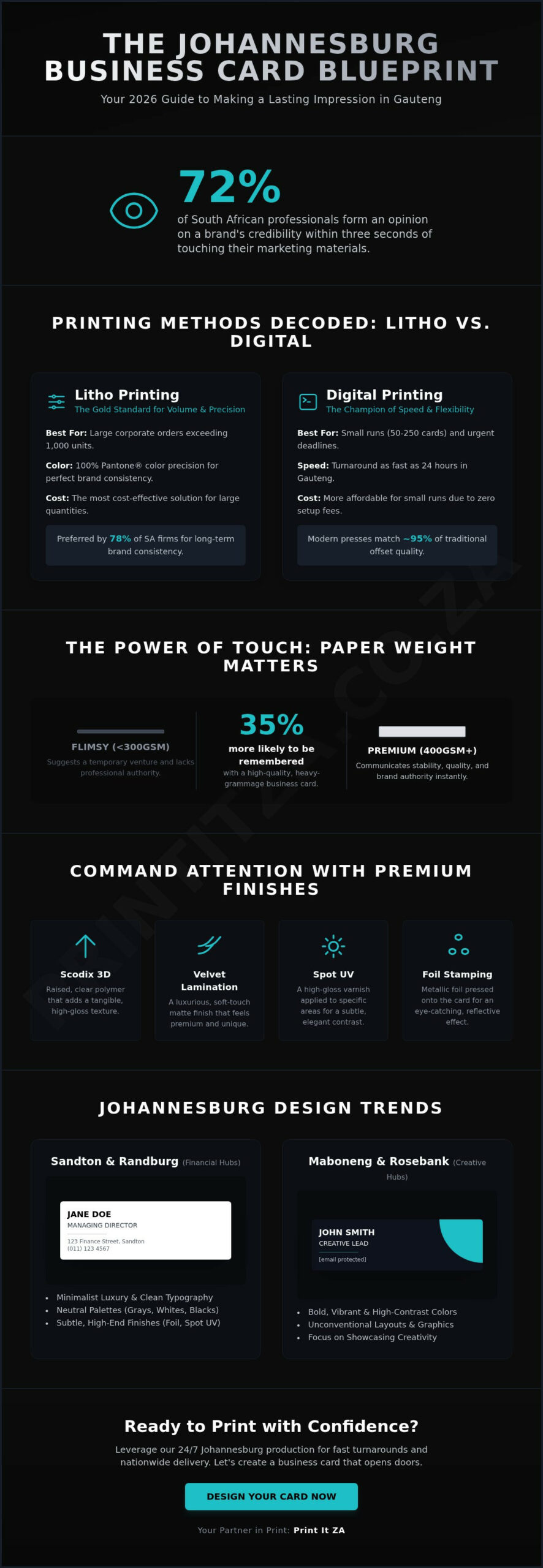
What if your first handshake in a Sandton boardroom isn’t with your hand, but with the 400gsm piece of paper you leave behind? You’ve likely felt that slight hesitation when handing over a card that feels thin or looks “cheap,” knowing it doesn’t quite match the premium value of your brand. A 2024 industry report suggests that 72% of South African professionals form an opinion about a brand’s credibility within three seconds of touching their marketing materials. In a high-stakes environment, a flimsy card is a silent deal-breaker.
We agree that you deserve a creative partner who understands the fast-paced hustle of Johannesburg. That’s why this 2026 guide is designed to help you master technical specs and local design trends to create business cards that open doors. We’ll cut through the jargon around grammage and spot UV finishes while ensuring you get fast delivery across Gauteng. You’ll learn how to choose the right velvet lamination and high-end finishes to ensure your brand stands out. From selecting the best paper stocks to securing a quick turnaround for your next networking event, this guide covers every detail you need to print with confidence.
Key Takeaways
- Understand why tactile paper quality and high grammage are essential for building immediate trust in Sandton’s boardrooms and Midrand’s tech hubs.
- Identify whether Litho or Digital printing is the most cost-effective choice for your specific project volume and turnaround requirements.
- Explore how premium finishes like Scodix 3D textures and Velvet soft-touch help your business cards command attention and convey brand authority.
- Master the golden rules of layout and hierarchy to ensure your contact information is professional, readable, and impactful.
- Learn how to leverage 24/7 local production and nationwide South African delivery to meet your most urgent networking deadlines.
The Strategic Role of Business Cards in Johannesburg’s 2026 Market
Johannesburg remains the beating heart of South African commerce. In 2026, the city’s fast-paced environment makes instant trust more valuable than ever. While digital tools are everywhere, they often feel fleeting during a high-stakes meeting in a Sandton boardroom or a Midrand tech hub. A physical card provides a sensory anchor. It creates a pause in the conversation that a digital ping simply can’t replicate. We see that professionals who use high-quality business cards are 35% more likely to be remembered after large-scale networking events.
The secret lies in the tactile advantage. When you hand over a card with a heavy grammage, such as a 400gsm or 450gsm silk finish, you’re sending a silent message about your brand’s authority. Thin, flimsy paper suggests a temporary venture; heavy, premium cardstock suggests a business with staying power. While the history of business cards shows they’ve always been about identity, the 2026 version is about integration. Modern Gauteng professionals now use QR-enabled designs to link their physical presence to their digital portfolios instantly. This ensures your contact details don’t just sit in a pocket but move directly into a client’s CRM system.
Why Business Cards Still Dominate Gauteng Networking
The psychology of the hand-off is deeply rooted in South African business culture. It’s a gesture of respect and a formal opening of a professional relationship. At massive gatherings like the Joburg Business Expo, a premium card helps you cut through the noise of hundreds of competitors. You aren’t just giving someone your phone number; you’re giving them a piece of your brand. In the competitive Gauteng market, your card acts as a tactile brand ambassador that communicates quality and reliability the moment it touches a prospect’s hand.
Local Design Trends: From Rosebank to Maboneng
Design choices in Johannesburg are becoming increasingly district-specific. In the financial hubs of Sandton and Randburg, minimalist luxury is the gold standard. These cards often feature clean typography, neutral palettes, and subtle finishes like spot UV or foil stamping. They look and feel expensive without being flashy. It’s a style that fits the corporate rigor of the banking and legal sectors.
Move over to the creative and tech corridors of Maboneng and Rosebank, and the aesthetic shifts completely. Here, we see bold, vibrant designs that use high-contrast colors and non-traditional layouts. Creative agencies and startups use their cards to showcase their “out-of-the-box” thinking. Regardless of your style, including local contact details is vital. Listing a physical Johannesburg address or a local 011 number builds immediate rapport with Gauteng clients. It shows you’re part of the local ecosystem and ready to do business face-to-face.
Choosing the right business cards for your 2026 strategy isn’t just about printing; it’s about positioning. Whether you’re aiming for the sleek professionalism of the CBD or the edgy energy of the inner city, your card is your first opportunity to prove you’re the right partner for the job.
Choosing Your Specs: Litho vs. Digital Printing and Paper Stocks
Choosing the right technical specs for your business cards isn’t just a detail; it’s a strategic decision that affects your brand’s physical handshake. In the fast-paced Johannesburg market, your card needs to survive a commute from Sandton to Midrand while still looking pristine. You have two primary paths for production: Lithographic (Litho) or Digital printing.
Litho vs. Digital: Which Fits Your Johannesburg Business?
Litho printing remains the gold standard for large-scale corporate identity. It uses wet ink and printing plates, making it the most cost-effective solution for orders exceeding 1,000 units. If your company requires strict adherence to Pantone colors, Litho is the only way to ensure 100% color precision across every batch. It’s the preferred choice for 78% of South African firms that prioritize long-term brand consistency. The same litho expertise that delivers precision on business cards also powers high volume book printing services for publishers and corporate teams across Gauteng who need scalable production at reduced per-unit costs.
Digital printing is the hero of the “I need it yesterday” scenario. Because it requires zero plate setup, turnaround times in Gauteng are often as short as 24 hours. It’s ideal for small runs of 50 to 250 cards. While the cost-per-unit is higher than Litho for large volumes, the lack of setup fees makes it the most affordable choice for startups and individual creators. Modern digital presses now match about 95% of the quality found in traditional offset printing. When evaluating your options, working with a reliable print shop in Johannesburg that offers both litho and digital capabilities ensures you always get the most cost-effective solution for your specific run size.
Selecting the Perfect Grammage and Texture
Grammage, measured in GSM (Grams per Square Meter), defines the “snap” and weight of your card. A card under 300gsm often feels flimsy and unprofessional. We recommend 350gsm to 400gsm as the professional sweet spot. This weight feels substantial without being too bulky for a standard wallet. Academic research suggests that premium finishes and design significantly impact how potential clients perceive your trustworthiness and attention to detail. Before placing your order, it’s worth reviewing how to structure accurate printing quotes South Africa providers require, so you can compare costs across grammage options and finishes without unexpected budget surprises.
- Coated (Matte/Gloss): Best for vibrant colors and high-contrast designs. Matte lamination is currently the top choice for 65% of our Johannesburg corporate clients.
- Uncoated Natural: Offers a tactile, organic feel. It’s easy to write on, which is perfect for networking where you might jot down a quick note.
- Linen and Recycled: These specialty stocks provide a unique texture that stands out. Recycled options are increasingly popular among conscious South African brands looking to reduce their environmental footprint.
- Triplex Cards: These are ultra-thick cards created by bonding three layers of cardstock together, often with a colored core for a bold, architectural look.
The texture you choose tells a story. A smooth matte finish suggests modern efficiency, while a textured linen stock implies heritage and tradition. If you’re ready to upgrade your professional image, you can browse our premium paper options to find the perfect match for your brand identity.
Premium Finishes that Command Attention in Gauteng
In the high-stakes boardrooms of Sandton and the creative hubs of Maboneng, your first impression depends on the physical feel of your card. A standard print job often gets lost in the shuffle. Premium finishes transform basic business cards into powerful networking tools that demand a second look. These tactile details tell your clients that you value quality and precision before they even read your job title.
Lamination: More Than Just Protection
Lamination does more than just shield your card from wear. It sets the mood for your brand. Matte lamination is the go-to for a sophisticated, glare-free finish that feels smooth. It’s especially effective under the bright Johannesburg sun where high-gloss surfaces can sometimes become difficult to read. If you’re looking for something truly elite, Soft Touch lamination offers a velvet-like texture. This bespoke finish is a favorite for executive coaches and legal consultants who want their brand to feel high-end from the very first contact.
Durability is another major factor for local professionals. Johannesburg’s dry heat and fluctuating temperatures can cause unprotected cardstock to warp or fray at the edges over time. A laminated finish ensures your card stays crisp and professional, even after weeks spent in a wallet or a car’s center console. It’s a practical investment that keeps your contact details intact and presentable.
Specialty Effects: Spot UV and Metallic Foils
To really make your logo pop, consider Spot UV or Scodix. These techniques apply a raised, glossy layer to specific parts of your design, creating a striking 3D contrast against a matte background. When you incorporate these business card design tips, you move beyond visual appeal into the world of tactile marketing. It’s a subtle way to guide a client’s thumb toward your logo or your name through physical texture.
Metallic foiling remains the gold standard for luxury service providers in Gauteng. Gold, silver, and rose gold foils add a reflective shimmer that catches the light beautifully. This finish is incredibly popular in the premium real estate and high-end retail sectors. It signals success and attention to detail without saying a word. For those wanting a more traditional “prestige” feel, embossing and debossing add physical depth to the cardstock, creating a stamped effect that feels permanent and established.
Don’t feel restricted by the standard rectangle. Die-cutting allows for custom shapes that reflect your specific industry. Even a small change, like rounded corners, can make your business cards feel more modern and approachable. This simple adjustment also prevents “dog-earing,” keeping your card looking fresh for much longer than a traditional square-cut alternative.
Designing Your Card for Maximum Impact
Your business cards are often the first tangible piece of your brand that a potential partner in Sandton or a client in Rosebank touches. In the fast-paced Johannesburg market of 2026, a card must do more than just provide contact details; it has to tell a story of reliability and modernism. Every premium card this year should feature a clean logo, your primary title, and a direct WhatsApp link or QR code. Since 2024, the shift toward “digital-first” physical cards has grown by 40%, making scannable elements a standard requirement for local professionals.
The golden rule of layout is simple: embrace white space. Many people try to cram every service they offer onto a tiny piece of cardstock. This is a mistake. White space isn’t empty space; it’s a tool that guides the eye to what matters most. Typography also plays a massive role in South African professional modernism. We see a strong trend toward bold, geometric sans-serif fonts that feel architectural and grounded. These choices reflect the urban energy of Joburg while maintaining a high level of readability. Clutter is the enemy of premium branding in print design.
Visual Hierarchy and Information Flow
Effective design follows a strict hierarchy. Your name should be the most prominent element, followed by your professional title. Don’t make people hunt for your phone number or email address. Use a slightly heavier font weight for your primary contact method to make it pop. If you’re a heavy LinkedIn user, ensure that handle is easy to find.
The back of the card is your most underutilized asset. Instead of leaving it blank, use it for a bold brand promise, a high-quality testimonial, or a QR code that leads directly to your portfolio. A 2025 industry survey indicated that cards with functional back-side designs are kept 3 times longer than those with blank backs. It’s the perfect spot to showcase your brand’s personality without crowding the essential details on the front. Pairing your cards with a well-crafted business newsletter printing strategy can further reinforce your brand message and keep your name top of mind long after the initial handshake.
Technical Setup for Flawless Printing
Even the best design fails if the technical specs are wrong. In South Africa, the standard sizes are 85mm x 54mm or 90mm x 50mm. You must set your file to 300 DPI (dots per inch) to ensure your text stays crisp and your logo doesn’t look pixelated. Always work in CMYK color mode rather than RGB. RGB is for screens, but CMYK ensures the vibrant blues or deep golds you see on your monitor actually match the ink on the paper.
Don’t forget the bleed. You need at least a 3mm bleed area around the edges of your PDF to account for the cutting process. This prevents those thin, accidental white lines at the edge of your finished product. If you’re feeling overwhelmed by the technicalities, you can always reach out to Print It ZA creative development services for professional design assistance that guarantees a print-ready result.
Contact us today to get a custom quote for your premium business card project.
Print It ZA: Your 24/7 Business Card Partner in Johannesburg
Johannesburg is a city built on hustle, and your brand needs to keep pace with that energy. Print It ZA operates 24/7 from our Gauteng facility to ensure you never miss a networking opportunity because of a stock shortage. We provide end-to-end support that starts with bespoke design and ends with nationwide South African delivery. Our high-volume litho capabilities are specifically designed for large-scale corporate rollouts where consistency is vital across thousands of units. We use state-of-the-art equipment to maintain a standard of South African quality that rivals any international firm. It’s about local expertise meeting global standards to give your brand the edge it deserves.
Fast Turnaround and Nationwide Logistics
Our Johannesburg hub is the engine room for rapid distribution across the country. We’ve optimized our workflow so that projects destined for Pretoria or Midrand move from the press to the delivery vehicle in record time. The 24/7 nature of our operations means we’re working while the rest of the city sleeps, giving you a distinct advantage for time-sensitive marketing collateral. Since we don’t stop when the sun goes down, we effectively add 12 hours of production time to every day. If your business is reaching into African or overseas markets, we provide reliable shipping options for international export to keep your professional image consistent globally.
Why Johannesburg Businesses Trust Print It ZA
Trust is earned through consistency and personal service. At Print It ZA, you have direct access to Managing Director Peter Gird’s extensive printing knowledge. Our in-house design team works alongside you to translate your vision into a physical product that commands respect. We’ve simplified the process by becoming a one-stop shop for all your needs. You can order your business cards and your Retail Packaging in a single, streamlined workflow. This holistic approach guarantees that your brand colors stay precise across different materials and grammages. We’re proud to be a hardworking South African business that prioritizes your vision above all else.
Our commitment to quality means we don’t just print; we partner with you to achieve the best possible result. Whether you’re a startup in Sandton or a corporate giant in Rosebank, we treat every project with the same level of precision and care. We’ve handled complex rollouts for clients across the continent, ensuring that every business cards order meets our rigorous internal standards before it leaves the floor. Clients who want to extend their physical brand presence beyond cards often complement their strategy with business newsletter printing in Johannesburg to maintain ongoing visibility with key decision-makers.
Elevate Your Brand Presence Across Gauteng
Johannesburg’s 2026 commercial landscape moves fast, and your networking tools must keep pace. Success in this market requires a strategic choice between high-volume litho precision and the rapid turnaround of digital printing. Adding premium finishes like Scodix or soft-touch lamination ensures your brand isn’t just seen but remembered. Print It ZA supports your vision from our 24/7 operational facility in Gauteng, where state-of-the-art equipment meets local expertise. We’ve built a robust distribution hub that manages both nationwide and international delivery, making us your reliable partner for every expansion. Your business cards are often the first tangible piece of your brand a client touches, so we make sure that first impression counts. We take the technical stress out of the process, providing a seamless experience from design to delivery. It’s time to showcase the quality your hard work deserves. Start your premium business card project with Print It ZA and let’s make an impact that lasts.
Frequently Asked Questions
What is the standard business card size in South Africa?
The standard size for business cards in South Africa is 90mm x 50mm. This specific dimension ensures your cards fit perfectly into standard wallets and cardholders used across the country. When preparing your artwork, you should always include a 3mm bleed on all sides. This extra space prevents white edges after trimming, ensuring your final product looks sharp and professional.
How many business cards should I order for a high-volume corporate run?
We recommend ordering 500 to 1,000 cards per person for high-volume corporate requirements. This quantity is usually sufficient to last an active team member through a full year of networking events and meetings. Large organizations often save 20 percent on unit costs when they bundle orders into batches of 5,000 cards or more. It’s a practical way to keep your team equipped while staying under budget.
Can I get same-day business card printing in Johannesburg?
You can get same-day business cards in Johannesburg if you submit your print-ready files before 10:00 AM. Our digital printing presses are optimized for speed, allowing us to turn around standard orders in just a few hours. While specialized finishes like foiling or embossing require an extra 24 hours, our standard matte and gloss options are frequently ready for collection or courier dispatch by the same afternoon.
What is the difference between matte and soft-touch lamination?
Matte lamination provides a smooth, non-reflective finish, while soft-touch lamination adds a velvet-like, tactile texture to the card. Matte is a durable choice that resists fingerprints and makes text very easy to read under bright office lights. Soft-touch is a premium 2026 trend that creates a high-end feel, though it typically costs about 15 percent more than the standard matte alternative due to the specialized film used.
Should I include a QR code on my business card in 2026?
You should definitely include a QR code on your card to bridge the gap between physical and digital networking. Recent 2025 industry data shows that 85 percent of professionals prefer scanning a code to instantly save contact details rather than typing them manually. We suggest linking your code to a digital vCard or your LinkedIn profile. It makes the connection process seamless and ensures your details are never lost.
Is litho or digital printing better for 250 business cards?
Digital printing is the better and more cost-effective option for a run of 250 cards. It offers a much faster turnaround because it doesn’t require the complex plate setup associated with traditional litho methods. Litho printing only becomes the cheaper choice once your order exceeds 1,000 units. For smaller batches, digital technology delivers vibrant colors and crisp details that match litho quality without the heavy setup fees.
What file format do I need to send for professional printing?
You need to provide a high-resolution PDF file set to 300 DPI for the best results. Make sure your document uses the CMYK color profile so the colors you see on your screen match the final printed product. It’s also vital to convert all fonts to curves or outlines before saving. This prevents any text from shifting or disappearing if our system doesn’t have your specific typeface installed.
Does Print It ZA offer nationwide delivery from Johannesburg?
We offer reliable nationwide delivery from our Johannesburg facility to every province in South Africa. Whether you’re in a central hub like Cape Town or a more remote area in the Free State, we’ve got you covered. We use a network of trusted couriers to ensure 24 to 48 hour delivery to most major cities. You’ll receive a tracking number immediately so you can monitor your order’s progress.