
Why are your employees struggling to retain information from digital screens when a tangible, professionally bound document could be the key to their success? We know the frustration of seeing expensive Training Manuals end up with torn covers and loose pages after just a few weeks of use. With paper costs in South Africa rising by 47% since 2020, you can’t afford to waste your budget on materials that don’t last or fail to engage your team. It’s a common headache for Johannesburg businesses trying to balance high standards with tight procurement timelines and the reality of digital fatigue.
This article will help you master the art of producing durable, high-impact manuals that drive corporate compliance and boost employee performance. We’ll show you how to choose between digital and litho printing based on your volume, select the right binding for heavy daily use, and ensure your brand looks sharp. From understanding the 500-unit break-even point to hitting your 5 to 7 day lead times, we’ll help you create professional assets that survive the rigours of the modern workplace while remaining cost-effective.
Key Takeaways
- Understand the cognitive science behind tactile learning and why printed materials lead to better information retention than digital screens.
- Master the essential design elements, including white space and font contrast, that make your content accessible for users in the field.
- Determine whether litho or digital printing is the most cost-effective choice for your specific volume of Training Manuals.
- Select the most durable binding and finishing options, such as Wiro or spiral binding, to ensure your assets withstand rigorous daily handling.
- Discover how to streamline your entire production workflow by partnering with Print It ZA print and packaging for end-to-end support.
Table of Contents
-
The Strategic Value of Physical Training Manuals in a Digital Age
-
Designing Training Manuals for Maximum Engagement and Utility
-
Printing Techniques: Choosing Between Litho and Digital for Your Manuals
-
Professional Binding and Finishing: Ensuring Long-Term Usability
-
Streamlining Your Training Manual Production with Print It ZA print and packaging
The Strategic Value of Physical Training Manuals in a Digital Age
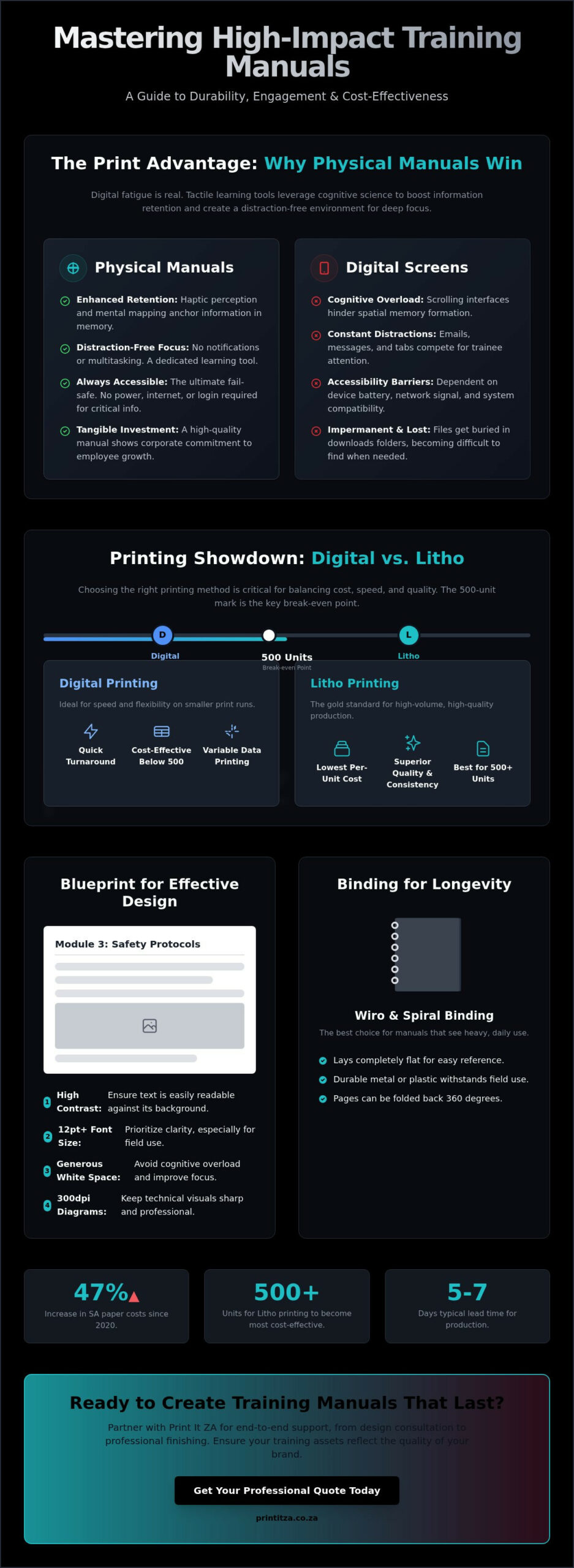
While screens dominate our daily lives, the printed page is making a powerful comeback in corporate environments. We define the modern Training manual as a comprehensive, tactile reference tool that exists to do much more than just relay facts. It’s a high-performance asset designed to bridge the gap between simple information and actual skill retention. While digital files are easy to distribute, they lack the physical presence that anchors a trainee’s focus. When you hand a new hire a physical book, you aren’t just giving them instructions. You’re providing a tangible roadmap for their success within your organization.
The science behind this shift is fascinating. Cognitive researchers often point to "haptic perception," which is the way we process information through touch and physical interaction. Our brains create mental maps of information based on where it sits on a physical page. You might remember a specific safety protocol because you saw it at the bottom left of page twenty. This spatial awareness doesn’t happen on a scrolling screen. By using physical Training Manuals, you’re leveraging the way the human brain naturally learns and stores data. It creates a deeper connection with the material that digital formats simply can’t replicate.
Beyond the science, there’s the message it sends to your workforce. A high-quality printed manual serves as a clear symbol of corporate investment. It tells your team that their growth matters enough to put it in ink. In many sectors across Johannesburg, such as the medical or manufacturing industries, these documents are also a matter of compliance. Hard copies ensure that critical safety information is accessible even when the power is out or the network is down. They provide a fail-safe reference that keeps your business running safely and legally at all times.
Combatting Digital Fatigue in Corporate Training
Digital fatigue is a real barrier to productivity. When trainees spend all day toggling between emails and training modules, their ability to focus drops. Physical books provide a distraction-free environment where the only thing that matters is the content on the page. It separates "skimming" a PDF from "deep diving" into a subject. These manuals also serve as a permanent desk reference. Your team won’t need to hunt through a cluttered downloads folder every time they have a question; they’ll just reach for the book on their shelf.
The ROI of Tangible Training Assets
Investing in professional printing isn’t just an expense; it’s a smart financial move. High-quality manuals reduce the need for repeat training sessions because the information sticks the first time. They also significantly enhance the onboarding experience. A new hire who receives a professional, branded manual feels welcomed and prepared from day one. This builds brand value and loyalty immediately. When your Training Manuals look and feel premium, it reflects the high standards of your entire business operation.
Designing Training Manuals for Maximum Engagement and Utility
Great design focuses on the user in the field. You should prioritize readability by using high-contrast colors and font sizes that don’t strain the eyes. We recommend using at least 12-point font for body text to ensure clarity in various lighting conditions. Generous white space is another secret weapon for effective learning. It prevents the "wall of text" effect that causes cognitive overload. When you leave room for the eyes to rest, the brain can process information much more effectively. Standardized increase employee efficiency because they provide a clear, distraction-free path to mastery that digital files often lack.
Visual aids are not just decorations. High-resolution diagrams at 300dpi ensure that technical details stay sharp and professional. If your manual includes complex machinery or intricate workflows, these visuals are the difference between a confused trainee and a confident employee. We also suggest integrating "Worksheet" sections at the end of every module. These interactive areas encourage note-taking and immediate application of the material. This transforms your Training Manuals from passive reading material into active learning tools that stick.
Anatomy of a Professional Training Manual
A successful manual follows a logical, predictable structure. It starts with a strong cover page and a detailed Table of Contents. Each module should flow naturally into the next, concluding with a summary or assessment section. Consistent branding is vital here. Your corporate colors and logos should appear throughout to reinforce your company identity. Using professional printing services in Johannesburg ensures that your brand remains vibrant across every page, from the first introduction to the final index.
Layout Considerations for Different Binding Styles
Your choice of binding dictates your digital layout. If you select wiro or spiral binding, you must calculate a larger "gutter" margin. This is the space on the inner edge of the page where the holes are punched. If your text is too close to this edge, it will be impossible to read once bound. We also recommend designing for tab dividers. These allow users to flip to specific sections in seconds, which is a huge benefit during fast-paced training sessions. To keep your costs down and the book’s weight manageable, format your content for double-sided printing. If you need help perfecting your file setup, it’s always best to consult a specialist printer before you hit the final "send" button.
Printing Techniques: Choosing Between Litho and Digital for Your Manuals
Choosing the right technology for your Training Manuals depends heavily on your specific volume and timeline. In the current South African market, where paper costs have surged by 47% since 2020, making the wrong choice can hit your budget hard. The standard break-even point between digital and litho printing is approximately 500 copies. If you’re running a small workshop or a pilot program with 50 to 100 copies, digital printing is your most cost-effective ally. It bypasses high setup fees and delivers sharp results quickly. For massive corporate rollouts exceeding 1,000 units, litho printing becomes the clear winner, driving down the unit cost significantly as the volume increases.
Paper selection is just as vital as the printing method. You need a balance between a premium feel and practical "write-ability." For the inside pages, 80gsm bond paper is the industry standard because it’s easy to write on with any pen. For the exterior, a 250 or 300gsm matt or gloss laminated cover provides the necessary durability to survive daily use. When designing effective instructional materials, you must consider how these physical elements affect the user’s experience. A manual that’s too heavy is a burden, but one that’s too flimsy won’t command respect.
Digital Printing for Agile Training Programs
Agile businesses love digital printing because it supports "Print on Demand" workflows. If your training content changes every few months due to new regulations or software updates, digital allows you to print only what you need. This prevents the waste of outdated stock. It also enables versioning, which means you can print 50 manuals tailored for your Cape Town branch and another 50 specifically for Johannesburg without a price penalty. If you’re still searching for the right partner, check out the essential guide to finding the best print shop to see what to look for in a regional provider.
Litho Printing for Large-Scale Educational Projects
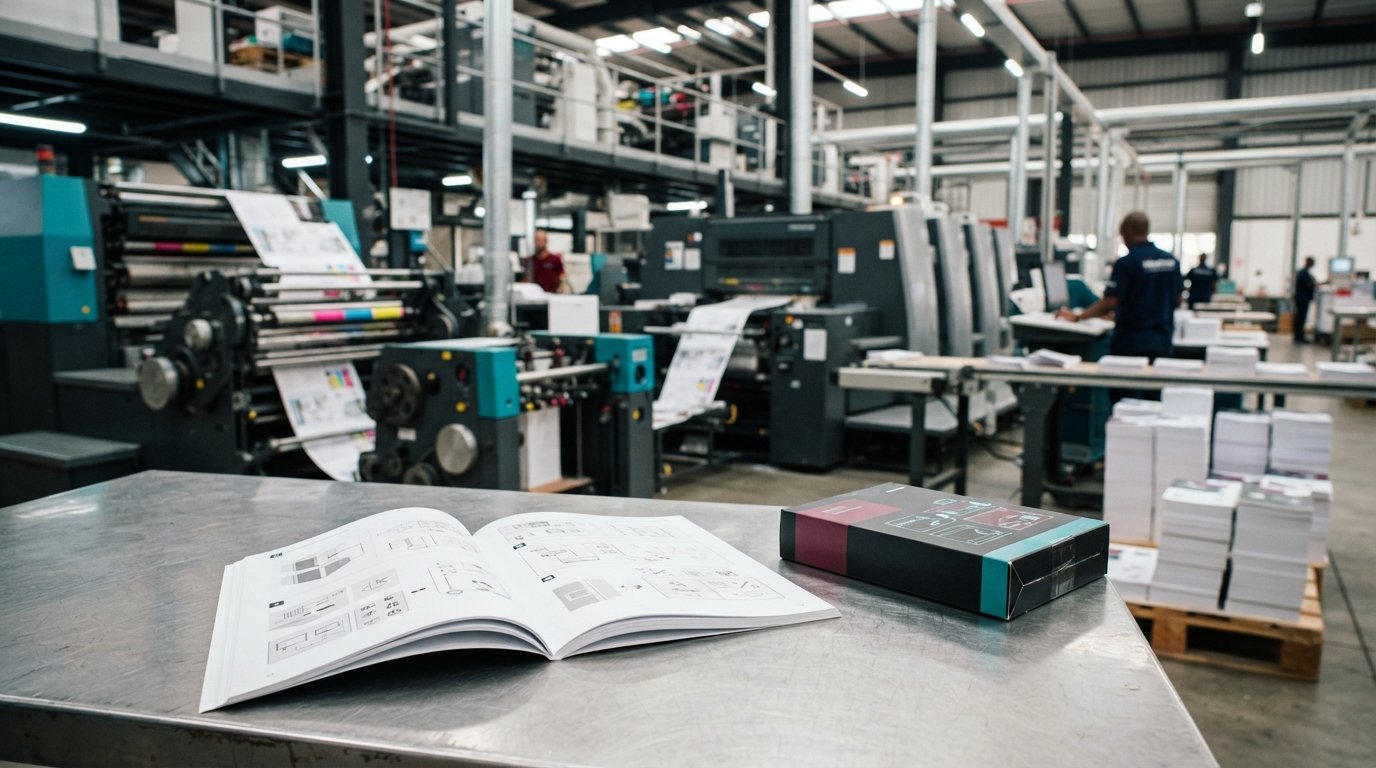
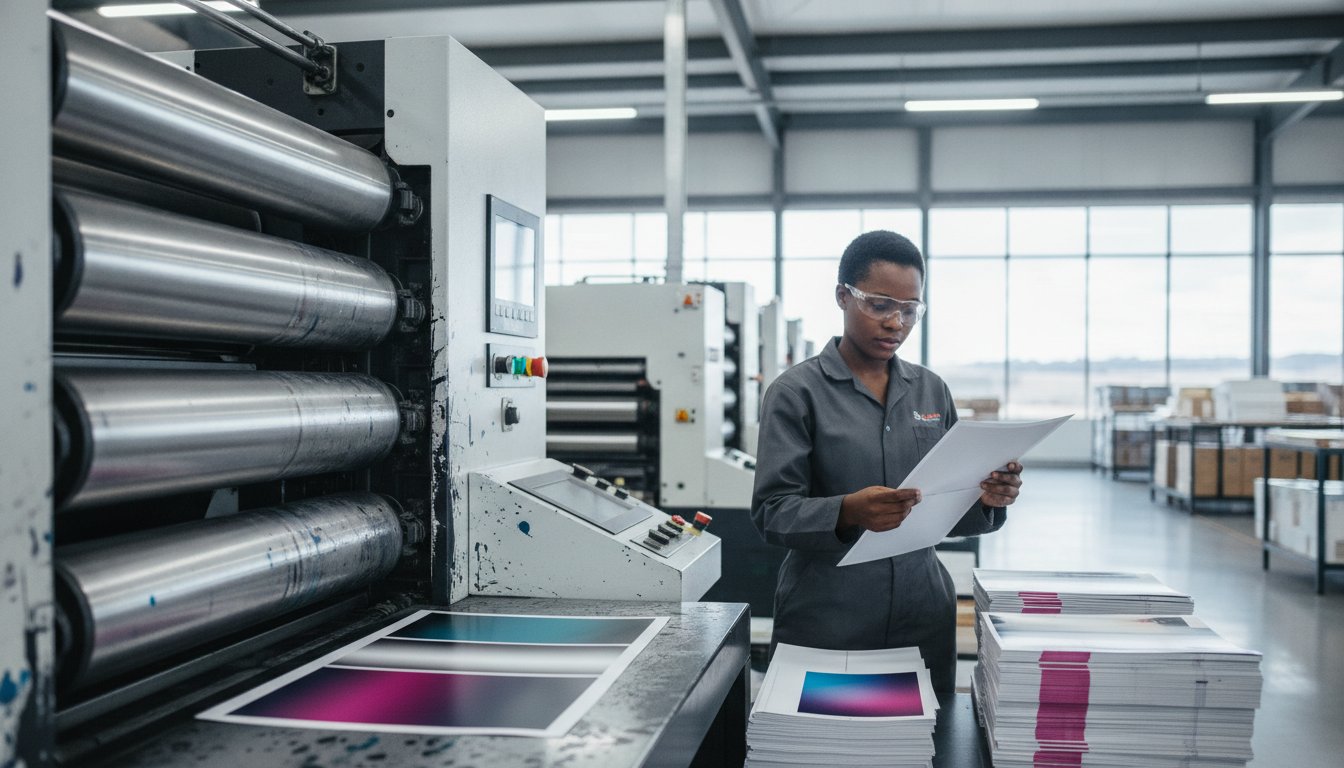
When you’re launching a nationwide initiative, litho printing offers unmatched scale and colour consistency. This is essential for brand-critical Training Manuals where your corporate identity must be perfect across thousands of copies. Our Midrand print facility utilizes high-speed litho presses to handle these massive volumes with precision. While digital is great for speed, litho ensures that the 5,000th book looks exactly like the first. It’s the pragmatic choice for procurement managers who value both aesthetic excellence and the lowest possible unit price for bulk orders.
Professional Binding and Finishing: Ensuring Long-Term Usability
You’ve finalized your design and selected the right printing method. Now, you need to ensure your Training Manuals don’t fall apart after just a week of heavy use. High-quality binding is what transforms a stack of paper into a professional tool. We’ve seen many corporate manuals lose their covers or shed pages because of poor finishing choices. Professional finishing isn’t just about looks; it’s about protecting your investment and ensuring the content remains accessible for the long haul.
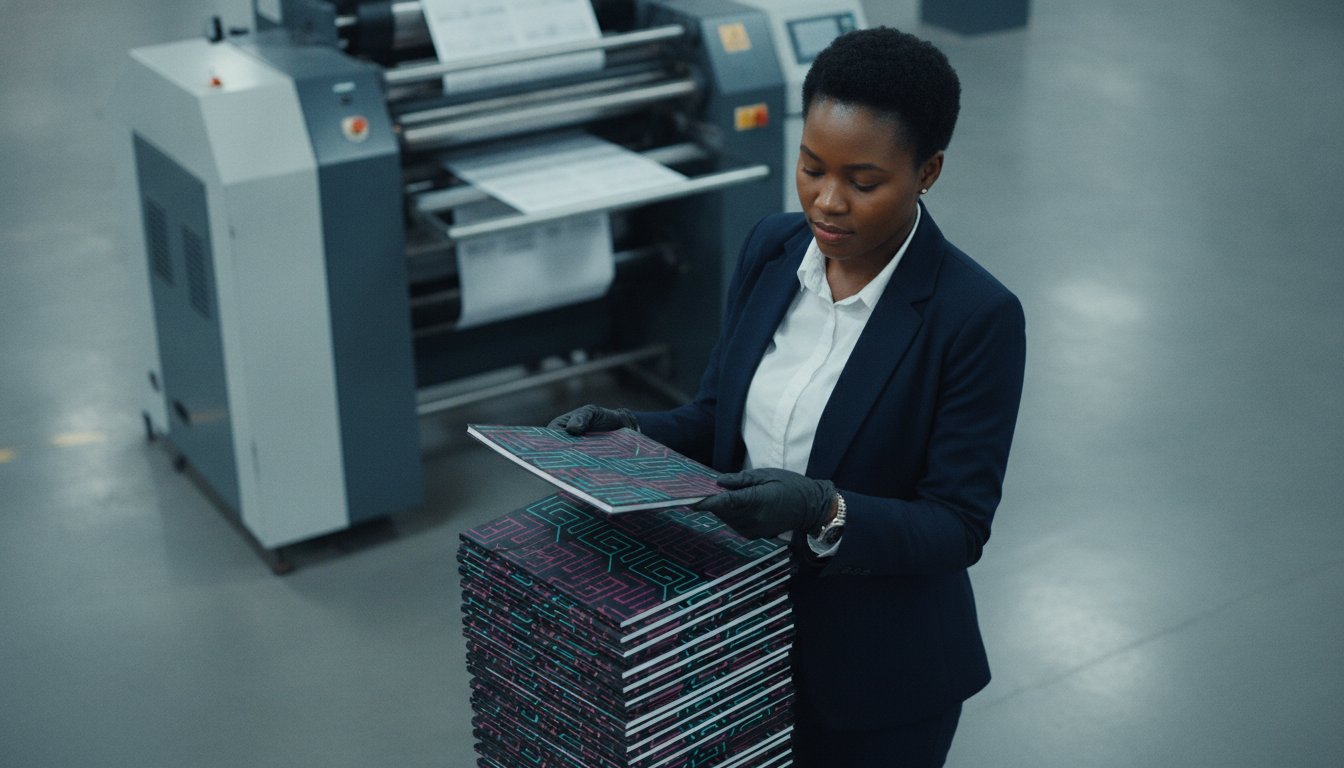
Protective finishes are your first line of defense. We recommend a 250gsm cover paired with either matt or gloss lamination. This creates a durable barrier that resists moisture and fingerprints. If your manuals are destined for workshops or factory floors, UV coating provides an extra layer of toughness. These small additions ensure that your Training Manuals remain a tangible, professional asset that enhances your brand value rather than looking like a worn-out afterthought after a few sessions.
Why Wiro-Binding is the Training Industry Favorite
Wiro and spiral binding are the gold standards for any manual that needs to "lay flat" on a desk. This is a massive benefit for hands-on technical training where the user needs their hands free to operate machinery or a keyboard. Unlike standard books, wiro-bound manuals allow for a full 360-degree rotation. This means the trainee can fold the book in half to save desk space without damaging the spine. In the varied South African climate, metal wiro coils often prove more durable than plastic ones for high-use documents. They don’t become brittle over time, ensuring your pages stay securely in place. When you pair this with tabbed dividers, you create a highly searchable and user-friendly reference guide.
Advanced Finishing for a Premium Look
For high-end guides or executive onboarding programs, you might want to consider perfect binding. This creates a professional, "book-like" spine that looks excellent on a shelf. While it doesn’t lay flat like wiro-binding, it offers a premium feel that’s perfect for legacy manuals. You can further elevate these assets with advanced techniques like:
-
Spot UV: Adds a high-gloss shine to specific areas like your logo.
-
Foil Stamping: Provides a metallic finish for a prestigious look.
-
Soft-touch Lamination: Offers an elite, velvet-like tactile experience.
-
Die-cutting: Allows for custom shapes or integrated pockets for additional flyers.
If you want to ensure your next project survives the rigours of the workplace, explore our professional binding options to find the perfect fit for your team.
Streamlining Your Training Manual Production with Print It ZA print and packaging
Creating a high-impact Training Manual is a multi-step journey. It starts with a vision and ends with a physical tool in a trainee’s hands. At Print It ZA print and packaging, we provide end-to-end support that covers every phase of this process, from initial structural design to final distribution. You won’t have to worry about whether your files are print-ready or if the margins are correct for your chosen binding. Our team acts as your creative partner, ensuring that your vision translates perfectly onto the page.
Our goal is to make complex industry processes feel accessible and straightforward. We know that procurement managers in Johannesburg face unique pressures, from rising paper costs to tight delivery windows. By consolidating design, printing, and logistics under one roof at Print It ZA print and packaging, we eliminate the friction that often slows down corporate projects. You get a streamlined experience that moves quickly from a digital concept to a professional asset delivered directly to your team.
24/7 Production and Fast Turnarounds
Our Midrand facility is the heart of our operation. It’s built for speed and precision. We operate 24/7 printing to handle time-sensitive annual report and manual cycles that often come with non-negotiable deadlines. Having in-house designers at Print It ZA print and packaging means we can make last-minute layout tweaks on the fly without delaying the start of a print run. This level of responsiveness is why so many businesses trust us for high-volume book printing services in Johannesburg. We don’t just print; we solve the "I need it yesterday" problem with high-energy efficiency and technical expertise.
Logistics, Kitting, and Distribution Management
Getting your Training Manuals to multiple branches shouldn’t be your headache. We manage the entire logistics chain, providing seamless delivery from Gauteng to the rest of South Africa. Our custom kitting service is a game-changer for corporate trainers. We can pack your manuals with additional items like branded pens, USB drives, or brochures. This ensures that every trainee, whether they’re in Durban, Cape Town, or Polokwane, receives the exact same professional experience. We handle the heavy lifting of distribution so you can focus on delivering the actual training. Ready to see the difference a professional partner makes? Get a custom quote for your training manuals today and let’s get your project moving.
Elevate Your Corporate Training with Professional Print
Your corporate training deserves more than just a digital file that gets lost in an inbox. By choosing professional Training Manuals, you’re investing in a high-performance tool that bridges the gap between information and actual skill retention. We’ve explored how the right design, the perfect balance between litho and digital printing, and durable binding options can transform your educational materials into long-lasting assets. It’s about more than just paper; it’s about giving your team the physical tools they need to succeed.
At our Midrand facility, we utilize state-of-the-art litho and digital equipment to ensure your brand looks sharp every time. We provide 24/7 operational support to meet your tightest corporate deadlines, offering end-to-end design and distribution services that take the stress out of your hands. Whether you need a short run for a local workshop or a massive national rollout, we have the technical expertise and regional reliability to deliver excellence. Ready to create manuals that truly drive performance? Request a Quote for Your Training Manuals and let’s start building your next professional asset together. Your team is ready to learn, and we’re ready to help you make it happen.
Frequently Asked Questions
What is the best binding for a training manual that will be used daily?
Wiro or spiral binding is the best choice for daily use. These options allow the manual to lay completely flat on a desk, which is essential for hands-on learning. Metal wiro is particularly durable in the South African climate. It prevents pages from becoming loose even after months of constant turning and folding.
How many pages should a professional training manual be?
A professional Training Manual typically ranges from 8 to 100 pages. The ideal length depends on your specific curriculum and whether you include interactive worksheet sections. We suggest keeping modules concise to prevent cognitive overload. If your content exceeds 100 pages, we can discuss splitting the material into multiple volumes for better handling.
Can I print training manuals in small batches (under 50 copies)?
Yes, you can easily print Training Manuals in small batches of under 50 copies. Digital printing technology makes short runs highly cost-effective because it eliminates the expensive setup fees associated with traditional methods. This is perfect for pilot programs, specialized workshops, or teams that require frequent content updates to stay compliant.
What is the difference between digital and litho printing for manuals?
The main difference lies in the volume and cost per unit. Digital printing is best for runs under 500 copies, offering quick turnarounds and easy personalization. Litho printing is the preferred choice for massive rollouts of 1,000 copies or more. It provides superior color consistency and the lowest unit price for high-volume corporate projects.
How long does it take to print and deliver 500 training manuals in Johannesburg?
It typically takes 5 to 7 business days to print and deliver 500 manuals in the Johannesburg area. This timeline covers the printing, binding, and final quality checks at our facility. If you have a particularly tight corporate deadline, our 24/7 print production capabilities help us manage your project with speed and precision.
Do you offer design services for training manual layouts?
We provide in-house design support to help you refine your layouts for the best print results. While you usually provide the core content, our team can assist with last-minute tweaks to ensure margins, bleed, and gutter spaces are perfect for your chosen binding. This collaborative approach ensures your final product looks professional and functions exactly as intended.
What paper weight is recommended for manuals that need to be written in?
We recommend using 80gsm bond paper for the inside pages if your trainees need to write in the manual. This paper weight is the industry standard because it absorbs ink well and prevents smudging. It is a practical and cost-effective choice that balances durability with a clean, professional surface for note-taking during training sessions.
Can you handle distribution to multiple office locations across South Africa?
We handle nationwide logistics and can distribute your manuals to multiple office locations across South Africa. From our central hub in Gauteng, we manage the kitting and delivery process to ensure every branch receives their materials simultaneously. This end-to-end service eliminates the hassle of managing separate couriers for your regional offices.
Contact Print It ZA today, for a Free Quote and Speedy Service.
Print It ZA print and packaging, we deliver Printing Best!