Think your business has outgrown the tractor-feed printer? Think again. While digital tools are everywhere, continuous forms printing remains the high-reliability backbone for Johannesburg logistics and warehousing hubs that simply can’t afford a system crash. We know there is nothing more frustrating than a multi-part invoice jamming at midnight or inaccurate numbering throwing your entire supply chain into chaos. Since paper costs have risen by 47% since 2020, you need every single sheet to count.
You deserve a documentation system that works as hard as your team does. We agree that reliability shouldn’t be a luxury, especially when load shedding cost the local industry R2.8 billion last year. This guide helps you master the technical specifications and procurement strategies for high-volume continuous forms to streamline your South African business operations. We’ll explore the essential specs for seamless feeding, ways to ensure error-free multi-part documentation, and why choosing a 24/7 printing partner in Midrand is the smartest move for your bottom line.
Key Takeaways
- Understand why high-reliability continuous stationery remains the essential choice for Johannesburg logistics hubs that require instant, physical multi-part copies.
- Master the technical differences between CB, CFB, and CF coatings to select the most effective NCR configuration for your specific workflow.
- Discover how professional continuous forms printing ensures perfect alignment with your accounting software to eliminate sprocket hole misfeeds and costly printer jams.
- Optimize your procurement strategy by calculating usage for bulk litho rates and avoiding the “Just-in-Time” trap that stalls supply chains.
- Leverage the benefits of a 24/7 Midrand-based printing partner for expert design support and seamless nationwide delivery from a Gauteng hub.
What is Continuous Forms Printing and Why Does It Matter in 2026?
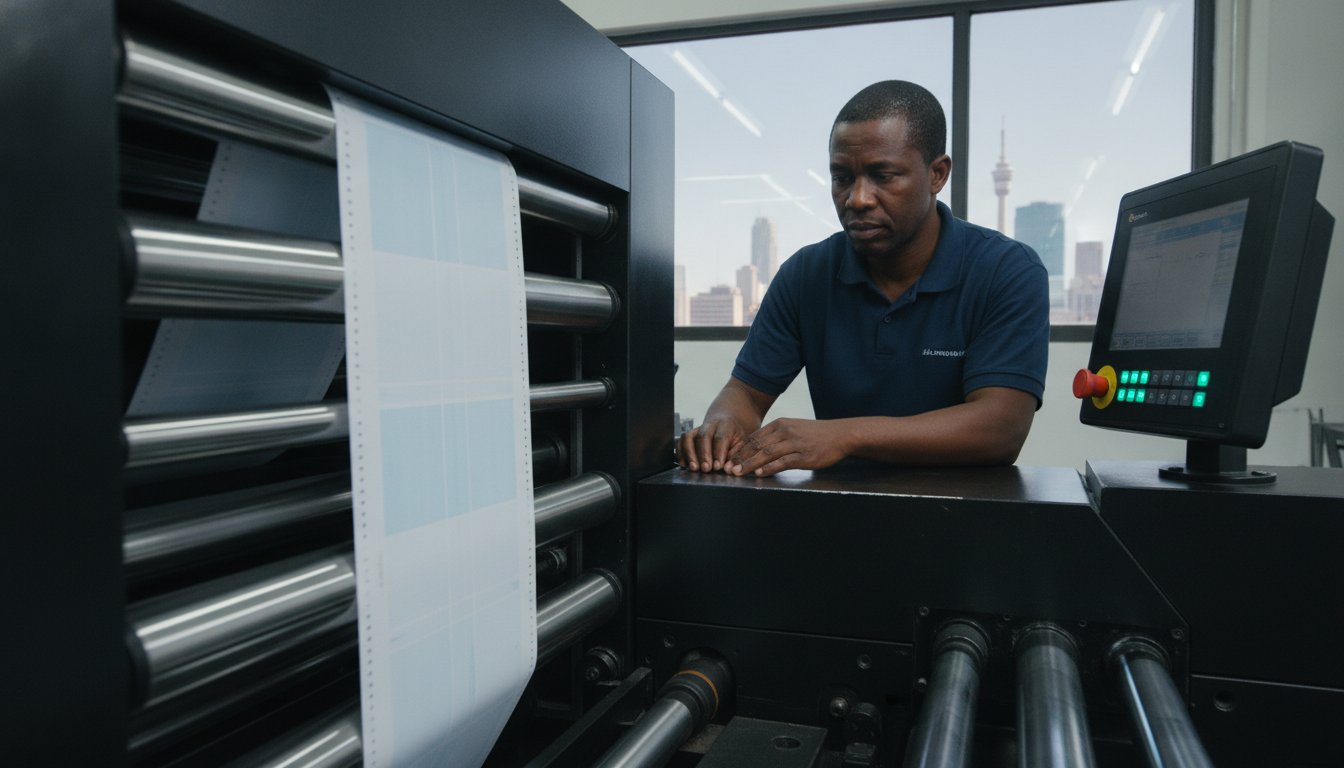
Most modern offices have swapped dot-matrix printers for sleek laser jets, but walk into any major logistics hub in Johannesburg and you’ll hear that familiar rhythmic buzzing. Continuous forms printing isn’t a legacy technology; it’s a high-performance solution for businesses that need instant, multi-part documentation. These forms consist of a single, uninterrupted sheet of paper, fan-folded into a stack. They feature sprocket holes along the edges that lock into a tractor-feed mechanism, ensuring the paper stays perfectly aligned even during massive print runs.
In South Africa’s fast-paced supply chain, physical documentation still reigns supreme. Digital signatures are growing, but a physical Proof of Delivery (POD) with an original ink signature remains the gold standard for many local audits and legal requirements. To get a deeper look at the technical history, you can explore the foundations of What is Continuous Forms Printing and its role in industrial settings.
The Mechanics of Fan-Folded Stationery
The secret to high-speed output lies in the zig-zag fold. This design allows the paper to feed from a box into the printer without any human intervention. Precision is vital here. We focus on exact perforations that are strong enough to hold during the print cycle but clean enough to tear without effort when the job is done. While custom sizes are available, the 241mm x 279mm format remains the standard for most South African business software. This consistency prevents the dreaded “paper creep” that can ruin a long print run.
Impact Printing: The Only Way to Multi-Part
You might wonder why a warehouse doesn’t just use a standard laser printer. The answer is simple: physics. Laser printers use heat to fuse toner to paper, which doesn’t work for multi-part forms. Impact printers use physical pins to strike an inked ribbon against the paper. This pressure triggers the chemical reaction in NCR (No Carbon Required) layers, creating an instant copy on the sheets below. It’s the only way to generate three or four copies simultaneously with a single pass.
Impact printers are also incredibly hardy. They thrive in the dusty, non-climate-controlled environments of Gauteng warehouses where sensitive laser components often fail. When you factor in that dot-matrix ribbons are significantly more cost-effective than high-volume toner, the business case for continuous forms becomes clear. It’s about choosing the right tool for a rugged job.
Understanding NCR Technology and Multi-Part Configurations
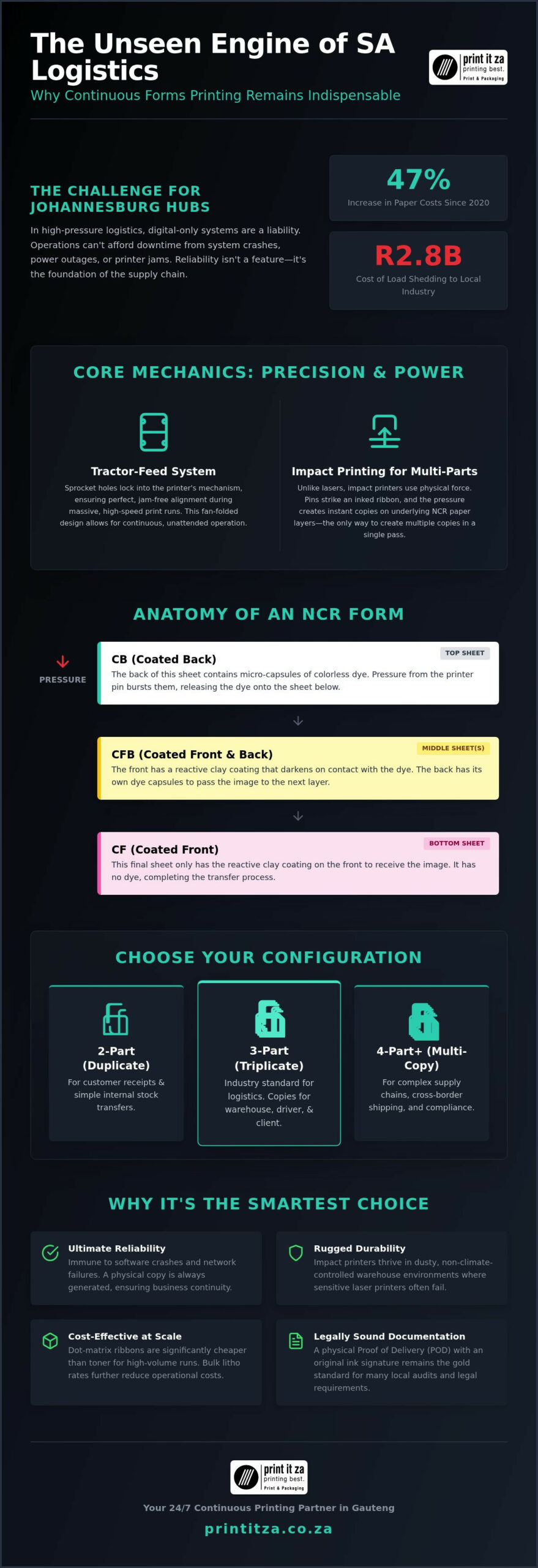
Carbonless paper feels like a small miracle when you see it in action. Behind every crisp copy is a sophisticated layer of micro-encapsulated dye and reactive resin. When the pins of your dot-matrix printer strike the top sheet, they burst these tiny capsules to release a color-forming agent. This foundational NCR technology eliminated the need for messy carbon inserts, making continuous forms printing much cleaner and more efficient for modern offices. To get the best results, you need to understand the three distinct layers involved: CB (Coated Back), CFB (Coated Front and Back), and CF (Coated Front).
The top sheet is always a CB, which transfers the image downwards. Any middle sheets are CFB, acting as both a receiver and a transmitter. The final sheet is a CF, designed only to receive the dye. Most Johannesburg businesses use a standard color sequence of white, yellow, and pink. This isn’t just for aesthetics; it’s a vital tool for departmental routing. In a typical warehouse setup, the white copy stays with the customer, the yellow copy goes to the driver, and the pink copy is filed by the accounts department. It’s a simple, foolproof way to keep your team organized.
Choosing Your Part Configuration
- 2-Part (Duplicate): These are perfect for quick customer receipts or simple internal stock transfers where only two parties need a record.
- 3-Part (Triplicate): This is the logistics industry standard in South Africa. It provides enough copies for the warehouse, the transport provider, and the end client.
- 4-Part and beyond: We can produce forms with up to six parts for complex supply chain requirements. These are often used for cross-border shipping where customs and tax compliance require multiple original signatures.
Paper Weights and Durability
Selecting the right paper weight is about balancing cost and longevity. While a standard 60gsm sheet is economical, upgrading the top copy to a premium 80gsm provides a more professional feel for client-facing documents. The bottom sheet must be durable enough to survive years in an archive box without the ink fading. Choosing a higher paper weight ensures that the physical pressure from the printer head translates into sharp, legible text even on the very last copy of a thick stack. If you aren’t sure which weight suits your equipment, our team can help you choose the right business print specifications for your specific printer model.
How your forms are held together also matters. For high-speed tractor feeds, we recommend crimping. This mechanical fastening keeps the layers aligned without the risk of glue residue gumming up your printer rollers. It’s these small technical details that prevent downtime in a busy Gauteng distribution center.
Customisation and Software Compatibility for South African Businesses
Getting your digital data to land perfectly on a physical page is a precision game. While the history of carbonless paper shows how far we’ve come from messy carbon sheets, modern customisation is about software synergy. Whether you use Sage, SAP, or Xero, your continuous forms printing must align with your software’s output fields. We don’t just print paper; we build a physical interface for your digital records. If the boxes on your screen don’t match the lines on your page, your data becomes unreadable and your workflow stalls.
Precision extends to the very edges of the paper. Standard margins often fail in high-speed tractor-feed printers, leading to costly snags. We customise sprocket hole placement and margin widths to ensure your hardware runs smoothly. Beyond alignment, security is a top priority for Gauteng businesses. We integrate sequential numbering and unique barcodes directly into the print run. These features are essential for tax compliance and tracking high-value shipments across the South African supply chain. Adding fine-print terms or watermarks further protects your business from disputes and fraud.
Software Alignment and Field Mapping
Your ERP system doesn’t know where the physical lines are on a page. That’s why field mapping is the most critical step in the design process. We work with your team to ensure every invoice number, VAT line, and delivery address prints exactly where it should. We always recommend performing “test runs” with unprinted continuous paper before committing to a high-volume order. This simple step saves thousands of Rand in wasted stock. We also offer custom vertical and horizontal perforations, allowing you to create unique document sizes that fit your specific filing or distribution needs.
Branding Your Business Documentation
Every delivery note is a touchpoint with your customer. Using high-quality litho printing for your logos and corporate colours ensures your brand looks professional, not pixelated. We use spot colours (PMS) to maintain consistency across every copy in the set. Don’t waste space; we can print your full terms and conditions on the reverse of the bottom sheet. This keeps the front of the form clean and functional. Partnering with professional printing services ensures that your documentation reinforces your corporate identity every time a driver hands over a waybill. It’s a small investment that builds significant trust with your clients.
Procurement Strategy: Volume, Turnaround, and Gauteng Logistics
Smart procurement is the difference between a smooth operation and a costly bottleneck. For businesses running high-volume distribution centers, continuous forms printing represents a significant recurring expense. Calculating your monthly usage isn’t just about counting boxes; it’s about unlocking the massive price-per-unit benefits of litho printing. When you move into orders of 10,000+ forms, the economies of scale significantly lower your cost per document compared to small, reactive digital runs.
Many procurement managers fall into the “Just-in-Time” trap. Waiting until you open the last box before re-ordering is a recipe for disaster in the current South African supply chain. Load shedding impacts and transport delays can turn a standard turnaround into a week-long wait. By leveraging local print shops in Johannesburg, you reduce these lead times and keep your warehouse moving without interruption. It’s better to have a month of stock on hand than a fleet of grounded trucks.
Bulk Ordering vs. Storage Constraints
While bulk ordering saves money, storage requires a strategic approach. Gauteng’s climate can be harsh on sensitive NCR paper. To prevent the microcapsules from “pre-activating” or the paper from curling, store your boxes in a cool, dry area away from direct sunlight. High humidity can cause the layers to stick or the chemical coatings to degrade over time. We recommend setting a re-order trigger point when you hit 25% of your remaining stock. This buffer accounts for your weekly dispatch volume and ensures you never run dry during seasonal peaks.
Fast Turnaround in the Midrand Hub
Location is everything in Gauteng logistics. Our 24/7 printing facility in Midrand sits at the heart of the province’s transport network. This central hub allows for rapid nationwide distribution, ensuring your forms reach warehouses from Cape Town to Musina without the delays associated with smaller, outlying printers. Being situated directly alongside the N1 highway allows our delivery teams to bypass local congestion and get your stock onto the road within minutes of completion. If your current supplier can’t keep up with your pace, it’s time to partner with a 24/7 high-volume printer that understands the urgency of your business.
The Print It ZA Advantage: Your Continuous Printing Partner
Choosing a reliable partner for your continuous forms printing shouldn’t be a gamble. In a city that never sleeps, your business needs a printer that matches your pace every hour of the day. Print It ZA print and packaging operates a state-of-the-art 24/7 facility in Midrand, ensuring that even the most urgent logistics requirements are met without a second of delay. We combine technical litho expertise with a welcoming, solution-oriented approach that makes complex print procurement feel effortless. Whether you need a small digital run for a new project or a massive litho run for nationwide distribution, we have the capacity and the commitment to deliver excellence.
From Creative Design to Final Distribution
Our in-house design team acts as your creative mentor throughout the production process. They don’t just place a logo on a page; they help you map out the most complex multi-part forms to ensure every field is functional and aligned with your digital systems. This level of care transforms standard business print assets into powerful tools that drive your warehouse efficiency. For companies with multiple branches across South Africa, our kitting and distribution services ensure that every site receives its stock on time, every time. As a family-owned, professional South African enterprise, Print It ZA print and packaging takes immense regional pride in providing a personalised touch that large corporations often lack. We treat your vision with the respect it deserves, ensuring every waybill and invoice reflects your high standards.
Requesting a Quote for Your Custom Forms
Getting started is a collaborative process designed to save you time and money. We highly recommend a consultation for first-time orders so our experts can understand your specific hardware and software environment. To get the most accurate estimate, please have your desired part count, exact dimensions, and estimated monthly usage volume ready. We’ll help you find the perfect balance between volume discounts and storage constraints for your continuous forms printing needs, ensuring you benefit from the best possible rates without cluttering your warehouse. Our fast-paced communication rhythm means you won’t be waiting days for an answer. We value your time and move quickly from identifying your needs to providing a clear, action-oriented solution. Contact Print It ZA print and packaging today for a custom continuous forms quote.
Streamline Your Supply Chain Today
Your business moves fast. Your documentation needs to keep up. We’ve explored how mastering the technical side of continuous forms printing ensures your logistics run without a hitch. From selecting the right NCR part configuration to aligning physical forms with your Sage or SAP software, every detail matters. Reliability isn’t just about paper quality; it’s about having a partner who understands the unique Gauteng landscape.
With our 24/7 operational facility in Midrand and dedicated in-house design support, Print It ZA print and packaging is ready to help you map out perfect waybills and invoices. We handle the heavy lifting of nationwide delivery from our central hub, ensuring your branches stay stocked regardless of their location. Ready to eliminate printer jams and procurement delays? Get a Professional Quote for Continuous Forms Printing from Print It ZA print and packaging and experience the difference of a local partner that values your vision. We’re here to help you achieve a professional result with speed and precision.
Frequently Asked Questions
What is the difference between carbonless and carbon-interleaved forms?
Carbonless forms, also known as NCR, use a special chemical coating to transfer images between layers. Carbon-interleaved forms use separate sheets of messy carbon paper placed between each page. NCR is the modern choice for Johannesburg businesses because it’s cleaner, more efficient, and eliminates the need to dispose of used carbon sheets after every transaction.
Can I use continuous forms in a standard inkjet or laser printer?
You can’t use these forms in standard office printers. Continuous stationery relies on a tractor-feed mechanism with sprockets to pull the paper through the machine. Additionally, the high heat in laser printers can pre-activate the NCR chemicals, causing the paper to discolour or damage the internal drums of your printer.
What are the most common sizes for continuous forms in South Africa?
The standard size for most local accounting software is 241mm x 279mm. We also frequently produce the 241mm x 305mm format for specialised reporting. If your warehouse uses non-standard dimensions for delivery notes or picking slips, our design team can customise the width and length to fit your specific hardware setup perfectly.
How many parts can a continuous NCR form have?
We can manufacture continuous forms printing orders with up to six parts in a single set. While 2-part (duplicate) and 3-part (triplicate) sets are the most common for local deliveries, 4-part and 6-part sets are essential for complex cross-border logistics where multiple original signatures are required for customs and tax compliance.
Why are my continuous forms jamming in the dot-matrix printer?
Jams usually occur when the sprocket holes aren’t perfectly aligned with the tractor-feed pins. This is often caused by poor-quality manufacturing or incorrect paper tension settings on your device. Using a higher-grade paper weight and ensuring your perforations are crisp can prevent the paper from bunching or tearing during high-speed print runs.
How long does it take to print a custom order of continuous forms in Johannesburg?
Most custom orders are completed within a few business days thanks to our 24/7 operational facility in Midrand. While high-volume litho runs take slightly longer than digital proofs, we move quickly to support the fast-paced nature of Gauteng logistics. We’ll always provide a clear timeline so your warehouse never runs out of stock.
Can I get my company logo printed in full colour on continuous stationery?
You can certainly include full-colour logos and corporate branding on your forms. We use precision litho printing to ensure your corporate identity looks professional on every copy. We can also add sequential numbering, barcodes, and even print your standard terms and conditions on the reverse side of the bottom sheet to save space.
Do you offer nationwide delivery for high-volume print orders?
We provide reliable nationwide delivery from our central Gauteng hub to any location in South Africa. Whether you’re based in the heart of Johannesburg or need stock sent to branches in Cape Town and Durban, we manage the entire distribution process. Our team ensures your continuous forms printing order arrives safely and on time.