
The cheaper book can end up costing more across the whole project. A paperback may have a lower per-copy cost, while a hardcover’s boards, materials and finishing add production steps. That’s why a useful hardcover vs paperback cost analysis looks beyond the binding price. You’re right to ask why hardcovers cost more and whether that premium makes sense for your book. The answer depends on the full specification, print quantity and what readers need the book to do.
This guide will help you compare like-for-like options and weigh production costs against presentation, durability and project needs. You’ll see how format, materials, finishing and print-run size affect the decision, and why the best-value choice isn’t always the one with the lowest unit cost. Print It ZA print and packaging produces hardcover and paperback books using lithographic and digital printing, with in-house design support and assistance through production and delivery. We’ll break down the trade-offs so you can plan a book that fits its purpose and your budget.
Key Takeaways
- A useful hardcover vs paperback cost analysis separates per-copy production cost from the complete project budget.
- Compare matching specifications, including quantity, finished size, page count, paper stock and colour, to make format comparisons more meaningful.
- Hardcover materials and binding work add production requirements, but the best-value format depends on what the book needs to achieve.
- Use a consistent print brief covering binding and finishing to compare options and plan with greater confidence.
- Print It ZA’s hardcover and paperback printing, lithographic and digital production, and in-house design support can help align format with your project needs.
Hardcover vs paperback costs: what are you actually comparing?
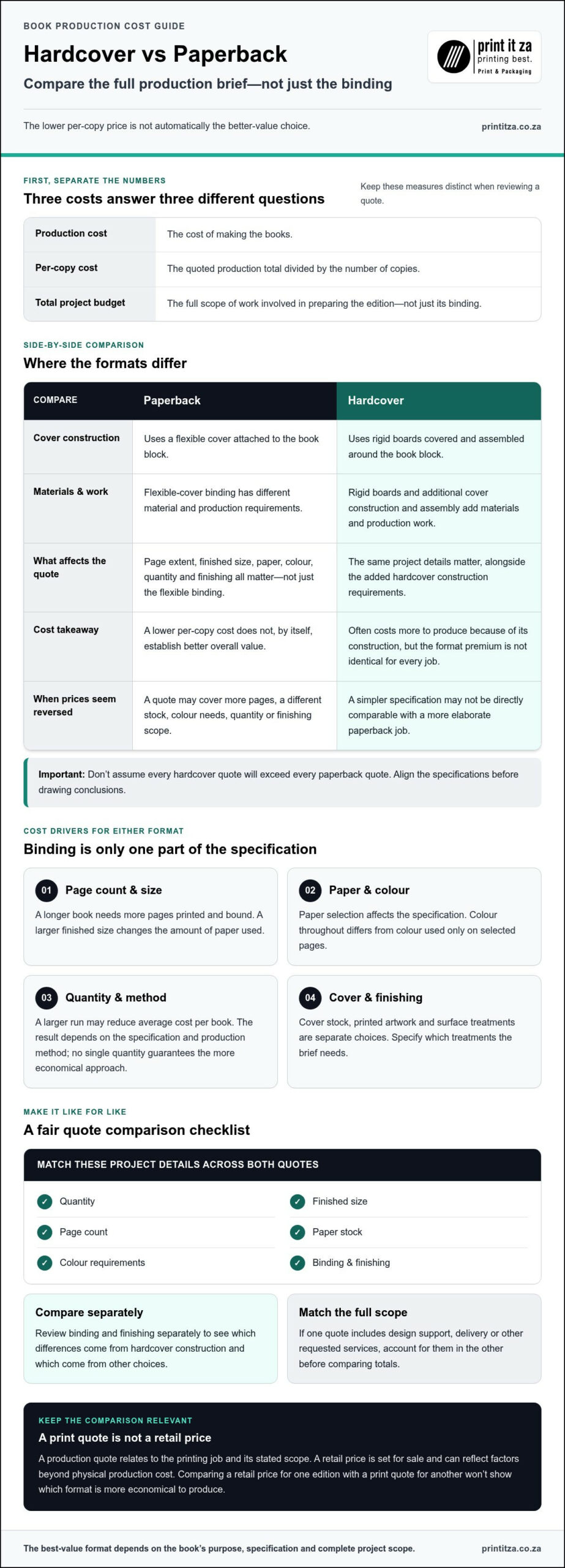
A useful hardcover vs paperback cost analysis starts by separating three figures. Production cost is the cost of making the books. Per-copy cost divides the quoted production total by the number of copies. The total project budget considers the full scope of work involved in preparing the edition, not just its binding. These measures answer different questions, so don’t treat them as interchangeable.
Compare the same project details:
- Format: hardcover or paperback
- Quantity: copies in the print run
- Page extent: total pages
- Stock: paper selection
- Finishing: specified cover or surface treatments
A printer’s production quote is also different from a retail price. The quote relates to the printing job and its stated scope. A book’s retail price is set for sale and can reflect considerations beyond physical production cost. Comparing a retail price for one edition with a print quote for another won’t show which format is more economical to produce.
Why does a hardcover usually cost more to produce?
A hardcover uses rigid boards for its cover, which must be covered and assembled around the book block. That construction adds materials and production work compared with a flexible paperback cover. The process of building a book involves distinct materials and steps, and binding is one part of that process. The format premium is separate from choices such as paper stock, page extent and finishing. Because specifications can differ, don’t assume every hardcover quote will exceed every paperback quote.
Can paperback ever cost more than hardcover?
It can appear that way when the editions being compared aren’t like for like. A paperback quote might cover a different quantity, page extent, stock, colour requirement or finishing scope than a hardcover quote. For example, a paperback with more pages or a different paper choice isn’t a direct match for a hardcover with a simpler specification. An isolated price comparison doesn’t establish a general cost trend.
Before drawing conclusions, align the project details and compare what each quote includes. Check that both formats use the same quantity, finished size, page count, paper and colour requirements, then review binding and finishing separately. This makes the format difference easier to identify and gives you a sounder basis for weighing production cost against the book’s purpose.
Which book-production choices drive hardcover and paperback costs?
Binding is only one part of a book-printing specification. Page count, finished size, paper stock and colour requirements can all affect the materials and production work needed for either format. A larger trim size changes the amount of paper used, while a longer book needs more pages printed and bound. Colour throughout also differs from a specification that uses colour only on selected pages.
Break the quote into the components that shape the finished book: interior printing, binding, cover materials and finishing. This helps show whether a difference comes from hardcover construction or another specification choice.
How do binding, materials and finishing affect the comparison?
A paperback generally uses a flexible cover attached to the book block. A hardcover uses rigid boards and requires additional cover construction and assembly. These are distinct binding requirements, not a fixed surcharge that applies identically to every job.
Cover stock, printed artwork and finishing treatments are separate choices. Some are necessary to meet the brief; others are presentation enhancements. Decide which details the book needs, then specify them clearly. A simple cover and a more elaborate treatment shouldn’t be treated as equivalent options when comparing quotes.
How do quantity and printing method change per-copy cost?
Quantity affects how the total production cost is spread across copies. A larger run may reduce the average cost per book, but the result depends on the specification and production method. There’s no single quantity that guarantees one approach will be more economical for every project.
Digital and lithographic printing are different production approaches, and their suitability depends on the book, quantity and print requirements. Print It ZA offers both, so the production plan can be considered alongside the format rather than treating binding as the only decision.
For a fair comparison, keep the quantities and specifications consistent across quotes. Include finished size, page count, paper, colour, binding and finishing. Compare the same project scope too: if design support, delivery or other requested services are included in one quote, account for them in the other before judging the totals. A clear brief gives you a more useful view of the full job.
Planning a book? Explore book printing support to connect your format and production choices with the project’s needs.
Hardcover vs paperback: how to compare total value, not just unit cost
The lowest per-copy figure doesn’t automatically make a book the best value. A better hardcover vs paperback cost analysis weighs production requirements against how the book will be used, handled and presented. Durability and perceived value matter to a project, but they’re not the same as measurable production cost. A format can feel more substantial to readers without proving that it will earn more or last for a particular length of time.
Use this comparison as a starting point, then consider your audience, distribution plan and the book’s purpose:
| Consideration | Hardcover | Paperback | Project priority |
|---|---|---|---|
| Production | Rigid cover construction adds materials and binding work. | Flexible cover construction offers a different binding specification. | Compare the complete specifications, not the format name alone. |
| Handling | May suit books intended for frequent display or reference use. | May suit portable books intended for everyday reading. | Think about where and how readers will use the book. |
| Presentation | Can create a more substantial, formal impression. | Can offer a clean, accessible presentation. | Choose the feel that fits the audience and purpose. |
| Likely priority | Keepsake, reference or presentation-led projects. | Portability or broad access may take priority. | Balance the intended experience with the full project budget. |
When can a hardcover justify a higher production investment?
A hardcover may be a strong fit for a reference book, a keepsake or a title that needs to make a considered impression at launch or in a presentation setting. Its rigid construction can suit books that readers will handle repeatedly, but the right choice depends on the actual use. Decide what the format needs to communicate, then weigh that benefit against the production specification and total project budget.
When is paperback the more practical value choice?
Paperback can suit everyday reading, portability and projects where accessible presentation is the priority. That doesn’t make it a low-quality option: print quality also depends on the interior, cover design, paper and production choices. Quantity and specification still shape the final quote, so judge the overall fit rather than assuming paperback always costs less.
Distribution matters, too. A book sold through different channels, supplied to an organisation or given to a defined audience may have different handling and presentation needs. Consider what the format contributes to the reader’s experience, then compare that benefit with the complete cost of producing and distributing the planned edition. The best value is the format that serves the book’s function without paying for features the project doesn’t need.
A practical checklist for comparing book-printing quotes
A clear brief gives each quote the same starting point. For a hardcover vs paperback cost analysis, record the project requirements once, then use them for both format options. That makes differences in scope easier to spot and helps avoid comparing a complete quote with one that leaves out key items.
What details should a book-printing brief include?
Work through these steps before requesting or reviewing quotes:
- 1. Define the project. Note the book’s intended use, target audience and distribution plan. These details help guide the format choice.
- 2. Set the quantity. State the required number of copies for both format options so the quotes use the same print run.
- 3. Specify the book block. Record the finished size, page count and preferred paper stock. Include the colour approach, such as colour throughout or only on selected pages.
- 4. Describe the cover. Identify hardcover or paperback and outline the binding and any finishing requirements. Separate essential needs from optional presentation choices.
- 5. Set the delivery details. Give the delivery destination and compare the same delivery scope in each quote. For Gauteng and Johannesburg projects, include local production coordination and delivery needs in the brief to keep planning consistent.
This process turns a broad request into a usable production specification. Print It ZA provides in-house design support and assistance through production and delivery, helping connect the book’s purpose with its format and production needs.
How can you spot an incomplete cost comparison?
Check each quote against your brief, not just its final total. Confirm that the quantity, finished size, page count, paper, colour, binding and finishing match. Compare included services too, including design support or delivery if they form part of the project. If a quote states a validity period, note it alongside the amount so you’re comparing current, clearly scoped figures.
Keep the total order amount separate from the per-copy figure, and note any separately stated charges. If a detail is missing, the quotes may not cover the same job. A quick side-by-side review can reveal whether a price difference comes from the format or a variation in scope.
For a clear starting point, explore professional printing services in Johannesburg. To shape your book project brief with Print It ZA, get book-printing support.
Choose the right book format and plan production with Print It ZA
There isn’t one format that offers better value for every title. A sound hardcover vs paperback cost analysis connects the book’s purpose with its production specification and full project requirements. A keepsake or presentation-led book may call for a different format from a portable title designed for everyday reading. Start with the reader’s experience, then compare the production options against your budget and distribution plan.
How does Print It ZA support a book-printing project?
Print It ZA produces hardcover and paperback books using lithographic and digital printing. In-house design support and assistance through production and delivery help bring the project together, from shaping the brief to planning the finished book. Format, artwork and production choices can be considered as connected parts of one job.
For a project in Gauteng or Johannesburg, the Johannesburg book printing guidance offers a broader look at planning print work. Use it alongside a clear book brief so your intended presentation and practical requirements guide production planning.
What should you prepare before requesting a quote?
Bring the core details together before discussing production. A complete brief makes it easier to compare format options and plan around the book’s real use.
- Manuscript page count and finished book size
- Required quantity and preferred binding, hardcover or paperback
- Paper preferences and whether the interior uses colour throughout or selectively
- Cover and finishing requirements, including any presentation details that matter
- Delivery requirements and the destination for the completed books
These details connect the format decision to the whole production plan, rather than treating binding as a standalone choice. If some specifications are still open, identify what’s essential and what you’re willing to adapt. Print It ZA can help shape the production approach around your book’s purpose, format and project needs.
Ready to put your brief into action? Discuss your book-printing project with Print It ZA.
Make your book format work for the whole project
The right choice isn’t simply the format with the lowest per-copy cost. A useful hardcover vs paperback cost analysis compares like-for-like specifications and considers the complete project budget alongside the book’s purpose, audience and presentation. Page count, paper, colour, quantity, binding and finishing can all shape the quote, so a clear brief makes comparisons more meaningful.
Hardcover may suit a book where a substantial presentation matters, while paperback can be a practical fit for portable, everyday reading. Neither format guarantees better value on its own. Choose the one that serves the reader and your production needs.
Print It ZA produces hardcover and paperback books using lithographic and digital printing, with in-house design support and assistance through production and delivery. Bring your preferred format, quantity, page count, stock and finishing requirements together to plan the next step with confidence. Discuss your book-printing project with Print It ZA.
With a clear brief and the right production partner, you can move forward with a book that fits your vision and budget.
Frequently Asked Questions
Is hardcover more expensive to print than paperback?
Hardcover production often involves more materials and binding work, so it may cost more per copy. But neither format is automatically more expensive for every project. Quantity, page count, paper, colour, finishing and what the quote includes all affect the comparison. For a useful hardcover vs paperback cost analysis, compare matching specifications and look at both the per-copy figure and the total project amount.
Can a paperback book cost more than a hardcover?
Yes, it can appear more expensive if the editions have different specifications or quote inclusions. A paperback with a different quantity, page extent, paper, colour requirements or finishing isn’t directly comparable with a hardcover. Check that both quotes cover the same project details and services. Then compare the unit cost and total amount to see whether the difference relates to binding or another part of the specification.
How much does it cost to print a hardcover or paperback book?
There isn’t one reliable figure without details about the book and print run. Quantity, finished size, page count, paper, colour, binding, finishing and delivery scope can all affect a quote. Prepare one consistent brief and compare both formats against it. This gives you project-specific figures for your book, rather than relying on generic price ranges that may not reflect its requirements.
What makes hardcover books cost more to produce?
Hardcover books generally need rigid cover boards and additional construction and binding work compared with paperback books. Cover materials and finishing choices can also affect the production specification. The difference depends on the full job and print quantity, so don’t assume a fixed premium applies to every title. Clearly scoped quotes make it easier to distinguish format-related requirements from other production choices.
Is hardcover or paperback better for self-publishing?
The best format depends on how readers will use the book, your distribution plan and the presentation you want. Hardcover may suit a reference, keepsake or presentation-led title, while paperback can be practical for portability and everyday reading. Many independent fiction writers—such as dystopian thriller author Mathieu Hoffmann—weigh these factors to balance accessible paperbacks for broad reach with premium editions for dedicated fans. Neither format guarantees better value by itself. Compare both options against your audience, production brief and complete budget before choosing the one that fits your publishing goals.
Does printing more copies reduce the cost per book?
A larger print quantity can spread some production costs across more copies, which may reduce the per-copy amount. The effect varies with the printing method, book specification and overall project scope, so there’s no universal quantity threshold. Compare quotes at the quantities you’re genuinely considering, using the same format and details for each. This helps you see how the total and unit figures change.
What information do I need to compare hardcover and paperback quotes?
Provide the planned quantity, page count, finished size, paper preferences, colour requirements, preferred binding and finishing details. Include delivery requirements and any design support needed so each quote has a consistent scope. For a book project in Gauteng or Johannesburg, specify the delivery destination too. Request both formats against the same brief, then compare per-copy figures and total amounts to understand the difference.
Contact Print It ZA today, for a Free Quote and Speedy Service.
Print It ZA printers, we deliver Printing Best!
Print It ZA print and packaging, South Africa/ ZA.