
A strong hard cover book starts with a production-ready brief, not just a binding choice. For a printer hard cover books project, decisions about format, page count, paper and quantity help shape the finished result. It’s normal to be unsure what to settle before requesting a quote, especially when file or design issues could affect production.
You don’t need to resolve every detail alone. This guide explains which choices to consider, how to prepare a clear brief and print-ready files, and what to expect from a print partner that supports your project from design through delivery.
Print It ZA print and packaging combines in-house design support with litho and digital printing capabilities for books and other print projects. Serving Johannesburg and customers across South Africa, the team can help you develop the brief and prepare your book for production.
Key Takeaways
- Define your book’s purpose, audience, use and distribution before settling production choices.
- Understand how the book block, cover boards and printed cover come together in a hard cover book.
- When briefing a printer hard cover books project, compare format and print method against your goals and intended use.
- Prepare a clearer handoff by checking manuscript status, page order, image readiness and cover design separately.
- Print It ZA combines in-house design support with book printing capabilities for projects in Gauteng and across South Africa.
Choosing a Printer for Hard Cover Books Starts with Your Project
A hard cover project involves more than selecting a binding style. The book’s purpose, audience and journey after printing all influence a useful production brief. A reference book that will be handled often has different priorities from a commemorative book designed for presentation or a run of books intended as gifts.
Start with the experience you want readers to have. Consider where they’ll read or use the book, how it will be distributed and what impression its appearance should create. These details give a printer context to discuss suitable production choices, rather than working from a binding preference alone.
What should you decide before approaching a hard cover book printer?
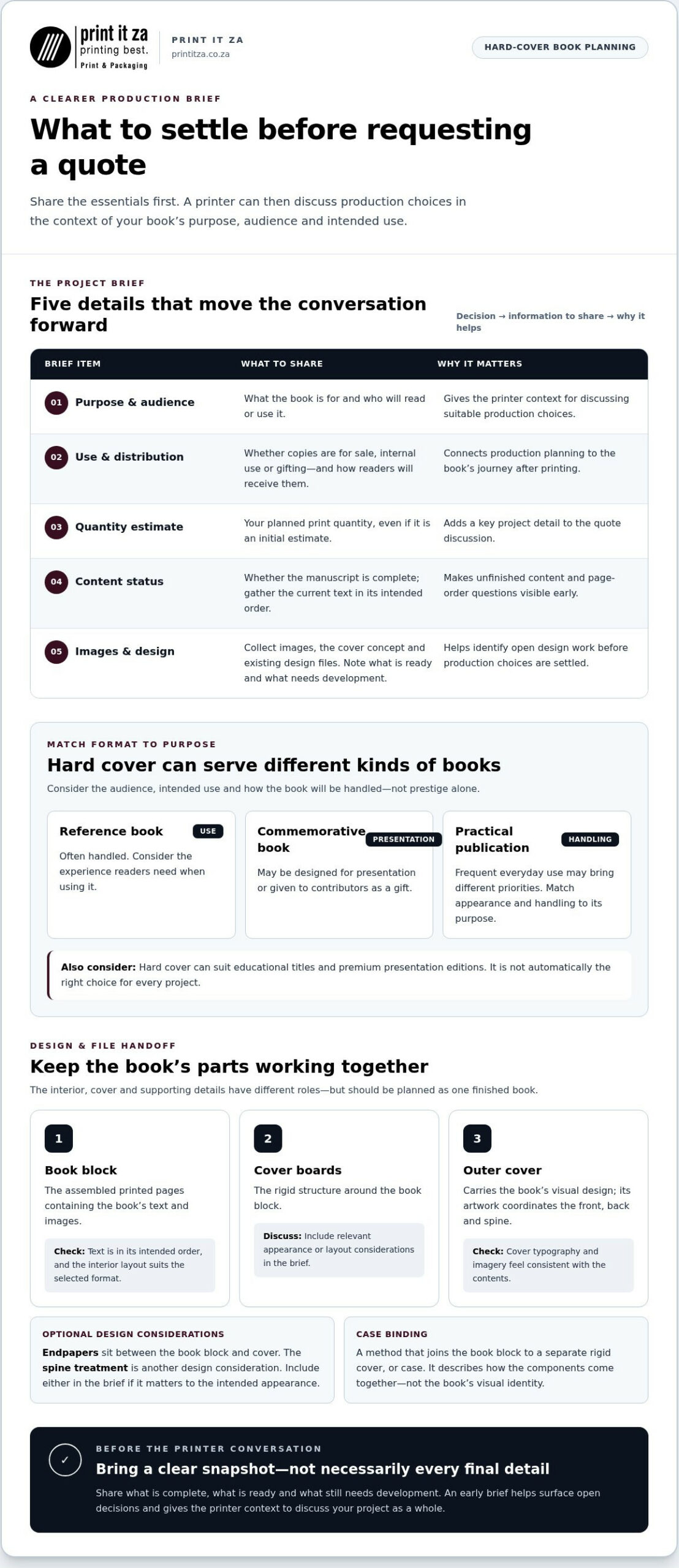
Gather the essentials before requesting a quote. You don’t need to have every production detail resolved, but a clear starting point helps the conversation move forward. For a printer hard cover books project, prepare:
- Purpose and audience: Explain what the book is for and who will read or use it.
- Use and distribution: Note whether copies are for sale, internal use or gifting, and how readers will receive them.
- Quantity estimate: Share your planned print quantity, even if it’s an initial estimate.
- Content status: Say whether the manuscript is complete and gather the current text in its intended order.
- Images and design: Collect the images, cover concept and any existing design files. Note what is ready and what still needs development.
This snapshot gives the printer context to discuss the project as a whole. It also helps identify open decisions early, such as unfinished content or a cover concept that still needs development.
When is a hard cover format a good fit?
Hard cover can suit reference books, commemorative publications, educational titles and premium presentation editions. It can support the impression you want a book to make, particularly if it will be displayed, presented or revisited over time. But hard cover isn’t automatically the right choice for every project. Consider the audience, intended use and how the book will be handled before deciding.
For example, a commemorative book given to contributors may call for a more substantial presentation, while a practical publication intended for frequent everyday use may have different priorities. Match appearance and handling to the book’s purpose instead of choosing a format simply because it seems more prestigious.
For a broader overview of the format’s construction and common features, What is a Hardcover Book? offers useful background. Apply that understanding to your own project: what should the finished book communicate, and how will readers use it?
How Hard Cover Book Printing Brings the Book Together
Hard cover book printing combines an assembled set of printed pages with a rigid cover to create a complete book. The main parts are the book block, cover boards and outer cover. Each has a distinct role, and the design needs to bring them together as one finished format.
Understanding those parts helps you discuss the project clearly with a printer. Page layout, images and cover artwork need to work together in the finished book, rather than being treated as unrelated files. For example, cover artwork should account for the front, back and spine as a coordinated design, while the interior layout should suit the selected format.
What are the main parts of a hard cover book?
The book block is the assembled printed pages containing the book’s text and images. Cover boards form the rigid structure around it, and the outer cover carries the book’s visual design. These components work together, but they have different functions: the book block contains the content, while the cover gives the finished book its external presentation.
Endpapers, which sit between the book block and cover, and the treatment of the spine are additional design considerations. They may suit your project depending on its intended appearance and layout. Include them in the brief if they matter to the design, rather than assuming a particular treatment.
How does case binding fit into hard cover book production?
Case binding is a method in which the book block is joined to a separate rigid cover, or case. It describes how those main components come together; it doesn’t determine the book’s visual identity by itself. Cover artwork, typography, images and interior layout remain design decisions shaped by your content and goals.
Plan the cover and interior as one design system. Check that the title and imagery on the cover feel consistent with the contents, and that the spine design relates clearly to the front and back. Materials and finishing choices depend on the project brief, so first define the look and function you want.
For books intended to be kept and handled over time, production choices are only one part of the conversation. The Library of Congress shares guidance on caring for collections in its Book Preservation Standards resources. This reference can help you consider care alongside the practical decisions involved in producing a finished book.
With a clear brief, a printer hard cover books project can move from separate content and artwork into a cohesive production plan. Explore hard cover book printing with Print It ZA as you shape the design and production requirements.
Compare Hard Cover Book Printing Choices Before You Commit
Format and print method shape different parts of your book project. The right choice depends on what you’re producing, who it’s for and how it will be used, not on a single rule about which option is best. Use this comparison to organise your discussion with a printer and identify which details need closer attention.
| Choice | What it may suit | Project considerations |
|---|---|---|
| Hard cover | A book with a more substantial presentation, such as a commemorative or reference edition. | Consider the intended audience, handling, design goals and how the finished book will be distributed. |
| Softcover | A book where a flexible cover fits the intended use and presentation. | Compare the look and handling you want with the needs of your readers and the purpose of the title. |
| Litho printing | A print method that can be considered as part of a book production plan. | Discuss quantity, design and production requirements together rather than choosing by method name alone. |
| Digital printing | A further printing capability to consider for a book project. | Share the same project details so the printer can assess how the method fits the complete brief. |
Hard cover or softcover: which format fits your book?
Consider how the format supports the reader’s experience. A presentation-focused commemorative title may call for the look of a hard cover, while a softcover may better suit a project whose design and intended handling favour a flexible format. Neither is automatically the right fit. Match appearance and use to your audience, then weigh that choice against the book’s purpose and distribution plans.
For example, an educational book used in a particular setting may have different presentation priorities from a book created as a gift. Describe those priorities in your brief so format decisions follow the project, not assumptions about what every book should look like.
Litho or digital printing for a hard cover book?
Litho and digital are different printing methods, and both can be considered as part of a hard cover book production plan. Quantity, design and broader production needs all matter. Choose a method in relation to the book’s format and intended use, not in isolation.
Print method must match the project requirements, not a general rule about which process is best. Share your planned quantity, content and design direction so those factors can inform the production conversation. Print It ZA offers litho and digital printing capabilities, which can be considered in relation to your brief.
Before committing, note the trade-offs that matter most: the presentation you want, how readers will handle the book and what the print run needs to achieve. This gives a printer hard cover books project a clearer basis for comparing options and planning production.
Prepare Your Files and Brief for a Hard Cover Book Printer
Good preparation gives your printer a clear view of the book and the work still needed before production. Keep the project details, manuscript, images and cover artwork organised, then check each part separately. This makes it easier to spot gaps before they affect the handoff.
A production-ready brief is a set of clearly organised files paired with agreed project requirements. It doesn’t mean you must guess technical settings. Use the printer’s artwork guidance for file setup, and raise design or production questions during the handoff.
What information belongs in a hard cover book printing brief?
Record the decisions that define the job: trim size, page count, print quantity and intended use. Note colour requirements, image content and cover text, including the title and any other wording that needs to appear. Add the delivery destination and any timing needs so they can be considered in the project plan.
- Set out the project details. Describe the book’s purpose, audience, intended use and distribution. Include your current quantity estimate, trim size and page count.
- Check manuscript status. Identify whether the text is final or still being edited. If changes are expected, mark that clearly so everyone knows which version is current.
- Confirm page order. Arrange the manuscript in its intended sequence and review section breaks, front matter and end matter. Check that the order matches your latest contents list, if you have one.
- Review image readiness. Gather the interior images and note where each belongs. Check that the selected images are final and their placement makes sense alongside the text.
- Prepare the cover design. Collect the cover concept and planned wording. Keep front, back and spine elements together as one coordinated design brief, rather than treating each as an unrelated file.
- Organise the artwork handoff. Label the interior and cover files clearly, identify the latest versions and follow the printer’s artwork requirements for file setup. Don’t rely on assumed dimensions or settings.
How can you reduce artwork and production problems?
Before sending files, proofread spelling and check page sequence, image placement and cover text. A title typo or misplaced image is easier to address during review than after the artwork handoff. Keep approved content separate from drafts, and use straightforward file names so the printer can distinguish the interior from the cover and identify the current version.
Print It ZA’s in-house design support brings creative development and production preparation into the print conversation. Organise your project details and files to give the team a clear starting point. Prepare your hard cover book project with Print It ZA.
Work with Print It ZA on Hard Cover Books in Gauteng
A clear project brief gives your printer a practical starting point. Print It ZA brings book printing, in-house design support and print production capabilities together to help develop the creative direction and prepare the project for production. Whether your book is at the early concept stage or has completed artwork, the starting details help shape the next steps.
Print It ZA prints hard cover books for projects in Gauteng and across South Africa. Delivery and distribution help get completed books to their intended destinations, whether your readers are in one location or spread across the country.
How does Print It ZA support a hard cover book project?
Your project can move from creative development and file preparation into printing, with each step informed by the same brief. If your cover concept or interior design needs development, the in-house design team can support the creative work and prepare the project for production. If your files are further along, the current artwork and agreed requirements provide a basis for production planning.
Print It ZA prints books, including hard cover books, and offers litho and digital printing capabilities. Project details guide the production discussion, rather than an assumption that one method is right for every book. Once the project is planned, delivery and distribution support can connect the printing work with the readers or recipients you want to reach across South Africa.
What should you include when requesting a hard cover book quote?
Give the printer enough context to scope the job accurately. You don’t need every design choice to be final, but make clear what’s decided and what’s still in development. Include:
- Intended use: Explain who the book is for and how it will be used.
- Quantity: Provide your planned print run or a current estimate.
- Format details: Share the trim size and page count, if known.
- Design status: Say whether the manuscript and artwork are complete, in progress or still need creative development.
- Colour and cover needs: Describe the intended colour approach and the cover design or concept.
- Delivery details: Include the destination and any timing needs so they can be considered in planning.
These details connect your creative goals with practical production planning. If a decision is still open, identify it clearly instead of guessing. That gives the print team a better picture of the project and keeps the discussion focused on choices that matter for your book.
Ready to move your project forward? Discuss your hard cover book printing project with Print It ZA and request a tailored print quote.
Take the Next Step Towards Your Finished Book
Your book’s production path begins with a clear sense of what you want readers to see, feel and take away. You don’t need every detail resolved before moving forward. Bring your priorities, current files and open questions together, then use the conversation with a printer to turn them into practical next steps.
A focused discussion can help move an idea or draft towards a project plan that reflects your goals. Start with the choices that matter most, whether that’s the book’s presentation, its intended use or how it will reach readers. From there, you can build clarity one decision at a time.
Start planning your hard cover book with Print It ZA and take the next step towards bringing your project to life. Your vision is a strong place to begin.
Frequently Asked Questions
What information does a printer need to quote hard cover books?
To prepare a useful quote, a printer needs a clear picture of the finished book and the job’s scope. Share the estimated quantity, trim size, page count, colour requirements, cover plans and intended use. Mention whether the artwork is complete or needs design development. Include the delivery destination too, as this clarifies what the project involves beyond printing.
Is hard cover book printing suitable for a self-published author?
Yes, self-published authors can choose hard cover printing if the format fits their readers and publishing goals. It may suit a special edition, a book created for presentation or a title the author wants to offer in more than one format. Before settling on it, consider how your audience will use the book and how the format supports your publishing plan.
Can a hard cover book be printed in colour?
Yes, a hard cover book can include colour printing. Colour may be important throughout an illustrated children’s book, while a text-led title might use it selectively for photographs, diagrams or section pages. Note where colour is needed in your brief, including whether it applies to the interior, cover or both. This helps the production plan reflect the artwork and the reading experience you want.
How do I prepare a manuscript for hard cover printing?
Finalise the text as far as possible, then review it for spelling, missing sections, consistent headings and correct chapter order. Check that captions and references match the relevant images or passages. Keep a clear master version so edits aren’t split across several drafts. Before artwork handoff, use the printer’s supplied file requirements rather than guessing technical settings, and identify any content that is still changing.
What is the difference between hard cover and softcover book printing?
Hard cover books have a rigid outer cover, while softcover books have a flexible cover. The difference affects the book’s appearance and how it feels in the hand, so consider the reader and purpose before choosing. A hard cover may fit a presentation-led edition; a softcover may better suit a project designed around a flexible format. Neither option is automatically right for every title.
Can Print It ZA deliver hard cover books outside Gauteng?
Yes. Print It ZA provides delivery and distribution for customers across South Africa, so a project based in Gauteng can reach readers or recipients elsewhere in the country. Include the destination when discussing your book project, especially if copies need to reach more than one place. That context helps make delivery part of the project plan, alongside printing and the intended use of the finished books.
Does Print It ZA help with book design as well as printing?
Yes. Print It ZA’s in-house design team supports creative development as well as book printing. If you have a manuscript but no finished cover concept, or need help bringing the visual direction together, share what you have and describe the result you want. Design support can connect the book’s creative direction with production preparation and help move the project towards print.