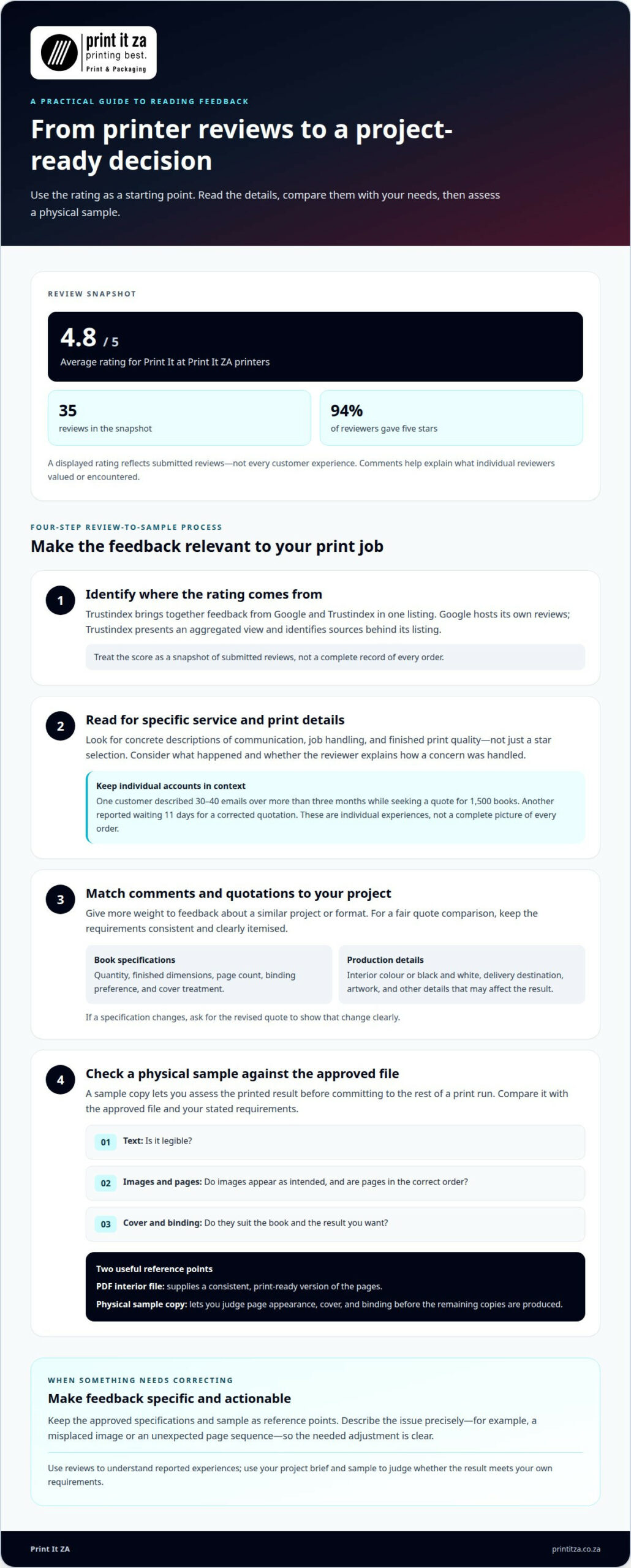
Over 35 reviews so far gives readers a useful starting point when assessing Print It ZA. Print It at Print It ZA printers has an average rating of 4.8 out of 5, with 94% of reviewers giving five stars. Those figures offer a snapshot, but customer comments also help show what people say about service and print quality.
Choosing a printer means looking beyond a rating to the details that matter for your project. This article explains how the overall score relates to the review count, summarises reported customer experiences, and covers how to request a printed sample before proceeding with a larger print run. You’ll get a clearer picture of what the feedback can tell you, and what to consider when judging whether a sample meets your expectations.
Key Takeaways
- Look beyond star ratings to understand what customer comments say about service and print quality.
- Learn how the overall review rating is assessed and what it can tell you about customer experiences.
- See why a printed sample can help you evaluate a book before committing to a larger print run.
- Find out where Print It ZA operates in South Africa and how to enquire about placing a print order.
- Explore how professional book printing can support your project from files to finished copies.
Customer experiences with service and print quality
For a useful comparison, make sure the quote reflects the same project requirements throughout. A book-printing brief should specify the quantity, finished dimensions, page count, binding preference, cover treatment, and whether the interior is in colour or black and white. Include the delivery destination and any artwork or production details that could affect the finished result. If a specification changes, ask for the revised quote to reflect it clearly.
Print quality depends on more than a general promise of a professional finish. The result reflects how files translate to printed pages and how the paper, binding, and cover work together. Supply print-ready artwork as a PDF and specify the paper, colour, and finishing requirements in your brief. For a text-led novel, black-and-white printing may suit the interior; a book with colour illustrations may need colour printing. Choose based on the content and the result you want.
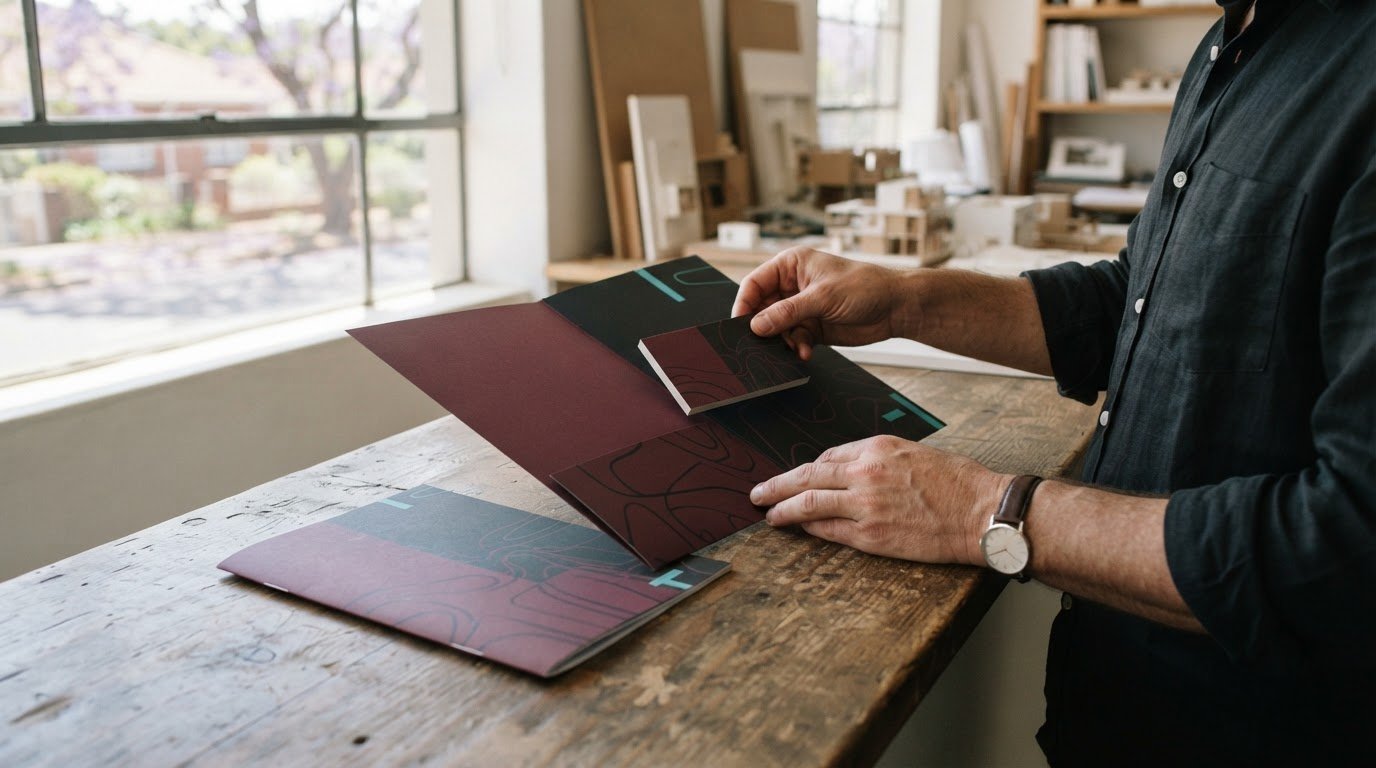
A printed sample gives you a tangible way to assess a book before committing to the rest of a print run. Request a sample copy and compare it with the approved file. Check that the text is legible, images appear as intended, pages are in the correct order, and the cover and binding suit the book. A sample is especially useful when colour reproduction, image detail, or the feel of the finished format matters to your decision.
Two practical tools support that review:
- PDF interior file: Useful for supplying a consistent, print-ready version of the book pages.
- Physical sample copy: Useful for judging the printed result, including page appearance, cover, and binding, before the remaining copies are produced.
Keep the approved specifications and sample as reference points when discussing corrections. If the sample differs from the intended layout, describe the issue precisely, such as a misplaced image or an unexpected page sequence. Specific examples make feedback actionable and help identify the adjustment needed. This also gives you a clear basis for assessing communication and print quality against your project’s requirements.
Overall review rating
A star average condenses many individual opinions into one figure, so it cannot explain what each reviewer valued. If you’re considering Print It at Print It ZA printers, comments offer more detail about the experiences behind the overall rating. Look for specific descriptions of communication, job handling, and finished print quality rather than relying on a score alone.
Trustindex brings together feedback from Google and Trustindex in one listing. This provides an aggregated view, while comments on each platform offer more context. The displayed rating reflects submitted reviews, not every customer experience. Read the comments to see what reviewers chose to mention and whether those details relate to your project.
Use a simple three-step reading process to make a rating more useful:
- Identify the platform: Note where the review appears and whether the listing combines sources.
- Read the comments: Look for concrete details about service and the finished print.
- Match feedback to your needs: Give more weight to comments about a similar project or format.
A star selection offers little explanation on its own. A comment describing clear communication, for example, tells you what that reviewer appreciated. A detailed account of a production concern offers different information. These are individual perspectives, so use them to understand the feedback, not as a promise about another order.
Google and Trustindex provide ways to explore customer feedback. Google hosts its own reviews, while Trustindex offers an aggregated view and identifies the sources behind its listing. Reading comments across both can show the range of topics people discuss. Look for reviews that explain their ratings with relevant details.
Specific wording can help distinguish personal preference from a practical concern. A reviewer’s preference for a particular finish may not apply to every project. A comment that describes an issue with the printed result gives more context about that experience. Consider what happened and whether the comment explains how it was handled.
Repeated wording alone does not establish a pattern. Compare what comments actually say and whether they relate to similar kinds of work. Feedback about different formats may reflect different requirements. Keeping your project priorities in mind makes it easier to interpret comments about Print It at Print It ZA printers without treating every review as equally relevant.
Before drawing a conclusion, note the aspects of service that matter most to you, such as communication or the finished result. Then look for comments that speak directly to those priorities. This makes review platforms more useful as a practical reference. You can also review print project information while considering your requirements.
What is Print It ZA and its South African locations?
The business is based in South Africa, with Johannesburg, Gauteng, as the relevant local market for this article. That places the topic in a city where businesses, authors, and organisations may need printed materials for local audiences. The location helps readers understand the regional context, but it shouldn’t be read as evidence of several branches. For a project, distinguish the company’s South African base from the place where finished copies need to go.
Johannesburg is a useful local reference when planning a print project in Gauteng. A customer elsewhere in Gauteng may have different delivery needs from one sending copies to another district. Include the final destination in your brief, whether it is a Johannesburg office, a school, or an event venue. Print It ZA print and packaging serves Johannesburg, Pretoria, Sandton, Randburg, Roodepoort, Fourways, Edenvale, Germiston, Boksburg, Benoni, Krugersdorp, Carlswald, and across the Gauteng region.
Include the destination, the person receiving the order, and any relevant access instructions in your production brief. For example, copies intended for a Johannesburg event venue should be directed to the correct receiving point, not simply labelled “Johannesburg.” Clear details help distinguish production requirements from delivery arrangements.
For Gauteng customers, geography is one part of deciding how to plan a print project. The format, quantity, artwork, and delivery destination also shape the job. A Gauteng-based organisation might be preparing materials for colleagues locally, while an author may need copies sent to a particular regional address. In both cases, a precise specification makes the project easier to define before production begins.
Use location tools for practical planning, not as proof of a company’s operating footprint. Google Maps can help you understand the relationship between Johannesburg and a destination within Gauteng. A route view can also help you think through access or collection logistics once you have the relevant address. It cannot establish where production takes place or whether a business has additional sites, so keep those questions separate from map-based travel planning.
A straightforward way to organise the location details is to separate the project into three parts:
- Production context: Identify the Gauteng market and the Johannesburg focus.
- Destination: Write the complete delivery or receiving location, such as a named office or event venue.
- Handover needs: Note who should receive the finished job and any useful access instructions.
This distinction is useful for projects serving local audiences. For example, a Gauteng organisation might need printed materials delivered to a specific branch within the province. Describe the print job in the production brief and specify where the copies need to go in the delivery details. This helps ensure that a Johannesburg location is not mistaken for the destination of every project.
For prospective customers in Johannesburg, Gauteng, the clearest takeaway is to consider both the local context and the actual receiving address. A South African base makes the regional setting clear; the destination details determine the practical requirements for each job. That gives you a more accurate starting point for discussing a project without assuming that every customer has the same location or handover needs.
How can customers contact Print It ZA or place a printer order?
A clear enquiry is the practical starting point for a printing order. Request a quote online or by phone, and describe the job and its intended destination. Include the item, quantity, finished dimensions, page count where relevant, paper preference, and binding requirements. For a book, distinguish the interior from the cover and state your preferred format.
Specific information helps the production team understand the scope before preparing a quotation. For brochures, describe the finished size, page count, colour requirements, and whether folding is needed. For a book, note whether you’re considering a hard cover or paperback. These details give your enquiry a defined starting point without assuming that two projects have identical specifications.
A project brief helps gather the details in one place. Keep the specifications together rather than spreading them across separate messages. Record the item, quantity, dimensions, page count, artwork status, finishing preferences, and delivery destination. For instance, a Johannesburg business planning a launch can name the event venue as the destination and list the materials needed there.
Attach or describe the artwork status clearly. Explain whether files are ready, still being prepared, or need design development. If you’re sending several files, name them so the cover and interior can be distinguished easily. A file list or spreadsheet can help keep versions organised, especially when a team is supplying artwork and approving the same project.
Once the requirements are clear, review the quotation against your brief. Confirm that the item, quantity, dimensions, finishes, and delivery destination match the request. If you’ve changed a specification, make sure the updated quote reflects it. This helps prevent an earlier version of the project from being mistaken for the final instruction.
Before approving production, make sure the decision-maker has reviewed the artwork and specifications. A named approver can help coordinate feedback across a business, school, or publishing team. Consolidate corrections into one response where possible. For example, list a requested cover adjustment and any page changes together rather than sending separate instructions from several team members.
Use a straightforward sequence to move from enquiry to order:
- Describe the job: State the item, quantity, dimensions, and intended use.
- Provide project information: Share artwork status, finishing preferences, and the South African delivery destination.
- Review the quotation: Compare its specifications with your submitted brief.
- Approve the final details: Keep the approved version and instructions together for the project.
A checklist is another useful tool for preventing omissions. Before sending your enquiry, make sure it covers the product format, quantity, finished size in mm, artwork, finishing, and destination. A spreadsheet is helpful when an order includes several items, such as a book alongside brochures. Separate rows let you describe each item without blending its specifications with another job.
For a project in Johannesburg or elsewhere in South Africa, state the receiving address and any relevant handover instructions in the enquiry. Clear information helps align the print brief with the intended delivery. Start your print enquiry with the project details and specifications gathered in one place.
Authors are advised to request a paid sample copy of their printed book before ordering the rest of the print run. Treat that sample request as a step to consider before committing to the remaining copies. It keeps the decision about the larger order separate from the initial enquiry and quotation, while giving the author a specific point at which to pause and consider the project. Include the sample request in the book-order discussion, alongside the details already gathered for the job. Once the author has considered the sample, the next decision can focus on whether to proceed with the rest of the print run. This advice is particularly relevant when planning a book order.
Print It ZA print and packaging: Book printers
Print It ZA prints books in-house, with no outsourcing of design, printing, or binding. Authors and organisations can also order catalogues, booklets and brochures, useful when a project needs printed materials alongside books. Print It ZA uses litho and digital printing, with customisation options for paper, colour, finishing, sizes, layouts, covers, and binding styles.
Bring your project requirements together, including the format, artwork, quantity, and delivery destination. These details help shape a clear brief for discussing the finished result. If you’re preparing a book and want to explore professional printing, Print It ZA print and packaging can help you move from project requirements to a print order.
Contact Print It ZA print and packaging to discuss your book printing project.
Turn your print plans into a clear brief
Your next step is to shape the project around the result you need. Decide who will use the finished material, where it will be seen, and what it must communicate. A book for readers, a catalogue for customers, and a brochure for an event each call for a different focus. Clear priorities help turn an idea into a production brief with a defined purpose.
If you’re considering Print It at Print It ZA printers, bring together your artwork, format preferences, quantity, paper preference, binding requirements, and delivery details. These choices give the conversation a practical starting point for books, catalogues, or brochures. Request a quote online or by phone to discuss your project and plan the next step.
Take the next step when you’re ready to discuss your requirements. Contact Print It ZA print and packaging to start shaping a print project that fits your goals. A thoughtful brief puts your vision in focus and helps move the work forward.
Frequently Asked Questions
How many reviews does Print It ZA have?
The count depends on the review platform: Trustindex lists over 35 positive reviews collected and growing from Google and Trustindex, while Print It ZA’s website displays 8 Google reviews. These figures refer to different listings, so read each count alongside its platform and the individual comments. For a useful comparison, focus on feedback that relates to your project type and the specific service details reviewers describe.
Contact Print It ZA today, for a Free Quote and Speedy Service.
Print It at Print It ZA print and packaging, South Africa/ ZA.
Print It ZA, we deliver Printing Best!