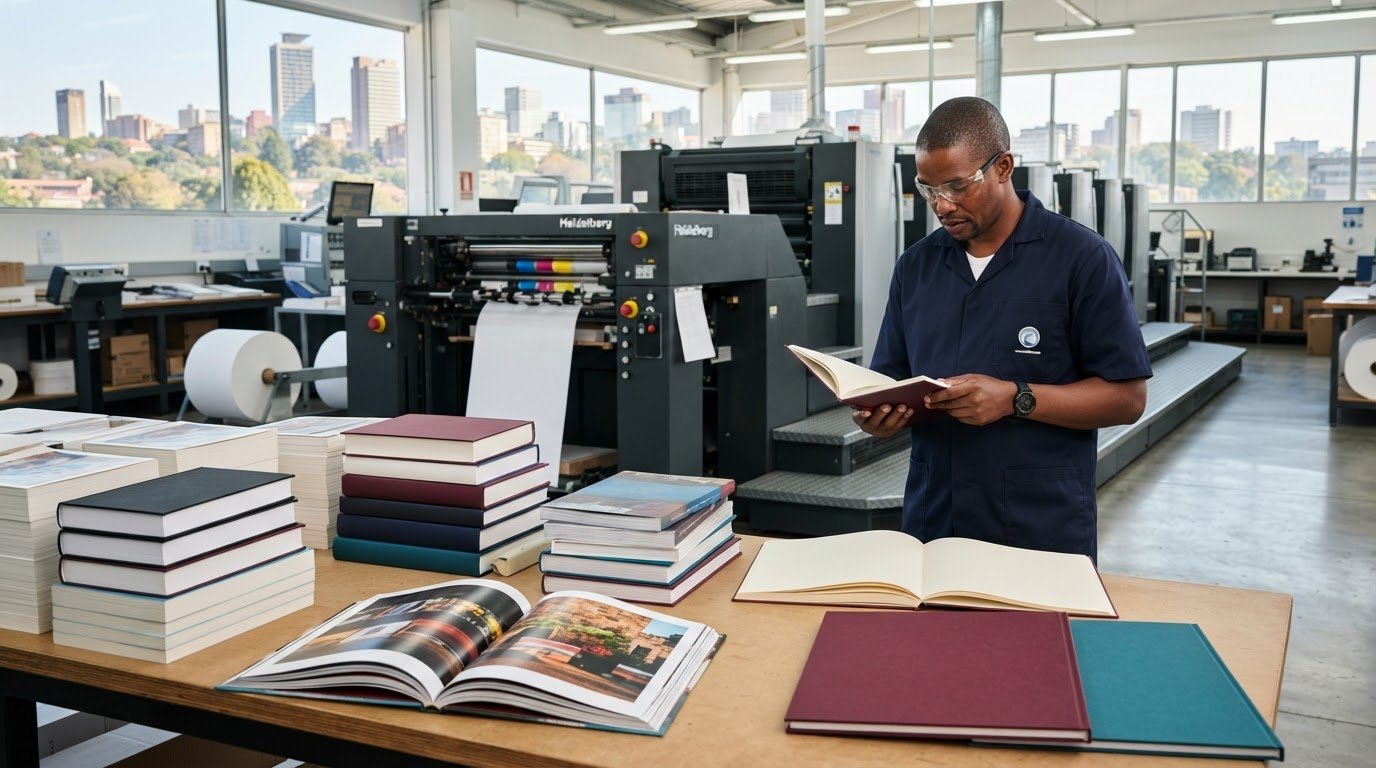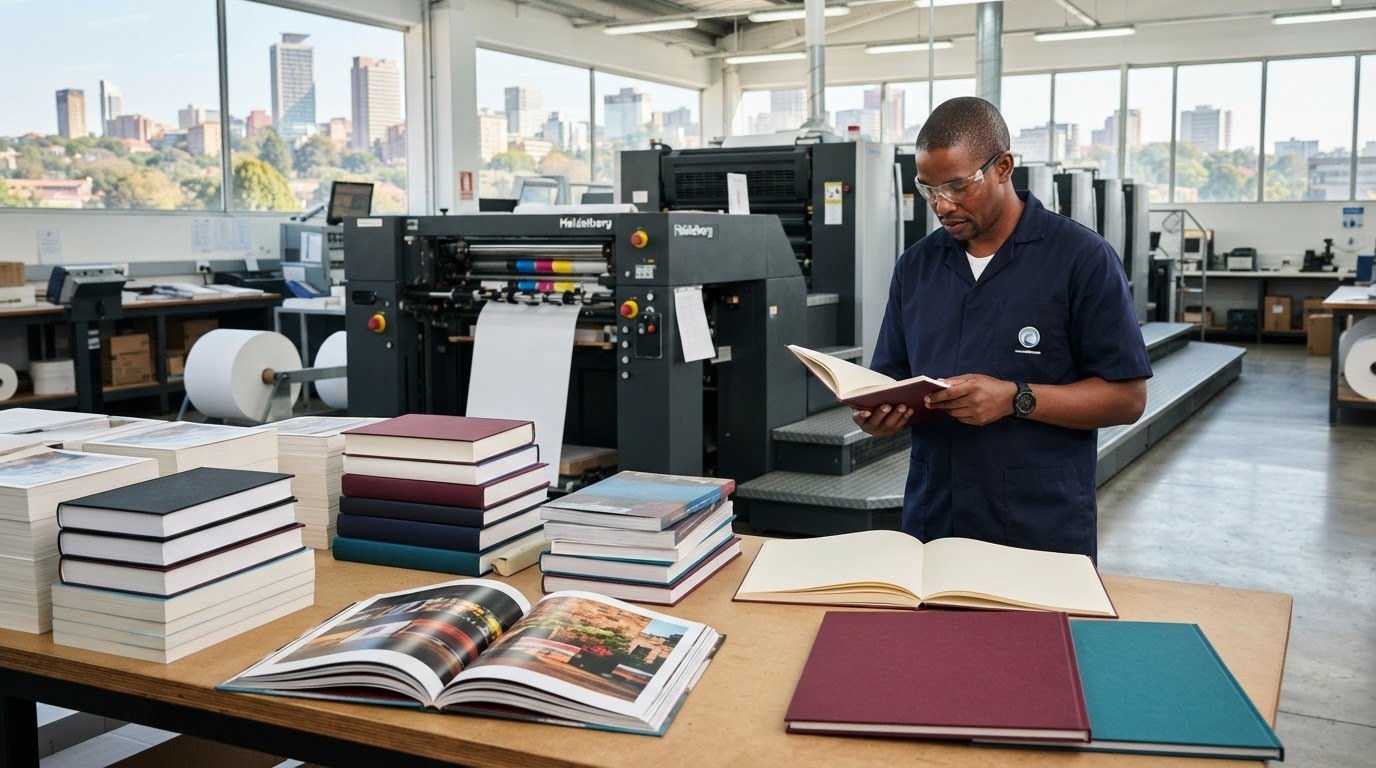
Did you know the global colouring book market is projected to hit $5.1 billion? While the opportunity is massive, many South African creators feel stuck between high setup costs for small local runs and the expensive international shipping fees from platforms like Amazon KDP. You want your designs on high-quality paper that won’t bleed, but finding a reliable partner for colouring book printing low volume shouldn’t feel like an impossible task.
It’s frustrating when international services limit you to thin 90 GSM stocks that can’t handle the markers and pencils your customers love. You deserve a professional finish that feels bookstore-ready without the hefty upfront investment of traditional litho printing. We believe every local artist should have access to premium results, regardless of their order size.
This guide shows you exactly how to print professional, short-run colouring books in South Africa without the high upfront costs. We’ll cover the best paper choices for local stationery, the importance of single-sided pages trends, and how to secure a fast turnaround in Johannesburg. Let’s turn your creative vision into a high-quality product that’s ready for the shelf.
Key Takeaways
- Learn why the sweet spot of 20 to 500 copies makes colouring book printing low volume a profitable and flexible reality for local artists.
- Discover how to select the ideal paper weight (GSM) to ensure your pages handle markers and pencils without inflating your production costs.
- Identify the break-even point between digital and litho printing to choose the most cost-effective method for your specific run size.
- Master essential file preparation steps, from setting correct bleeds to optimizing rich blacks, for crisp and professional line art.
- Streamline your production timeline with expert local support and fast turnaround times from our 24/7 printing facility in Midrand.
Table of Contents
The Rise of Low-Volume Colouring Book Printing
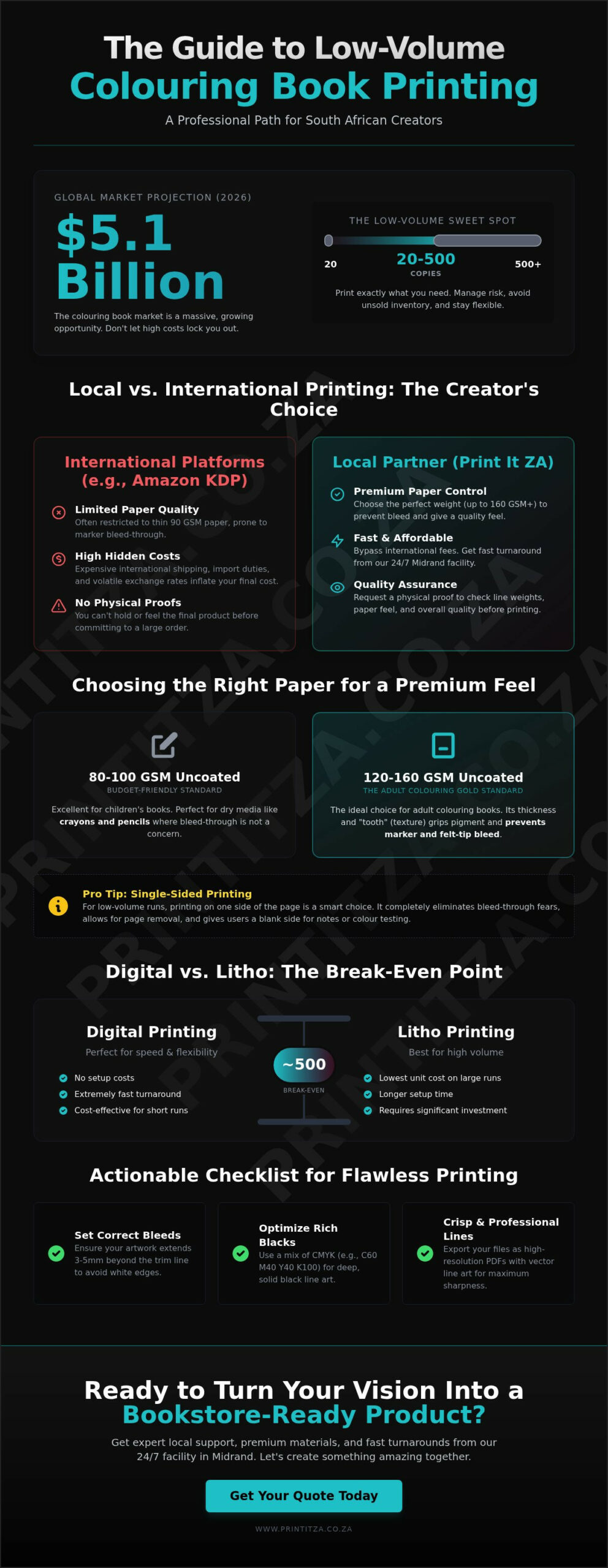
Publishing has evolved rapidly over the last few years. The global colouring book market is projected to reach a staggering $5.1 billion in 2026, proving that this isn’t just a passing trend. For South African creators, the traditional model of printing thousands of copies just to make the unit price viable is officially a thing of the past. Modern digital technology has changed the game, allowing for professional results on a much smaller scale.
We define the new "sweet spot" as runs between 20 and 500 copies. This range offers the perfect balance of affordability and risk management. Instead of filling a garage with unsold inventory, you can print exactly what you need for a specific launch or market. Looking back at the history of the printing press, it’s remarkable to see how we’ve moved from massive, static machines to agile digital systems that can swap designs in seconds. This flexibility makes colouring book printing low volume the most practical choice for authors who want to stay lean and responsive.
Many local artists are now moving away from international platforms like Amazon KDP or Lulu. While those services offer global reach, they often restrict you to 90 GSM paper, which is too thin for the high-quality markers and pencils many enthusiasts prefer. By choosing a local partner, you gain control over the tactile experience of your book. You can test a niche, like the rapidly growing grayscale photo colouring market, with a small batch before committing to a larger run.
Who is Short-Run Printing For?
Indie illustrators are leading the charge, creating bespoke books to sell at local Gauteng markets or through their own online stores. Corporate brands in Johannesburg are also jumping in, using custom colouring books as unique, high-end promotional gifts that offer more value than a standard flyer. Additionally, educational institutions in Pretoria and beyond use short runs to produce custom workbooks tailored to specific classroom curricula, ensuring students have the exact tools they need.
The "Print Local" Advantage in South Africa
Choosing to print locally in South Africa means you bypass the headache of high import duties and the uncertainty of volatile exchange rates. International shipping fees can often exceed the production cost of the books themselves. When you work with a facility in Midrand, you benefit from fast turnaround times and the ability to request a physical proof. There’s no substitute for holding a finished copy in your hands to check the line weights and paper feel before the final run begins.
Selecting the Best Paper and Binding for Colouring
Paper is the most critical decision you’ll make for your project. It dictates the entire user experience. If the paper is too smooth, coloured pencils will slide across the surface without leaving enough pigment. If it’s too thin, markers will bleed through and ruin the next design. For colouring book printing low volume, you have the advantage of choosing premium stocks that international print-on-demand services often can’t provide. You want a paper with "tooth" or texture. This microscopic roughness allows pencils and crayons to grip the page, resulting in vibrant, rich colours that your customers will appreciate.
When deciding on your production specs, it helps to understand the technical differences between digital vs. offset printing, as modern digital machines are now highly compatible with a wide range of uncoated textured stocks. This compatibility is what makes short runs so professional. You aren’t stuck with "standard" office paper. You can choose a stock that feels substantial and premium, elevating your work from a simple activity book to a high-end creative journal.
Recommended Paper Stocks for ZA Creators
For budget-friendly projects, especially children’s books meant for crayons or pencils, 80gsm to 100gsm uncoated white paper works well. However, if you’re targeting the adult colouring market where felt-tips and markers are popular, 120gsm to 160gsm is the gold standard. These heavier weights significantly reduce bleed-through. A smart tactic for low-volume books is to use single-sided printing. This allows artists to use heavy ink without fear, and it provides a "blank" back page for notes or testing colours. If you’re unsure which stock suits your specific illustrations, you can chat with the team at Print It ZA to discuss your project needs.
Binding Options for Small Batches
The way your book stays together matters as much as the paper inside. Saddle stitching is excellent for thin books under 40 pages; it’s cost-effective and allows the book to open relatively flat. Perfect binding is the choice for a "bookstore-ready" look, providing a clean, printable spine that looks great on a shelf. For the ultimate user experience, consider wiro or spiral binding. It’s the gold standard for colouring because it allows the book to lay perfectly flat on a table, giving the artist full access to the inner margins without fighting the spine.
Digital vs. Litho: Which is Better for Low Volume?
Choosing the right technology is about more than just ink on paper. It’s about financial agility. While many online forums suggest lithographic (offset) printing is the only way to get a low unit price, they often overlook the massive setup hurdles. For colouring book printing low volume, digital is the undisputed champion. It eliminates the need for expensive aluminium plates, which can cost thousands before a single page is even printed. This means your initial investment stays focused on the quality of the paper and ink for your coloring book rather than industrial setup fees.
The "break-even" point is where the math shifts. Generally, for runs under 500 copies, digital printing offers the best value. Digital presses work much like high-end office printers but on a massive, industrial scale. They don’t require hours of calibration or plate making. You get consistent, crisp blacks and sharp line art from the first copy to the last. This consistency is vital for colouring books, where a faded line can ruin the experience for the end user.
The Digital Printing Process Explained
Digital technology allows for "versioned" printing. Imagine you’re launching a series of books for different Johannesburg neighbourhoods. You can print 20 copies with a Soweto-themed cover and 20 with a Sandton-themed cover in the same run without extra setup costs. It’s incredibly efficient. The speed advantage is also significant. While litho might take weeks due to scheduling and plate prep, digital projects can often move from file upload to finished book in just a few days. It’s a more eco-friendly choice for small South African businesses too, as it produces far less chemical waste and paper scrap during the setup phase.
Cost Comparison for Gauteng Creators
When you’re an indie creator in Gauteng, cash flow is everything. Starting with a small digital run of 50 copies allows you to test the market at a local market or via social media. You don’t have to worry about the high unit price typically associated with small orders because you’ve saved so much on setup. As your brand grows and you need to scale up to 1,000 copies or more, that’s when litho starts to make sense. For those ready to make that jump, exploring professional printing services in Johannesburg will help you understand how to transition from short-run digital to high-volume lithographic production effectively.
Actionable Checklist: Prepping Your Files for the Press
The transition from a digital canvas to a physical page is a technical journey. Even the most beautiful illustrations can lose their impact if the file isn’t optimized for the press. When handling colouring book printing low volume, the goal is to eliminate any technical friction that could lead to costly reprints. Johannesburg printers expect specific markers in your PDF to ensure the final product matches your vision perfectly. Start by setting up your document with a 3mm bleed on all sides. This ensures that your art extends to the very edge of the page after the final trim without leaving white gaps.
Line art optimization is your next step. You want your blacks to be "rich" and crisp. On a screen, black always looks dark, but in print, a simple 100% K (black) ink can sometimes look like a very dark charcoal. For high-impact areas like your cover, using a rich black formula adds depth and a premium feel. For the interior pages, focus on keeping your lines sharp and solid. This prevents the "greyed out" look that can happen with lower-quality digital settings. Your cover design also needs to be high-impact; a bookstore-ready finish often features a high-gloss or soft-touch laminate to protect the book from shelf wear during handling.
Technical Specifications for Success
A 300 DPI resolution is the non-negotiable standard for professional results. Anything less will produce jagged, blurry lines that frustrate your customers. You must also convert your files from RGB to CMYK. Screens use light to create colour, but local presses use ink. Converting early prevents unexpected colour shifts during production. Don’t overlook the "gutter" allowance. This is the extra space on the inner margin. If your gutter is too small, your art will disappear into the spine, making it impossible for someone to colour the entire image comfortably without breaking the book’s back.
Final Review and Proofing
Your page count is a critical technical detail. Most professional binding styles require your total page count to be a multiple of four. If your count is off, you might end up with unexpected blank pages at the back of your book. We always suggest reviewing a physical proof rather than relying solely on a digital one. A physical proof allows you to check the line weight consistency and see how the paper handles your specific designs. It’s the only way to be 100% sure the product is ready for your customers. If you’re ready to move from screen to shelf, you can contact Print It ZA to discuss your file setup and get your project started.
Print It ZA: Your 24/7 Printing Partner in Midrand
Success in the creative market requires a partner that works as hard as you do. Our 24/7 facility in Midrand is built to support your ambition, providing a reliable hub where your ideas become physical products. We specialize in colouring book printing low volume, ensuring that independent creators don’t get sidelined by massive minimum order requirements. We bridge the gap between your digital files and a bookstore-ready finish, treating every self-publisher with the same respect as a large corporate account. Your vision deserves a professional output that feels premium to the touch.
While we’re rooted in the heart of Gauteng, our reach extends far beyond the Midrand corridor. We offer efficient nationwide delivery to ensure your books reach your customers, whether they’re in Cape Town, Durban, or a small town in the Free State. We understand that your reputation as an artist depends on the quality we deliver. That’s why we maintain high standards for every page, ensuring the blacks are deep and the paper texture is exactly what you requested. We’re here to make the transition from a digital file to a retail-ready book as seamless as possible.
End-to-End Support in Johannesburg
We provide more than just ink on paper. Our team offers in-house design assistance to help you polish your colouring book layout, ensuring your margins and bleeds are press-ready. One of our core strengths is flexibility. We love helping local brands grow; you can start with 10 copies for a small launch and scale up as your fan base expands. When you’re ready to move beyond short runs, we also offer high-volume book printing services to handle your growth. We’re committed to being your creative partner at every stage of your journey.
Getting Your Custom Quote
Getting an accurate quote for a low-volume project is simple and transparent. To help us provide the best value, please have your page count, desired paper weight, and binding style ready. We pride ourselves on transparency in pricing. Unlike traditional litho methods, our digital runs don’t carry hidden "setup" fees that eat into your margins. This clarity allows you to price your books competitively while still making a healthy profit. We invite you to contact our team for a collaborative consultation. Let’s discuss how we can bring your 2026 colouring book project to life with the speed and precision your work deserves.
Ready to Bring Your Designs to Life?
The landscape for local creators has never been more promising. By embracing digital technology and focusing on high-quality paper stocks, you can bypass the risks of bulk inventory and the high costs of international shipping. Success in 2026 is about being agile. Whether you’re testing a niche grayscale project or launching a custom corporate gift, colouring book printing low volume provides the flexibility you need to grow at your own pace.
Our 24/7 operational printing facility in Midrand is equipped to handle every step of the process. We provide end-to-end design and distribution support, ensuring your work meets the highest South African quality standards. You don’t have to navigate technical hurdles alone when you have a reliable creative partner by your side. It’s time to stop dreaming and start publishing.
Start your short-run colouring book project with Print It ZA today and turn your illustrations into a professional, bookstore-ready reality. We’re excited to help you make your mark on the shelf.
Frequently Asked Questions
What is considered a "low volume" order for colouring books?
A low volume order typically ranges from 20 to 500 copies. This range is the sweet spot for digital printing, where you can avoid the heavy setup costs of traditional litho plates. It’s the perfect batch size for testing a new niche or selling at local Gauteng markets without the risk of holding too much inventory.
What is the best paper weight (GSM) for an adult colouring book?
We recommend using between 90gsm to 160gsm uncoated stock for adult colouring books. These heavier weights are essential for preventing marker bleed-through and provide a professional feel. The natural texture of this paper also offers the "tooth" that coloured pencils need to grip the page effectively.
Can I print just one copy of my colouring book as a sample?
Yes, we provide physical proofs so you can see exactly how your book looks before the full run. Holding a "wet" proof is the best way to check your line weights and ensure the paper handles your chosen colouring tools. It’s a vital step for any creator who wants a bookstore-ready result.
How long does it take to print a short run of books in Johannesburg?
Most short-run projects are completed within a few business days once your files are approved. Because our print facility in Midrand operates 24/7, we can offer much faster turnaround times than international platforms. You’ll save weeks of waiting for shipping and avoid the headache of customs delays.
Do I need to provide my own ISBN for a small batch of colouring books?
You don’t strictly need an ISBN if you’re selling directly to fans or at craft markets. However, if you plan to sell your work through major South African retailers, an ISBN is required for their tracking systems. You can apply for one through the National Library of South Africa if you intend to go the formal retail route.
Which binding is best if I want the book to stay open while colouring?
Wiro or spiral binding is the gold standard for books that need to lay perfectly flat. This binding allows for 360-degree rotation, making it much easier for artists to reach every corner of your designs. It’s an incredibly popular choice for colouring book printing low volume projects because of its practical, user-friendly nature.
Does Print It ZA deliver colouring books outside of Gauteng?
We offer nationwide delivery to all corners of South Africa. While we’re based in the Midrand and Johannesburg corridor, we regularly ship professional print projects to creators in Cape Town, Durban, and beyond. We ensure your books are packaged securely to arrive in pristine condition.
Is digital printing lower quality than litho for line art?
Modern digital presses produce exceptionally crisp and sharp line art that rivals traditional litho quality. You’ll get deep, rich blacks and precise details without the high setup fees associated with plate-making. This makes digital the superior choice for keeping your colouring book printing low volume project both affordable and professional.
Contact Print It ZA today, for a Free Quote and Speedy Service.
Print It ZA print and packaging, we deliver Printing Best!