
Your print brokers aren’t shielding your enterprise budget from market volatility; they’re quietly inflating it with opaque markups while scattering your brand collateral across fragmented third parties. Streamlining corporate print procurement shouldn’t mean fighting rogue branch spending, enduring mismatched color reproduction across executive annual reports, or explaining delayed rollouts to stakeholders. You already know how fast decentralized ordering eats into departmental margins, creates operational headaches, and dilutes hard-earned brand consistency across nationwide locations.
It’s entirely possible to transform this chaotic channel into a lean, predictable commercial advantage. In this guide, you’ll master enterprise print procurement strategies that eliminate supply waste, strip out unnecessary broker fees, and secure reliable high-volume output with transparent, volume-tiered cost structures. We’ll explore how shifting to direct manufacturing partnerships, enforcing rigorous color governance across books, retail packaging, and brochures, and establishing synchronized distribution logistics can give your team complete operational control over every print run.
Key Takeaways
- Consolidate departmental spend and eliminate rogue purchasing by transforming corporate print procurement into a centralized, value-driven operational strategy.
- Bypass hidden middleman markups and agency commissions by transitioning from print brokers directly to dedicated commercial manufacturing partners.
- Implement a standardized five-step framework to audit enterprise inventory, unify print specifications, and enforce uncompromising color governance.
- Protect collateral schedules against regional transport bottlenecks and material shortages through integrated warehousing and scheduled nationwide distribution.
- Leverage dedicated 24/7 manufacturing capacity to guarantee reliable turnaround times for high-volume books, catalogues, annual reports, and retail packaging.
What Is Corporate Print Procurement and Why Does Strategy Matter?
At enterprise scale, corporate print procurement is the disciplined practice of treating print as a structured supply chain rather than an administrative afterthought. Instead of reacting to disconnected order requests across separate business units, forward-thinking organizations apply strategic sourcing principles to plan, manufacture, and distribute their critical assets. These tangible assets span high-stakes investor annual reports, customer-facing brochures, retail packaging, product catalogues, and internal training manuals. Without an overarching plan, print buying defaults to chaotic, branch-level ordering that quietly drains budgets, dilutes executive presentation standards, and inflates corporate expenditure.
Core Components of Enterprise Print Sourcing
Strategic print sourcing rests on three operational pillars that turn unpredictable print runs into measurable cost savings:
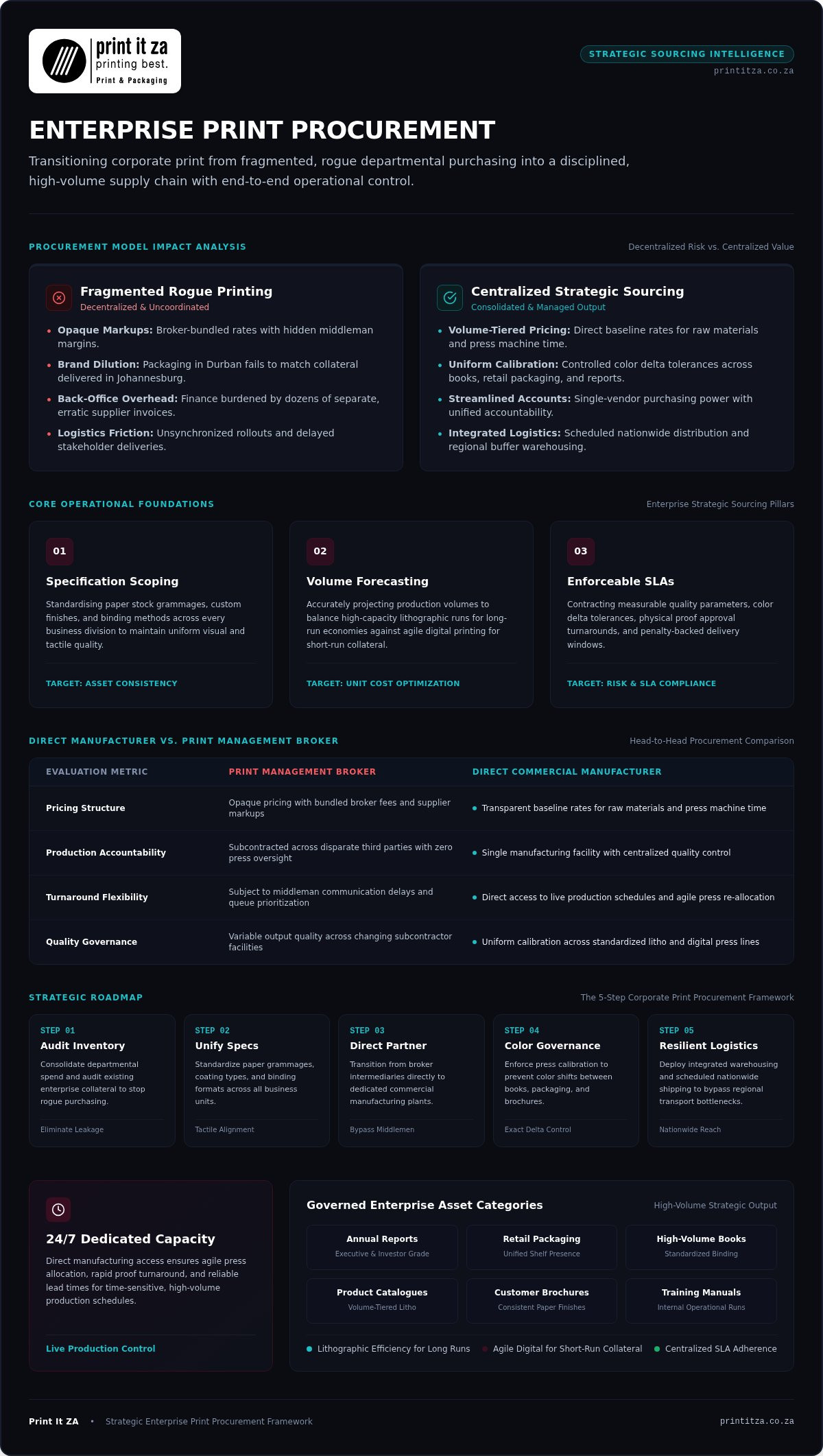
- Specification scoping: Standardising paper stock grammages, custom finishes, and binding methods across every business division to maintain uniform tactile and visual quality.
- Volume forecasting: Calculating production thresholds accurately to balance high-capacity lithographic runs for long-run cost efficiency against agile digital printing for short-run, time-sensitive collateral.
- Enforceable Service Level Agreements (SLAs): Contracting clear quality standards, color delta tolerances, physical proof turnarounds, and penalty-backed delivery windows.
The True Cost of Fragmented Rogue Printing
When individual branches or marketing teams independently hire local suppliers, the hidden costs add up quickly. Rogue spending scatters buying power across disparate suppliers who lack enterprise accountability. The result is jarring color variation, where corporate packaging in Durban fails to match collateral delivered in Johannesburg, weakening brand integrity at the customer touchpoint. Decentralization also burdens back-office operations. Finance teams end up processing dozens of separate invoices, managing erratic supplier markups, and untangling delivery delays that a centralized corporate print procurement strategy eliminates entirely.
Print Manufacturer vs. Print Broker: Sourcing Models Compared
When structuring your corporate print procurement model, choosing between a print management broker and a direct commercial printer dictates both your bottom line and production agility. Brokers act as intermediaries. They outsource your orders across a fragmented network of third-party facilities, tacking on administrative margins while filtering your project requirements through account managers. Direct manufacturers, conversely, produce your collateral under one roof. They give procurement teams direct control over the physical press equipment, scheduling, and ink reproduction.
The structural trade-offs between both sourcing models directly affect day-to-day enterprise operations:
| Evaluation Metric | Print Management Broker | Direct Commercial Manufacturer |
|---|---|---|
| Pricing Structure | Opaque pricing with bundled broker fees and supplier markups | Transparent baseline rates for raw materials and press machine time |
| Production Accountability | Subcontracted across disparate third parties with zero press oversight | Single manufacturing facility with centralized quality control |
| Turnaround Flexibility | Subject to middleman communication delays and queue prioritization | Direct access to live production schedules and agile press re-allocation |
| Quality Governance | Variable output quality across changing subcontractor facilities | Uniform calibration across standardized litho and digital press lines |
Financial Transparency and Margin Preservation
Broker agreements often conceal variable markups inside blended rate cards. Every manual, catalogue, or packaging run carries an extra layer of commission that inflates operational spending without adding tangible value to the final product. Direct commercial partnerships strip away these middleman commissions entirely. By sourcing straight from the press floor, your procurement team gains clear visibility into substrate costs, finishing operations, and volume breaks. Purchasing at factory scale unlocks volume-tiered economies that keep large-format collateral and regular print runs cost-effective.
Production Accountability, Lead Times, and Press Approvals
Technical communication falters when passed through an external agency. When an urgent layout fix or custom PMS adjustment is required for critical collateral, brokers have to relay those details down the supply chain, losing valuable press time. In contrast, direct collaboration allows brand managers to conduct physical press checks, review wet proofs, and speak directly with the master press operators running the equipment. Partnering directly with specialized professional printing services eliminates miscommunication and guarantees rapid turnarounds on every production run. If you’re reviewing your current supplier margins, exploring a direct partnership with Print It ZA can help simplify your supply chain while preserving production standards.
The 5-Step Corporate Print Procurement Framework
Transforming corporate print procurement from an erratic expense into a predictable operational advantage requires a disciplined methodology. Enterprise teams don’t need theoretical models; they need an actionable framework that audits usage, standardizes assets, aligns press technology, and locks in supplier accountability. Following a systematic process ensures every rand spent delivers measurable commercial value.
Step 1 & 2: Spend Auditing and Specification Rationalisation
Start with a forensic audit across every business division. Track down historical order spikes, tally obsolete collateral gathering dust in regional stockrooms, and flag unapproved vendor invoices. Once you’ve mapped your actual consumption, rationalize your print specifications. Standardizing your paper grammages, sheet sizes, and custom coatings across regular print runs unlocks bulk raw-material purchasing tiers. Consolidating disparate branch marketing collateral, training manuals, and product sheets into unified master templates also eliminates redundant prepress setup costs.
Step 3: Allocating Runs Between Litho and Digital Printing
Smart procurement matches each print asset to the most cost-effective manufacturing technology. Channel high-volume, static materials like retail packaging, product catalogues, corporate books, and investor annual reports to commercial litho presses to capture aggressive per-unit economies. Conversely, route time-sensitive collateral, short-run manuals, and variable marketing pieces to commercial digital presses for rapid turnaround. When balancing these methodologies, evaluating the pressroom capabilities of your prospective print shop ensures they can handle both heavy lithographic volume and agile digital cycles under one roof.
Step 4 & 5: Colour Governance Protocols and SLA Enforcement
Protecting enterprise brand equity across nationwide distribution networks requires uncompromising color governance. Mandate certified ISO color management protocols and signed hard-copy contract proofs before the main press run begins. This technical control guarantees that corporate spot colors remain identical across packaging runs, softcover books, and marketing brochures. Finally, enforce these benchmarks through rigorous Service Level Agreements. Codify delivery windows, kitting requirements, and clear return policies directly into your vendor contracts. Review performance scorecards quarterly to track delivery punctuality, waste reduction, and cumulative budget savings.
Supply Chain Resilience, Warehousing, and Nationwide Logistics
Producing pristine printed assets means very little if your delivery pipeline collapses before materials reach your branch network. In South Africa, strategic corporate print procurement must account for real operational friction points. Port congestion, global paper import delays, transport corridor bottlenecks, and municipal power interruptions can quickly derail rigid rollout schedules. Building real resilience into your print supply chain means shifting away from reactive, run-by-run freight toward integrated manufacturing, secure warehousing, and coordinated nationwide distribution.
Centralized Warehousing and Pick-Pack-Kit Fulfilment
Splitting high-volume production into smaller, frequent batches drives unit costs up and wastes valuable prepress time. A more efficient approach involves mass-producing core enterprise assets, such as annual reports, product manuals, training guides, and retail packaging, in a single run, then storing them in a secure, centralized facility. From there, collateral can be drawn down on a scheduled, just-in-time basis. Dedicated pick-pack-kit operations streamline multi-branch rollouts by collating marketing collateral, point-of-sale displays, and regional staff packs into tailored consignments. When high-volume boxed goods or specialized folding cartons are involved, working alongside experienced custom packaging manufacturers ensures your packaging integrates directly with your warehousing workflow without separate transit handoffs.
Mitigating Regional Operational Vulnerabilities
Local operating environments demand strict supplier due diligence before signing enterprise contracts. Ensure your print manufacturing partner maintains continuous operational readiness:
- Uninterrupted production capacity: Verify that the production facility utilizes industrial backup power generators and automated redundancies to keep heavy litho presses running 24/7 during grid outages.
- Strategic transport proximity: Sourcing from a central hub situated near major freight arteries like the N1 corridor in Gauteng simplifies road transit across Johannesburg, Pretoria, and regional hubs in Cape Town, Durban, and Gqeberha.
- Paper stock buffering: Work with partners that hold substantial rolling inventories of coated, uncoated, and packaging boards to insulate your corporate contracts against international supply chain delays and raw material pricing spikes.
If recurring distribution delays and disjointed storage vendors are draining your team’s resources, partner with Print It ZA to centralize your production, kitting, and nationwide fulfillment under one dependable roof.
Why Leading Enterprises Partner with Print It ZA for Print Procurement
Modern enterprises need a direct manufacturing partner that combines industrial-scale output with hands-on accountability. Established in 2005 and led by Managing Director Peter Gird, Print It ZA serves as a single-source commercial printing and packaging partner for South Africa’s leading businesses. Operating a round-the-clock manufacturing facility strategically located in Midrand, Gauteng, the company delivers uninterrupted production continuity. This local presence removes the logistical delays, communication gaps, and unchecked costs common when dealing through third-party brokers.
Industrial Capacity Meets Meticulous Quality Standards
Consolidating diverse print lines requires comprehensive press technology under one roof. Print It ZA pairs heavy-duty lithographic presses designed for high-capacity output with precision digital systems built for rapid turnarounds. The facility handles every production phase entirely in-house, including prepress checking, structural design, binding, die-cutting, lamination, and custom finishing. By managing the end-to-end manufacturing process directly, print runs maintain strict color accuracy across every deliverable, whether you’re producing investor annual reports, retail packaging, softcover books, product catalogues, or employee training manuals.
Seamless Onboarding for Enterprise Procurement Contracts
Restructuring your corporate print procurement doesn’t have to disrupt ongoing business operations. Print It ZA provides enterprise clients with dedicated account managers who conduct initial specification audits, identify volume consolidation opportunities, and map out quarterly manufacturing schedules. This structured approach aligns directly with corporate governance protocols, giving finance and marketing teams complete billing transparency, predictable lead times, and guaranteed quality. Partner with Print It ZA today to schedule an enterprise consultation and secure reliable, factory-direct manufacturing for your organization.
Take Control of Your Enterprise Print Strategy
Treating print as a strategic supply chain asset protects your brand equity, eliminates rogue expenditure, and delivers measurable balance-sheet efficiency. Moving away from opaque broker markups doesn’t just trim unnecessary fees; it puts your team back in full control of production timelines and output quality. By standardizing specifications, enforcing rigorous color governance, and centralizing warehouse distribution, you build an agile operation capable of weathering any regional supply disruption.
Achieving this level of consistency requires a manufacturing partner with proven industrial capacity. Backed by trusted commercial printing and packaging leadership since 2005, Print It ZA unites heavy litho, high-speed digital, specialty finishing, and nationwide logistics under one roof. Modernize your corporate print procurement with Print It ZA’s 24/7 Midrand facility to secure the scale, turnaround speed, and dependable quality your enterprise needs to thrive. When your print supply chain runs smoothly, your entire organization moves faster.
Frequently Asked Questions
What does a corporate print procurement contract typically include?
An enterprise print agreement establishes agreed baseline pricing for specified raw materials, machine press time, and finishing processes. It codifies enforceable Service Level Agreements covering proofing turnarounds, print run delivery windows, and certified color tolerances. Additionally, it details logistics terms, including off-site warehousing conditions, inventory drawdown procedures, and freight schedules to regional branch offices across South Africa.
How can our enterprise reduce print expenditure without sacrificing paper quality?
You can lower overall expenditure by standardizing paper stock grammages and finishes across all corporate departments. Ordering uniform stocks in bulk volume secures preferential paper mill pricing without compromising the tactile feel of your collateral. Rationalizing print collateral into combined litho runs and eliminating obsolete bespoke sheet sizes immediately reduces setup waste and trim losses.
Is it more cost-effective to use a print broker or contract directly with a printer?
Direct contracting with an established commercial manufacturer is significantly more cost-effective. Brokers add administrative margins and management markups to every invoice while outsourcing the actual printing to third parties. Contracting straight with a manufacturing facility gives you direct visibility into baseline press rates, eliminates agency markups, and provides immediate access to live press scheduling.
How do high-volume litho and digital printing complement a corporate procurement strategy?
Modern corporate print procurement uses both technologies strategically to balance unit economics with operational agility. Long-run publications like retail catalogues, annual reports, and standard packaging runs are assigned to high-speed litho presses to achieve the lowest per-unit production cost. Shorter, personalized runs, urgent branch collateral, and on-demand training manuals run on high-resolution digital presses without plate setup delays.
What happens if our corporate brand guidelines require specialized spot colors or finishes?
Direct manufacturing plants handle custom brand specifications in-house using precise ink mixing stations and specialized finishing machinery. Color technicians match Pantone formulas under standardized D50 lighting booths and provide certified physical contract proofs before production. Precision embellishments like spot UV varnishing, embossing, foil stamping, and custom die-cutting are executed on the press floor under single-source quality control.
Can Print It ZA manage nationwide distribution and bulk storage for our corporate print?
Yes, Print It ZA provides comprehensive warehousing, custom kitting, and nationwide distribution from our centralized Midrand production facility. We produce your high-volume annual collateral in cost-effective bulk runs, store it securely, and assemble multi-item branch packs as orders arise. Our logistics team coordinates scheduled despatches directly to offices and retail destinations across Gauteng and all major South African commercial centres.
How do we transition our existing decentralized print buying into a unified corporate contract?
The process starts with a historical spend audit to collect all active collateral specs, branch invoices, and order frequencies. Print It ZA’s account management team assists in rationalizing these materials into unified templates, identifying volume tier discounts, and establishing structured ordering protocols. This transitions your organization smoothly into an accountable corporate print procurement structure with clear approval limits and consolidated monthly billing.