
What if the biggest risk in a company-wide print project isn’t the press, but a brief that changes hands without anyone owning the next step? Managing print projects for a large company means coordinating teams, artwork, approvals and delivery details, often across different formats and locations. When departments follow different processes, small gaps can lead to avoidable revisions and last-minute production pressure.
You need a workflow that gives every project a clear starting point, accountable decision-makers and a reliable route to delivery. This guide covers how to build one, from setting the brief and controlling versions to confirming quantities, formats and delivery requirements. You’ll also learn how to reduce production surprises and assess whether internal coordination, project-by-project sourcing or an ongoing print partner suits your organisation.
Examples such as brochures, catalogues, annual reports and packaging make the process practical. The goal is consistent output, clear approvals and better control from the first request to delivery.
Key Takeaways
- Start with one accountable project owner and a shared brief to align teams on scope and requirements.
- Build a step-by-step workflow with clear inputs, owners and handovers from intake through distribution.
- When managing print projects for a large company, compare internal coordination, project-by-project sourcing and an ongoing print partner against your actual needs.
- Use named approvers and clear review gates to catch artwork, quantity, version and delivery issues before production.
- Test your process with a suitable pilot project, and give potential partners a clear picture of your formats, artwork and delivery needs.
Managing Print Projects for a Large Company Starts with a Clear Brief
Company-wide print can involve several departments, locations and audiences, each with different needs. Marketing may need brochures while another department is planning annual reports or packaging. Without a shared starting point, teams can submit conflicting content, unclear quantities or artwork that isn’t ready for production.
Give each project one owner to gather requests, confirm scope and manage handovers. That person doesn’t need to make every decision, but should know who can make them and keep approved information in one place. A clear brief helps teams agree on the project’s purpose before artwork and production move ahead.
What should a company print brief include?
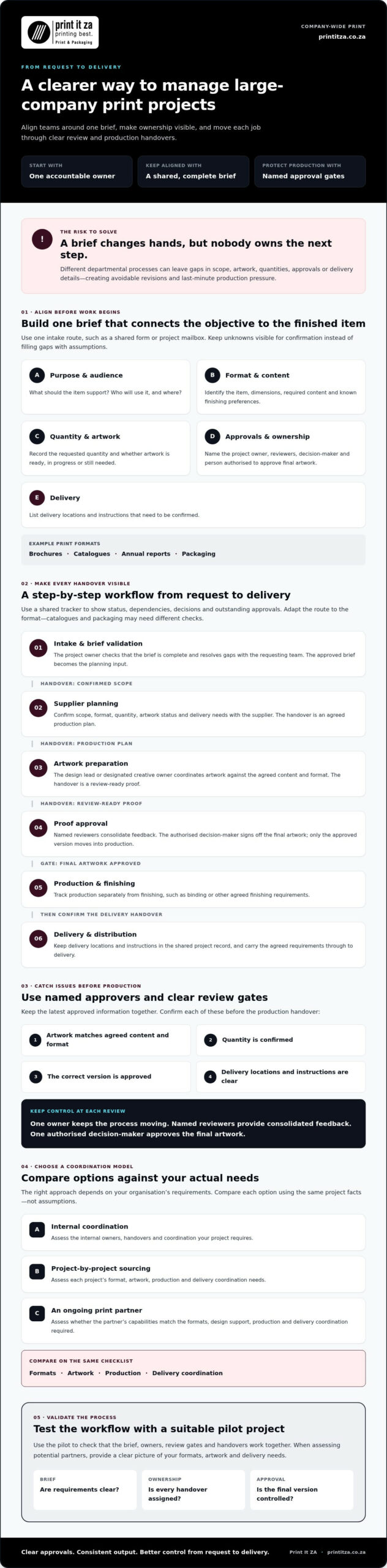
A useful brief connects the business objective to the finished item. It can also serve as a practical creative brief, bringing the audience, message and intended use together before creative work begins. Record the essentials in a format every participating team can review:
- Purpose and audience: What should the item support, who will use it, and where?
- Format and content: Identify the item, dimensions, required content and any known finishing preferences.
- Quantity and artwork status: Record the requested quantity and whether artwork is ready, in progress or still needed.
- Approvals: Name the project owner, reviewers, decision-maker and person authorised to approve final artwork.
- Delivery: List delivery locations and instructions that need to be confirmed.
Sample outline: Purpose: [objective]; audience and use: [details]; format and content: [requirements]; quantity: [amount]; artwork: [status]; approvals: [names or roles]; delivery locations: [list]. Keep unknowns visible for confirmation instead of letting teams fill gaps with assumptions.
How do you align departments before production?
Set one intake route, such as a shared form or project mailbox, and ask every team for the same core details. The project owner can then identify overlaps, flag missing information and separate essential requirements from preferences or optional variations. For example, teams may share core brochure content but need different versions for particular audiences. Confirm which differences are necessary before artwork is prepared.
Before selecting a supplier, compare the confirmed scope with the capabilities the project requires, including formats, design support, production and delivery coordination. The professional printing services guide outlines considerations for assessing a provider. With a complete brief and one clear point of contact, supplier discussions can focus on the project rather than unresolved internal requests. For organisations in Gauteng and Johannesburg, also make delivery destinations and local coordination needs clear at this stage.
A Step-by-Step Workflow for Managing Large-Company Print Projects
A brief sets the direction. A workflow keeps the work moving. A print project workflow is the agreed sequence of owners, approvals and production handovers that takes a job from request to delivery. For teams managing print projects for a large company, a shared tracker makes that sequence visible, including current status, dependencies, decisions and outstanding approvals.
Which stages belong in a corporate print workflow?
Use clear milestones, with an owner, input and handover at each stage. The exact route should suit the format. Producing a catalogue may involve different checks from producing packaging, so avoid forcing every project into identical steps.
- Intake and brief validation: The project owner checks the request for a complete brief and resolves gaps with the requesting team. The approved brief becomes the input for planning.
- Supplier planning: The owner and supplier confirm scope, format, quantity, artwork status and delivery needs. The handover is an agreed production plan.
- Artwork preparation: The design lead or designated creative owner prepares or coordinates artwork against the agreed content and format. The handover is a review-ready proof.
- Proof approval: Named reviewers consolidate feedback, and the authorised decision-maker signs off the final artwork. Only the approved version moves into production.
- Production and finishing: The supplier tracks production separately from finishing, such as binding or other agreed finishing preferences. Record each completed milestone before the next handover.
- Packing and delivery: The supplier or distribution owner checks packing and dispatch details against the approved delivery instructions. The project owner records delivery status and closes the job.
Some projects may combine or omit stages, depending on format and scope. The aim is not to add process for its own sake, but to make each handover clear. A print-industry resource such as PRINTING United Alliance can also help teams explore production practices and supplier considerations.
How should teams manage artwork and approvals?
Keep one clearly identified master file in an agreed location. Label revisions consistently so reviewers can tell which version is current, and define who checks content, design and production details before artwork is released. Collect comments in one place, then have the project owner resolve conflicting departmental edits with the relevant decision-makers. This prevents overlapping feedback from creating uncertainty about what has approval.
In the tracker, record the current milestone, its owner, the next handover, dependencies and decisions still required. A simple status such as “awaiting content,” “proof review” or “approved for production” helps teams spot blockers without relying on scattered email updates. Print It ZA’s printing and packaging capabilities can be considered when planning support across formats and production stages.
Compare Print Management Options Without Losing Control
The right print model depends on your workload, internal capacity and mix of formats. A company producing occasional, straightforward items may manage them internally, while a varied or recurring programme may benefit from a print partner. Outsourcing production doesn’t mean handing over control: your team can retain ownership of the brief, brand standards, approvers and final artwork sign-off.
- Internal coordination: A central team manages requests and suppliers. This can suit organisations with staff capacity and established processes, but the team still needs to coordinate production and delivery details.
- Project-by-project sourcing: Teams select a supplier for each job. This offers flexibility for distinct projects—for instance, when planning large-format marketing displays, you can visit Banner 4 Sale for custom vinyl banners—but requires someone to compare capabilities, communicate requirements and keep quality checks aligned each time.
- Recurring print-partner relationship: A consistent supplier may support repeated work or varied formats. This can simplify communication, but the arrangement should still be reviewed against actual needs, performance and project scope.
When does centralised print coordination make sense?
Central coordination is useful when departments share formats, brand standards or approval practices. One coordinator can bring requests together and help teams avoid unnecessary variations. Keep local input, though: audience needs, content and delivery instructions may differ between locations. A shared process should make those differences visible, not flatten them into one standard request.
When managing print projects for a large company, choose an approach that gives each job a clear owner without adding steps that don’t serve the work. A coordinator might standardise briefs and approvals while allowing departments to specify distinct requirements for a brochure, catalogue or packaging project. As an industry reference, FESPA explains how print production workflows connect work from concept to production.
What should you evaluate in a print partner?
Start with your project mix, not a generic promise of capability. Ask whether the supplier’s litho and digital printing options suit the formats and quantities you need. Then clarify how the work will be coordinated, from design support and proofing to production updates and delivery arrangements.
- Scope and formats: Can the supplier support the items in your plan, such as brochures, annual reports, catalogues or packaging? For projects expanding into custom apparel and screen-printed goods, learn more about B-BAM! Inc. to see how specialized merchandise partners handle corporate branding.
- Communication and approvals: Who handles questions, shares proofs and confirms what is approved to proceed?
- Quality checks and delivery: How will agreed checks, packing needs and delivery locations be managed and confirmed?
Compare answers against your requirements, and keep internal decision rights clear. For more questions to guide supplier evaluation, see this Johannesburg print shop selection guide.
Control Quality, Revisions and Delivery Across Print Projects
Quality control depends on clear decision points, not simply a final glance at the artwork. Set approval gates that show who reviews content, who checks production details and who can authorise release. This keeps feedback from arriving through competing channels and gives the production team a clear instruction to follow.
How can a company reduce artwork and version errors?
Store working files in a controlled location, label revisions consistently and make superseded versions easy to identify. Ask reviewers to consolidate their comments before the approval owner makes a decision. Conflicting edits can then be resolved centrally rather than passed on as separate instructions.
Final approval should identify the exact artwork version authorised for production. Before release, compare the approved proof and production specification with the latest brief. Confirm the final artwork, quantities, versions, finishing requirements and other agreed project details. If a change is needed after sign-off, record who requested it, what changed and whether another approval is required.
Keep a simple issue log alongside the project record. Note the issue, the decision made, the person responsible for corrective action and the outcome. After delivery, capture lessons that could improve the next job, such as a missing brief detail or a review step that needs clarification. These records help teams refine the process without relying on memory.
How should teams coordinate delivery across locations?
Before dispatch planning, gather the destination details, receiving contacts and allocation instructions for each location. Confirm who will monitor delivery status and notify destinations if arrangements change. For example, if a print run is split between offices, record each location’s allocation clearly and give the responsible contact one agreed source of information.
Keep delivery instructions with the approved project details, and check them before handover. The custom packaging procurement guide offers related considerations for planning supplier requirements.
Consistent controls make managing print projects for a large company easier to review and repeat. The Print It ZA print and packaging site provides information relevant to projects involving print or packaging.
Scale Your Print Process with the Right Production Partner
A dependable print process doesn’t have to begin with a large-scale supplier change. Appoint an internal owner, standardise the brief and choose a pilot project that reflects the work your teams actually need. This gives you a practical way to test how requests, artwork, approvals and delivery hand over before applying the workflow more widely.
What should a company prepare before requesting print support?
Give a potential partner a clear picture of the project and how your organisation makes decisions. Gather representative briefs, existing artwork, brand guidance and known production requirements. Identify the departments involved, the people who review the work and the person authorised to approve it. Include the formats required, the project objective and whether artwork is ready or needs design support.
Delivery scope matters too. List destinations, receiving contacts and any distribution coordination the project may need. Clear information helps a supplier assess whether its capabilities match your requirements and identify questions before work begins. It also gives your internal owner a sound basis for comparing proposals without committing to a particular supplier model upfront.
How can a pilot project improve the wider process?
Select a project that’s representative enough to test important handovers, but manageable enough for your team to review closely. Track how the brief is received, how proofing and approval are handled, and how delivery information is confirmed. After completion, discuss where communication flowed well and where an unclear decision or handover caused friction. Then update the shared process before using it for other work.
For relevant projects, Print It ZA’s in-house design support, litho and digital printing capabilities can connect creative development with production and final delivery. Its services include print and packaging production, as well as nationwide delivery and international export capability. These may suit organisations assessing support across locations. The right fit depends on your formats, artwork status, approval structure and delivery scope.
To explore a project, review Print It ZA’s print and packaging services and consider the formats, approvers and delivery details your team needs to confirm.
Make Your Next Company Print Project Easier to Manage
Managing print projects for a large company becomes more straightforward when there’s a clear owner, a shared process and an agreed point for final approval. Start with a suitable pilot, identify where handovers need attention, then refine the workflow before applying it to more projects. Choose a supplier model that fits your print mix while keeping your organisation’s briefs and brand standards in its hands.
For projects that need production support, Print It ZA offers in-house design support together with litho and digital printing capabilities. Support can extend from creative development through production to final delivery and distribution, including nationwide delivery and international export capability.
Ready to discuss a company print project? Contact Print It ZA about your print requirements and share the formats, approval process and delivery scope. A clear brief gives the conversation a practical starting point.
Frequently Asked Questions
How do you manage print projects across multiple departments?
Manage them through one shared process, with a named coordinator responsible for collecting requests and tracking decisions. Use a standard intake route so departments provide consistent project details, then record owners, approvals, dependencies and delivery needs in a shared tracker. This gives teams visibility without removing their input. For managing print projects for a large company, make sure each department knows who can approve changes and where to send consolidated feedback.
What should a corporate print project brief include?
A corporate print brief should explain the project’s objective, audience and intended use, then specify the required format, dimensions, content and quantity. Include the artwork’s status, any known finishing preferences, approval roles and delivery destinations. If some details aren’t confirmed, mark them as open questions rather than making assumptions. A clear brief helps your team and printer assess what’s needed before artwork preparation or production planning begins.
How can a large company keep print artwork and versions under control?
Keep artwork in a controlled shared location and use consistent file names or revision labels so the current version is easy to identify. Ask reviewers to combine their comments before sending feedback to the approval owner. Record the final decision and identify the exact proof authorised for production. If artwork changes after approval, log the change, confirm who must review it and make sure the production team receives the newly approved file.
Should a large company manage printing in-house or use a print partner?
Choose the model that fits your team’s capacity, project mix and coordination needs. Internal management can work if you have the people and processes to oversee suppliers, artwork approvals and delivery. Sourcing each project separately offers flexibility, while an ongoing print partner may suit recurring work or several formats. You can outsource production while keeping control of the brief, brand standards, decision-makers and final artwork approval.
How do you choose a commercial printer for a large company in South Africa?
Compare printers against your actual requirements: formats, quantities, design support, proofing communication, quality checks and delivery arrangements. For a Gauteng or Johannesburg organisation, consider whether the supplier can support your local coordination needs and destinations beyond the area. Ask about relevant litho and digital capabilities, and clarify how responsibilities and approvals are handled. Print It ZA offers in-house design support, litho and digital printing, plus nationwide delivery and international export capability.
What quality checks should happen before a print project goes into production?
Before production, confirm that the final artwork matches the approved content and current brief. Check quantities, versions, format, dimensions, agreed finishing requirements and delivery instructions. Make sure the authorised decision-maker has approved the precise proof intended for production, and that the production team has received the correct file and details. Resolve open questions before release, then document approved changes so there’s a clear record of what was authorised.
How can companies coordinate print delivery to multiple locations?
Plan distribution by listing each destination, receiving contact and required allocation before dispatch arrangements are confirmed. Assign someone to monitor delivery status and communicate updates or changes to affected locations. Keep the approved instructions in one shared project record so teams and suppliers work from the same information. For nationwide delivery, confirm the supplier’s ability to support the destinations and clarify who manages each handover.
Contact Print It ZA today, for a Free Quote and Speedy Service.
Print It ZA, we deliver Printing Best!
Print It ZA print and packaging, South Africa/ ZA.