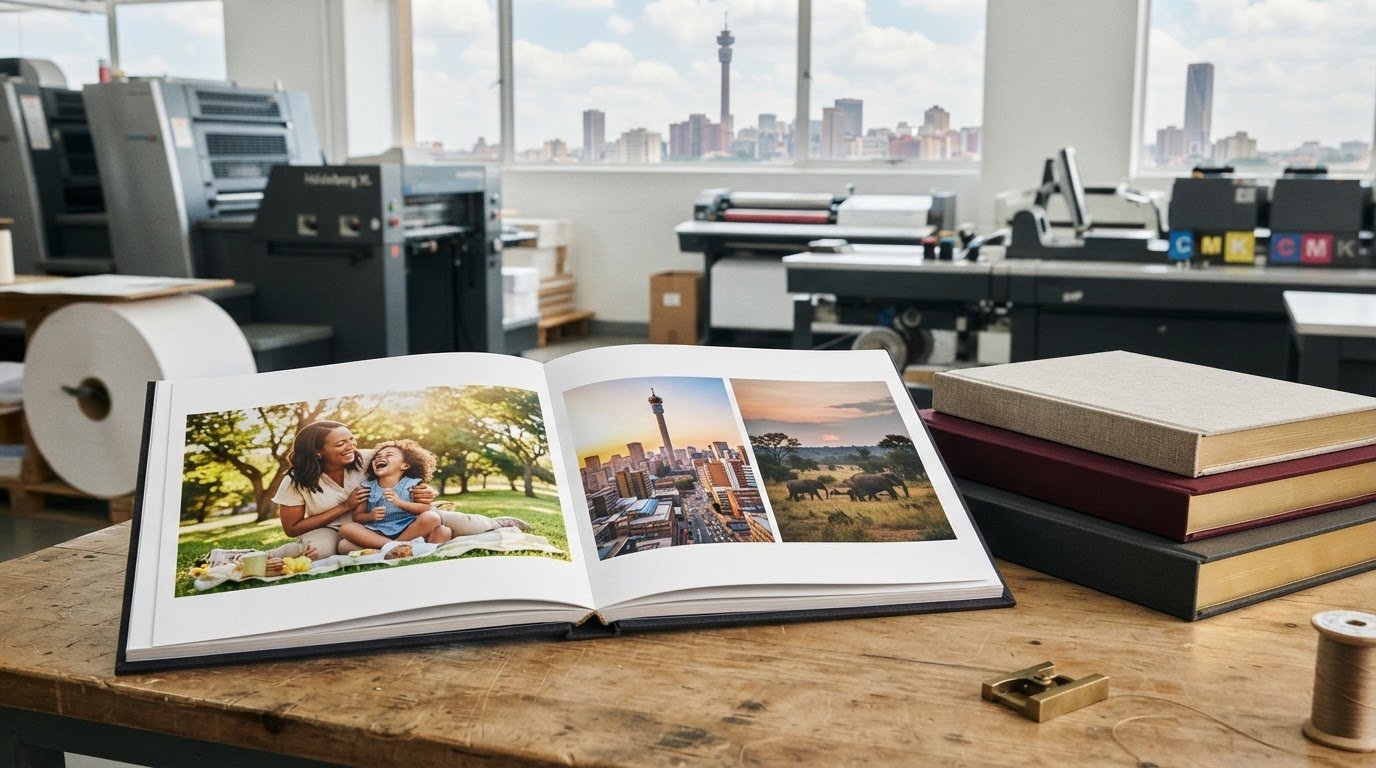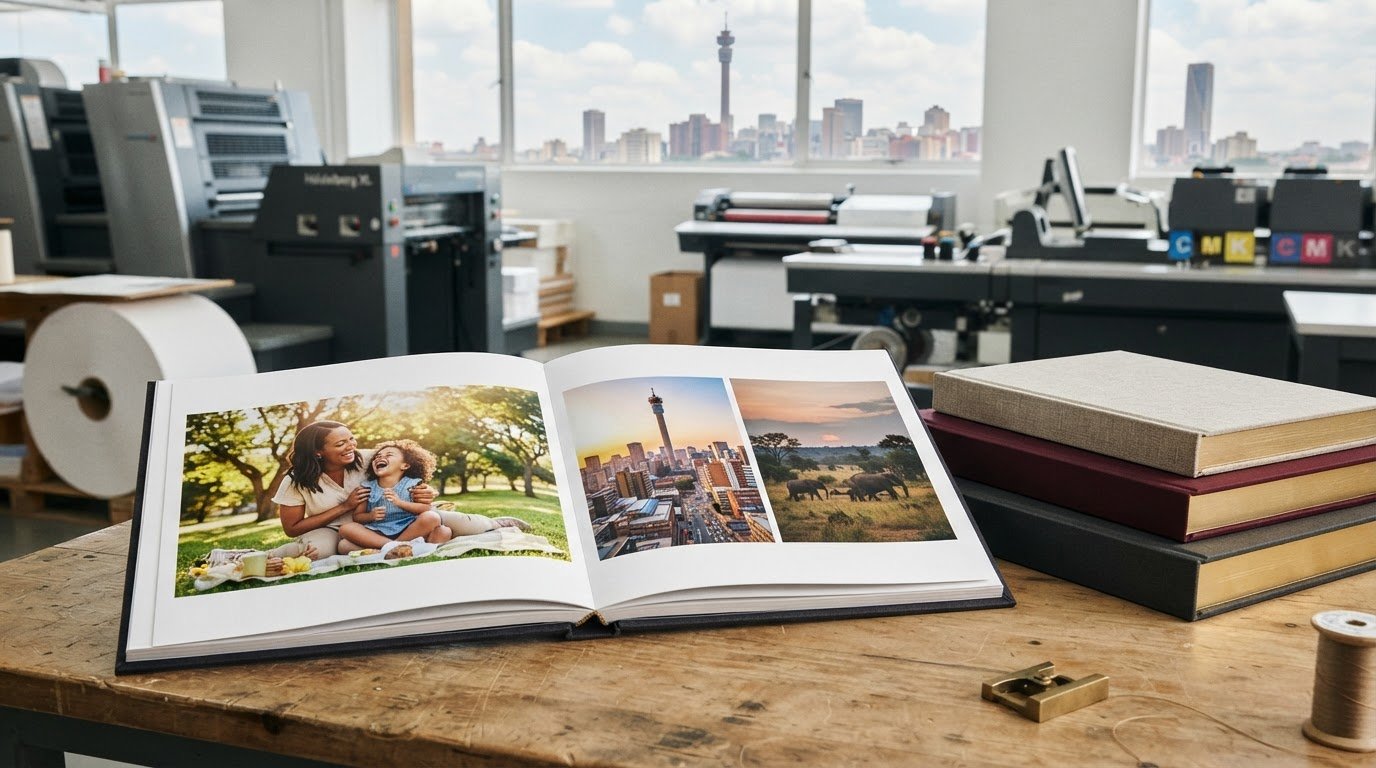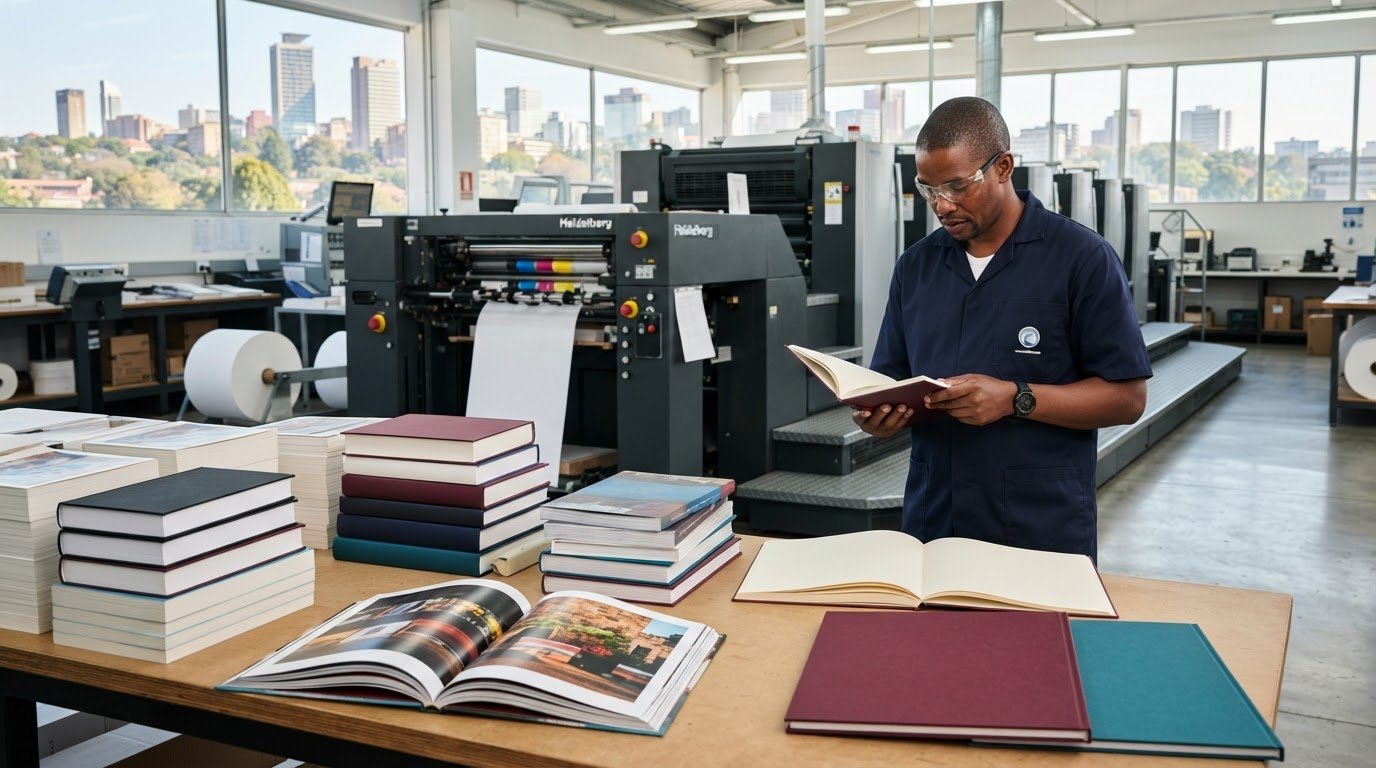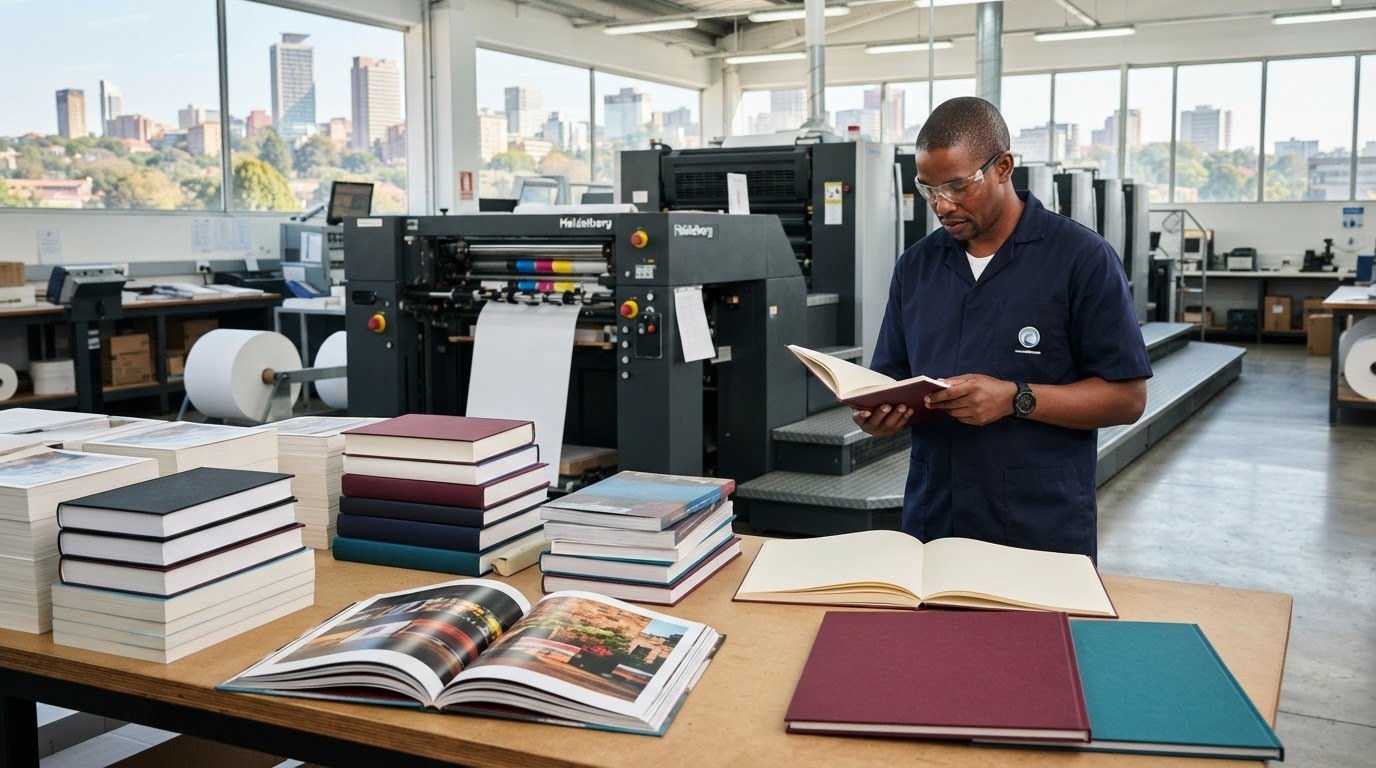
Why do ten copies of your novel cost almost as much as fifty? It is the classic riddle of the printing world that leaves many South African authors feeling stuck between a garage full of unsold books and a price tag that eats all their profit. Finding the right minimum order quantity for book printing is not just about meeting a manufacturer’s rule; it is a strategic financial move to protect your investment. You don’t want to be forced into a massive 500-unit run before you’ve tested the market, but you also need a professional result that looks great on a shelf.
You likely feel the pressure of choosing between high international shipping fees for single copies or the anxiety of over-ordering locally. We understand that every Rand counts, especially with paper costs rising 47 percent since 2020. This guide will show you how to navigate MOQs to find your cost-per-book sweet spot without sacrificing quality. We will explore the shift toward flexible digital runs in 2026, explain when to jump from digital to litho, and help you secure a production plan in Gauteng that fits your vision and your storage space.
Key Takeaways
- Learn how to use the minimum order quantity for book printing as a smart financial tool to keep your project profitable from the very first copy.
- Understand the critical differences between digital and litho technology so you can pick the most cost-effective method for your specific volume.
- Identify how your choice of binding, like premium hardcover versus standard paperback, influences the smallest run a printer can realistically produce.
- Realize the logistical benefits of printing locally in South Africa to avoid the high costs and long waits associated with international shipping.
- Discover how a flexible 24/7 partner in Midrand can help you scale from a small digital proofing run to a massive nationwide retail release.
Table of Contents
- What is Minimum Order Quantity (MOQ) in Book Printing?
- Litho vs. Digital: How Technology Dictates Your Minimums
- MOQ by Book Type: Hardcover, Paperback, and Beyond
- The South African Context: Choosing Your Quantity in 2026
- Why Print It ZA print and packaging is the Ideal Partner for Any Print Run
What is Minimum Order Quantity (MOQ) in Book Printing?
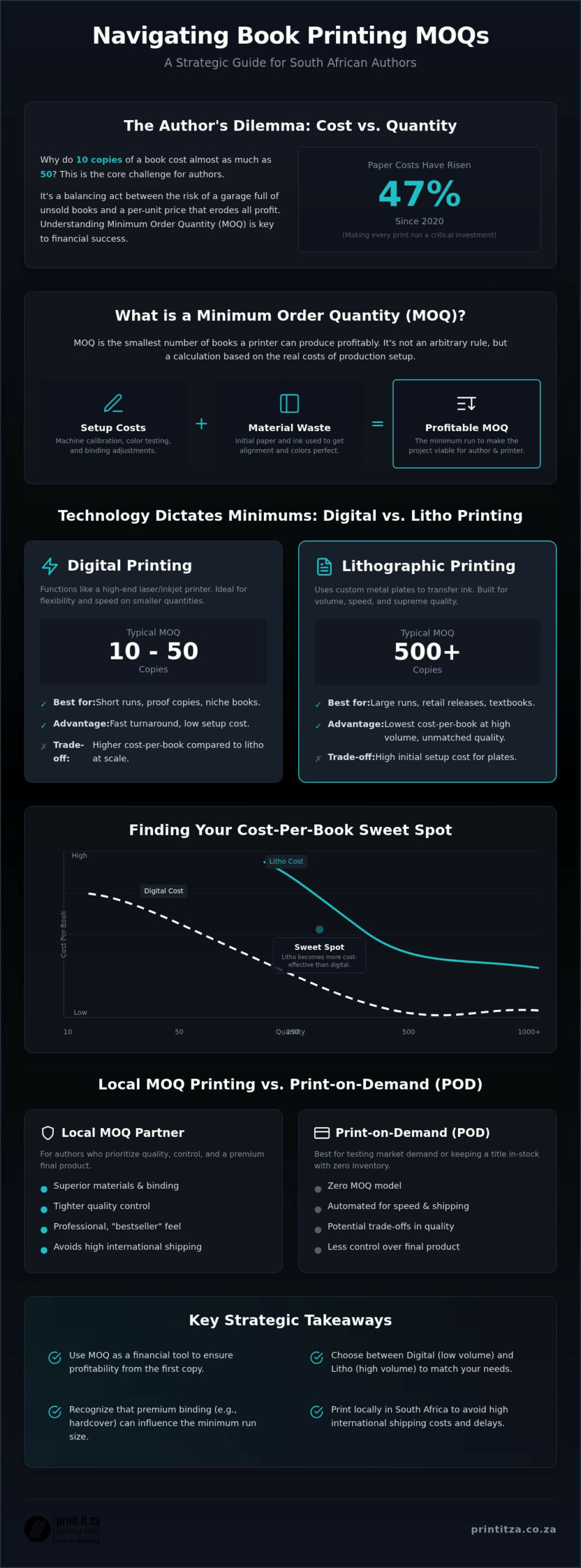
Minimum Order Quantity (MOQ) is the lowest number of books a printer can manufacture while keeping the project profitable for both the business and the author. It isn’t a random number designed to frustrate you; it’s a practical calculation based on machine time, labor, and material waste. Without an MOQ, the overhead of starting a massive industrial press would make a single book cost as much as a high-end piece of electronics. For South African authors, understanding the minimum order quantity for book printing is the first step in turning a manuscript into a sustainable business venture.
The ‘Setup Cost’ Factor
Every print job requires a significant amount of "behind-the-scenes" work before the first page is even produced. Our team in Midrand must calibrate the colours, set the binding equipment to your specific spine width, and test the trim accuracy. Setup costs are amortized, or spread out, over the total number of books in your order. This mechanical reality is why printing a single proof can sometimes cost 50% of the price of a full small batch; the labor to get the machines ready is identical whether you want one copy or fifty. By 2026, digital inkjet advances have made these setups faster, but they haven’t eliminated the need for a skilled technician to oversee the process.
MOQ vs. Print on Demand (POD)
Many new authors consider Print on Demand (POD) as the ultimate solution because it technically offers a zero-MOQ model. While POD is excellent for keeping a title "in stock" without needing a warehouse, there are often visible trade-offs in paper weight, cover lamination quality, and binding durability. These highly automated systems prioritize speed and individual shipping over the artisan touch. Choosing a printer with a modest MOQ, like 20 or 50 units, typically gives you access to premium materials and much tighter quality control. You end up with a professional product that feels like a bestseller rather than a quick photocopy, which is vital for building your brand as a serious author in the competitive SA market.
Litho vs. Digital: How Technology Dictates Your Minimums
The technology under the hood of your chosen press is the single biggest factor in determining your minimums. It isn’t a choice between "good" and "bad" quality; it’s a choice between two different manufacturing philosophies. Digital printing functions much like a high-end industrial version of a laser printer, using toner or inkjet technology that requires zero mechanical setup for each unique page. This flexibility is why the minimum order quantity for book printing can be as low as 10 to 50 copies for digital projects. You pay a slightly higher price per book, but you avoid the massive upfront investment required for larger industrial runs.
Lithographic printing, on the other hand, is built for sheer speed and volume. It uses metal plates to transfer ink onto paper, a process that delivers unmatched image clarity and color depth. However, creating those plates takes time and specialized labor. Because of this, offset printing is most cost-effective for large print runs where the initial setup cost is divided among 500 or 5,000 units. At Print It ZA, we operate both technologies under one roof. This allows us to support you whether you’re launching a limited-edition poetry chapbook or a national textbook series.
Digital Printing for Short Runs
Digital is your best friend during the early stages of publishing. Since there are no plates to manufacture, we can offer faster turnaround times and much lower MOQs in Gauteng. It’s the ideal choice for proof copies, niche academic journals, or personalized children’s books. By utilizing professional printing services that specialize in digital quality, you can achieve a look that’s nearly indistinguishable from traditional litho without the financial risk of overstocking.
Lithographic Printing for Scale
Once your book gains traction and you need hundreds of copies for retail distribution, litho becomes the clear winner. The "break-even" point usually sits around 500 copies. Beyond this number, the unit price for litho drops significantly, making it the preferred method for retail-ready novels and commercial catalogues. If you’re planning a national launch, chat with our team about how to transition your project from a digital short run to a high-volume litho production for the best possible ROI.
MOQ by Book Type: Hardcover, Paperback, and Beyond
The physical format of your book is just as important as the technology used to print it. While digital presses allow for low numbers, the binding and finishing equipment often have their own operational requirements. For example, a standard paperback is much easier to set up than a premium, cloth-wrapped hardcover. This mechanical distinction is why the minimum order quantity for book printing often shifts based on whether you want a simple softcover or a complex case-bound edition. We see this most often when authors want to mix formats for a single launch.
Finishing touches like lamination, foil stamping, or spot UV also play a role in your final volume. These additions require extra passes through specialized machines, adding to the setup time. If you’re looking for a high-end coffee table book with gold foiling, a tiny run of five copies becomes very expensive because the "die", the metal stamp used for the foil, is a fixed cost. Balancing your creative vision with the mechanical realities of the bindery ensures your project stays within a realistic budget without sacrificing the "wow" factor.
Paperback vs. Hardcover Requirements
Most novels in South Africa use a process called perfect binding, where the pages are glued into a wrap-around cover. It’s a fast, highly automated system that allows our Midrand team to be very flexible with minimums. Hardcover books are a different story. They require case binding, involving multiple steps like creating the hard greyboard case and marrying it to the book block. Because this often involves more manual craftsmanship, the MOQ is usually higher to make the labor costs viable. Print-on-demand services are an option for single hardcovers, but for a retail-ready finish that lasts, consulting with a professional print shop in Johannesburg is the best way to find a middle ground between quantity and quality.
Corporate and Educational MOQs
Training manuals, annual reports, and school workbooks have their own unique needs. For these projects, the minimum order quantity for book printing is often dictated by the distribution scale rather than just machine limits. While we can print 20 manuals for a small workshop, the per-unit savings on a run of 500 or 1,000 copies are significant. Bulk ordering educational materials isn’t just about saving money; it’s about ensuring consistency across your entire organization. Our 24/7 print facility is built to handle these high-volume corporate projects, moving from the press to nationwide distribution with speed and precision.
The South African Context: Choosing Your Quantity in 2026
South African authors in 2026 face a unique set of challenges that international guides often overlook. While global platforms offer tempting entry points, they rarely account for the hidden costs of shipping, customs, and the unpredictable Rand. Choosing the right minimum order quantity for book printing requires a local perspective that balances these logistics against your actual sales potential. Since 2020, paper costs have risen by 47 percent, making every sheet in your print run a valuable asset that needs to be managed with precision.
Finding your "sweet spot" means identifying the volume where your unit cost is low enough to allow for a retail markup, but high enough to avoid the "storage unit" trap. For most local self-publishers, this sweet spot sits between 50 and 200 copies for a first launch. This range allows you to satisfy initial demand from local bookshops and launch events while keeping your minimum order quantity for book printing manageable. It also gives you the flexibility to update your manuscript for a second edition if you find errors after the first batch is in the hands of readers.
Gauteng Logistics and Turnaround
The 24/7 print facility in Midrand serves Johannesburg and Pretoria with unmatched speed. Using a local printer means you won’t wait weeks for a proof copy to clear customs; you can often see a physical sample within days. This proximity allows for tighter quality control and eliminates the anxiety of international tracking. Local delivery is cheaper and more reliable than international couriers, which directly lowers the total cost of your minimum order.
Budgeting in Rands for Self-Publishers
Self-publishing is a business, and business owners hate currency volatility. By keeping your production in South Africa, you avoid price hikes that happen when the Rand dips against the Dollar. You can plan your marketing with certainty, knowing exactly what your next 100 copies will cost. Local procurement supports the South African creative economy, ensuring that our homegrown talent and infrastructure continue to thrive. If you’re ready to get started, you can request a custom quote to see how our local expertise brings your project to life.
Why Print It ZA print and packaging is the Ideal Partner for Any Print Run
Choosing the right minimum order quantity for book printing shouldn’t feel like a gamble. At Print It ZA print and packaging, we position ourselves as more than just a manufacturer; we are your creative partner. Our facility in Midrand bridges the gap between the small-scale needs of a first-time author and the high-volume requirements of established publishers. We understand that your book represents months or years of hard work. That is why we offer a seamless transition from digital short runs to large-scale litho production as your audience grows.
Our 24/7 print operations mean we never stop working on your vision. We take pride in our regional roots and our ability to deliver professional results across South Africa. By managing every stage of the process in-house, from the initial digital proof to the final binding, we maintain strict quality control that automated international services simply cannot match. You get the technical expertise of an industrial leader with the approachable, friendly service of a local business that truly cares about your success.
Tailored Solutions for SA Authors
Self-publishers often feel overwhelmed by the technical jargon of the printing world. We simplify the experience by helping you determine the most cost-effective volume for your specific goals. Our in-house designers are available to ensure your files are print-ready, while our finishing team adds the professional touches like lamination and premium binding that make your book stand out. Whether you are printing a personal memoir or a high-end coffee table book, Print It ZA print and packaging treats your minimum order quantity for book printing with the precision it deserves. We help you avoid the common pitfalls of over-ordering while ensuring your unit cost remains competitive for the local market.
Ready to Print Your Book?
The path from a finished manuscript to a physical book in your hands is shorter than you think. Once you have selected your ideal quantity and binding style, our team handles the rest. We provide physical proofs for your approval, manage the full print run in our print facility, and coordinate nationwide distribution to get your work into the hands of readers. Don’t let confusion over order volumes hold your project back. We invite you to a collaborative consultation to find the perfect pricing structure for your needs. Get a custom quote for your book printing project today and take the final step toward becoming a published author.
Step Into Your Future as a Published Author
Mastering the minimum order quantity for book printing is about more than just numbers; it’s about launching your literary career with total confidence. You now understand how digital technology allows for flexible short runs, while litho printing remains the king of high-volume retail success. By keeping your production within South Africa, you bypass the hidden costs of international shipping and gain the advantage of local quality control. It’s time to stop worrying about unsold stock and start focusing on your readers.
At Print It ZA print and packaging, we’ve been specialists in both litho and digital printing. The 24/7 Midrand production facility is designed to handle everything from niche poetry batches to massive textbook runs with speed and precision. We offer nationwide SA delivery to ensure your books arrive exactly when you need them. Ready to see your name on a professionally finished spine? Request a Professional Book Printing Quote today and let our team help you find the perfect volume for your project. Your journey to becoming a bestseller starts with a single, well-planned print run.
Frequently Asked Questions
What is the absolute minimum number of books I can print with Print It ZA print and packaging?
Our absolute minimum for digital book printing starts at just 10 copies for most standard paperback projects. This low threshold allows authors to test the market or fulfill small pre-orders without a massive financial commitment. While we can technically produce single copies for specific high-end portfolio projects, the unit cost becomes much more favorable once you reach the 10 to 20 unit range.
Why does the price per book drop so significantly when I order more?
The unit price decreases because fixed setup costs are spread across a larger number of books. Every print job requires machine calibration, file preparation, and bindery setup that remains the same whether you print ten books or a thousand. When you increase your order volume, these initial labor and material costs become a smaller percentage of the total price, significantly lowering the cost per book.
Can I order a single copy as a proof before committing to a full run?
Yes, we highly recommend ordering a single digital proof before you commit to your full print run. Seeing a physical copy allows you to check the colour accuracy, binding quality, and paper feel in person. This step is vital for catching any last-minute formatting errors and ensures you are completely satisfied with the minimum order quantity for book printing you eventually choose.
Do hardcover books have a higher minimum order quantity than paperbacks?
Hardcover books generally require a higher minimum order quantity because the binding process is more complex and involves more manual labor. While paperbacks can be produced in very small digital batches, the specialized machinery used for case binding hardcovers often makes runs of 50 or more copies the most practical entry point. This ensures you get a professional, durable finish that justifies the higher production value.
How long does it take to print a minimum order of 50 books in Johannesburg?
Most digital orders of 50 books are completed within 7 to 14 working days after you approve the final proof. Since our 24/7 production facility is based in Midrand, we can often expedite local projects for authors in Johannesburg and Pretoria. Your specific timeline depends on the complexity of your binding and whether you have selected any specialized finishes like lamination or spot UV.
Is it cheaper to print 100 books twice or 200 books once?
It is always more cost-effective to print 200 books in a single run rather than two separate batches of 100. Every time we start a new print job, we must repeat the entire setup and calibration process. By doubling your initial quantity, you eliminate the second setup fee and take advantage of better bulk material pricing, which results in a much higher profit margin per sale.
Does the MOQ change if I want special finishes like gold foil or embossing?
Special finishes like gold foil, embossing, or spot UV often require a higher minimum order quantity for book printing due to the cost of custom dies and additional machine passes. These artisanal touches involve extra labour and specialized equipment setup. If you want a high-end retail look, we usually suggest a minimum of 50 to 100 units to ensure these premium features remain affordable for your project budget.
Can Print It ZA print and packaging handle the distribution of my minimum order across South Africa?
We provide comprehensive nationwide distribution for all our authors across South Africa. Once your books are printed and bound in our Midrand facility, our logistics team can coordinate the delivery of your order to multiple locations, including bookstores, launch venues, or your private residence. This end-to-end service ensures your project moves seamlessly from the press to your readers without you having to manage separate courier services.
Contact Print It ZA today, for a Free Quote and Speedy Service.
Print It ZA print and packaging, South Africa/ ZA