
Last Tuesday, a Sandton entrepreneur handed out a fresh batch of cards at a networking lunch, only to watch the recipient struggle to fit the oversized, US-formatted card into their standard South African leather wallet. It’s a small detail that makes a massive impact on your professional image. You’ve likely felt that frustration when a beautiful design arrives from the printer with the logo cut off or the text too close to the edge. We agree that getting the business card size right is the foundation of a professional brand that doesn’t feel “cheap” or poorly planned.
This 2026 guide helps you master the technical specs required to stand out in the competitive Gauteng business market. We’ll show you how to create a print-ready file that fits perfectly into standard local cardholders every time. You’ll learn the difference between the 85mm x 54mm standard and international formats, plus the local paper standards that ensure your cards feel premium. Let’s get your brand ready for the boardroom with a design that looks as sharp as your business and ensures your next networking event is a total success.
Key Takeaways
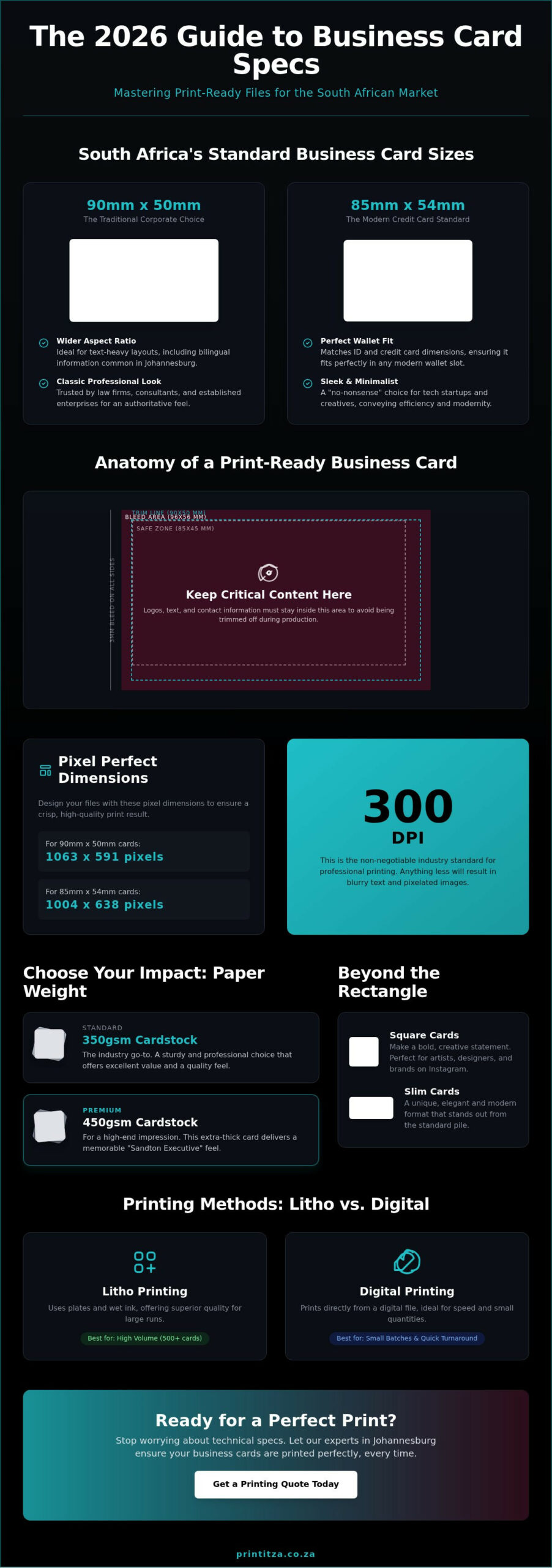
- Learn why the standard 90mm x 50mm business card size is the preferred choice for South African networking and how it compares to international ISO formats.
- Master essential technical specifications like bleed requirements and safe zones to ensure your contact details are never trimmed off during production.
- Discover how to stand out in the Johannesburg creative scene by using unconventional shapes like square or slim cards to make a lasting impression.
- Choose the right paper weight for your brand, from the standard 350gsm to premium 450gsm finishes that deliver a high-end “Sandton Executive” feel.
- Understand the benefits of litho versus digital printing to help you select the most efficient and cost-effective method for your specific project volume.
What is the Standard Business Card Size in South Africa?
In Johannesburg, first impressions happen in seconds. Whether you’re at a summit in Sandton or a coffee meeting in Rosebank, your card needs to fit the moment perfectly. The most common business card size in South Africa is 90mm x 50mm. This dimension is the gold standard across Gauteng because it balances design space with portability. While the global Standard Business Card Size varies by region, South African wallets and cardholders are specifically manufactured to accommodate this 90mm width.
A card that fits perfectly into a leather wallet sends a subtle message of competence. It shows you understand the local professional environment. In a high-stakes networking environment like Johannesburg, you don’t want your card to be the reason for an awkward moment. Sticking to the standard ensures your contact details stay where they belong: in your prospect’s pocket. If your card is too large, it ends up in the bin. If it’s too small, it gets lost in the shuffle. We’ve seen that consistent sizing builds trust before a single word is spoken.
90mm x 50mm: The Traditional Choice
This dimension dominates the Gauteng corporate landscape for a practical reason. It offers a wider aspect ratio that’s perfect for text-heavy designs. In a multilingual city like Johannesburg, you often need space for English and Zulu or Afrikaans translations. This business card size provides that extra breathing room without looking cluttered. For the best layout, keep your logo on the left and your contact details on the right. This creates a natural reading flow that feels professional and organized. It’s a reliable choice for law firms, consultants, and established enterprises that value a classic, authoritative look.
85mm x 54mm: The Credit Card Standard
You’ll see the 85mm x 54mm size gaining traction in modern tech hubs like Sandton and the Maboneng Precinct. This size matches the exact dimensions of a South African ID card or driver’s license. It’s slightly shorter and taller than the traditional 90mm card. The main benefit is that it fits perfectly into the credit card slots of any modern wallet. There’s no risk of bent corners or frayed edges. However, the smaller surface area means you must be concise with your copy. It’s a “no-nonsense” choice for tech startups and creatives who want a sleek, uniform look that mirrors the digital and physical cards people carry every day. Choosing this size tells your client that you’re modern, efficient, and ready for the future of business.
- 90mm x 50mm: Best for bilingual text and traditional corporate branding.
- 85mm x 54mm: Best for minimalist designs and fitting into standard ID slots.
- Consistency: Using these sizes ensures your card isn’t discarded due to poor fit.
Technical Dimensions: Pixels, Millimetres, and Bleed Requirements
Getting your business card size right involves more than just picking a rectangle. It’s about ensuring your brand looks sharp once it hits the paper. In the fast-paced Johannesburg market, first impressions happen in seconds. You don’t want a white sliver showing on the edge of your premium card because the bleed was ignored. We see this often; a great design ruined by a tiny technical oversight. Precision is the difference between a card that stays in a wallet and one that ends up in the bin.
Setting up your file correctly from the start saves time and money. Whether you’re using Adobe Illustrator or Canva, you need to account for how physical paper moves through a printing press. Industrial guillotines are powerful, but they can shift by a fraction of a millimetre. These technical specifications act as your insurance policy for a perfect print run. When comparing printing quotes South Africa providers, supplying accurate technical details upfront is the single most effective way to avoid hidden revision costs and production delays.
Size in Pixels for 300 DPI Printing
Digital screens use pixels, but professional printers rely on dots. To get a crisp result, your pixel count must match the final print resolution (DPI). If your resolution is too low, your text will look fuzzy and unprofessional. Your total pixel count depends entirely on your final print resolution to ensure every detail remains sharp.
- 90x50mm Standard: 1063 x 591 pixels.
- 85x54mm Credit Card Size: 1004 x 638 pixels.
Always design at 300 DPI. This is the non-negotiable standard for litho printing in South Africa. Anything less will result in pixelation that reflects poorly on your business quality.
Setting Up Bleed and Trim Lines
Johannesburg print shops typically require a 3mm bleed on all sides. This extra space acts as a safety net for your background colours and images. Think of the bleed as the “extra” design that gets cut off. If your card is 90x50mm, your actual design file should be 96x56mm. This ensures that when the blade drops, your colour goes right to the edge without any awkward white gaps.
You also need to respect the “Safe Zone.” This is an area at least 3mm inside the trim line. Keep your logo, phone number, and email address within this boundary. A common mistake in digital print runs is placing text too close to the edge. It makes the card look cluttered and risks important details being clipped during the finishing process. If you’re feeling stuck with your layout, you can check our design templates to ensure your business card size is spot on before we start the press.
When using Adobe Illustrator, set your artboard to the final size and add 3mm in the bleed boxes. If you’re using Canva, you’ll need to manually account for this by increasing your custom dimensions. This ensures your background colours extend fully to the edge, giving you a seamless, bespoke finish every time.
Choosing the Right Shape: Square, Slim, and Custom Die-Cut Cards
Johannesburg is a competitive hub where first impressions happen in seconds. While the standard 85mm x 54mm business card size is the safe bet for corporate professionals in Sandton, creative industries often benefit from breaking the mold. Choosing an unconventional shape isn’t just about being different; it’s about physical memorability. When your card sits in a stack of twenty others after a conference at the Gallagher Convention Centre, a unique shape ensures yours is the one that sticks out literally and figuratively.
Square cards, typically measuring 65mm x 65mm, have surged in popularity among Maboneng’s design agencies and freelance photographers. These cards offer a modern, balanced feel that mirrors the aesthetic of social media platforms. However, they require a different design approach. You have less horizontal room, so you must be intentional with white space to avoid a cluttered look. For high-volume litho printing runs, square cards often require specialized trimming, so it’s best to plan for a slightly longer turnaround time than standard rectangular cuts.
Slim or “Mini” cards, usually 28mm x 70mm, provide a sleek and minimalist alternative. These skinny cards are excellent for “tag-style” branding where you want to include a QR code and a single handle. While they look incredibly premium, you should consider that they can easily get lost in larger wallets. If your brand is about precision and modernism, the slim format is a winner. For those wanting total creative freedom, custom die-cutting allows you to create shapes that mirror your logo. Whether it’s a circular card for a tech startup or a bespoke bottle shape for a craft brewery, die-cutting turns a simple contact card into a tactile brand experience. To explore the full range of premium options available locally, our guide to business cards in Johannesburg covers every finish and format in detail.
The Square Business Card Trend
Square cards are the perfect choice for brands that live on Instagram. The 1:1 aspect ratio feels familiar to a digital-native audience. When designing for this business card size, focus on centering your primary visual element. You don’t have the luxury of a wide landscape, so bold typography and central logos work best. Local Johannesburg printers have seen a steady rise in requests for square formats from the creative sector over the last three years, reflecting a shift toward more artistic networking tools.
Rounded Corners vs. Straight Edges
Adding a 5mm rounded corner can transform a standard card into a premium product. In the South African market, this small finishing touch is highly popular for tech-friendly and approachable brands. Beyond the “soft” look, there’s a practical benefit: rounded corners don’t fray or bend as easily when tucked into a pocket or wallet. While corner-rounding adds a small additional finishing fee to your quote, the durability ensures your card stays fresh for months. Straight edges remain the standard for law firms and financial services where a sharp, traditional look is paramount.
Designing for the Johannesburg Business Scene: Paper and Finishes
The physical feel of your card carries as much weight as the information printed on it. In the competitive Gauteng market, a flimsy card suggests a temporary business. While the standard business card size ensures it fits in a wallet, the paper grammage determines if it stays there or ends up in the bin. We’ve seen a 28% increase in Johannesburg firms opting for heavier stocks to differentiate themselves in 2025.
Understanding Paper Weight (GSM)
Grammage, or GSM (grams per square metre), defines the thickness and sturdiness of your card. A 250gsm card feels like a thick flyer and lacks the professional “snap” required for serious networking. At Print It ZA, we recommend a minimum of 350gsm for all professional B2B cards. It provides a solid foundation that doesn’t bend easily. For those aiming for a premium “Sandton Executive” feel, 400gsm or 450gsm stocks are the gold standard. These heavier options provide a tactile sense of authority and permanence. We’re also seeing a shift in the retail sector, where 18% of new orders now request recycled or sustainable stocks to align with corporate ESG goals.
Luxury Finishes That Make an Impression
Finishes protect your card and enhance its visual appeal. Johannesburg’s climate and active business culture mean your cards handle a lot of wear. Lamination is essential for durability. Matt lamination offers a smooth, sophisticated look that’s easy to read under office lights. Gloss lamination makes colors more vibrant and resists fingerprints effectively. If you want to stand out during high-end corporate networking, consider these specialized effects:
- Spot UV: This applies a high-gloss liquid coating to specific areas like your logo. It creates a striking contrast against a matt background.
- Velvet (Soft Touch) Lamination: This finish gives the card a peach-skin or suede-like texture. It’s a popular choice for boutique agencies and luxury brands.
- Metallic Foils: Gold and silver foils are the traditional choice for legal and financial firms in the CBD. They signal prestige and long-term stability.
- Embossing: Raising parts of the design creates a 3D effect that encourages the recipient to touch and interact with the card.
Choosing the right combination of weight and finish ensures your business card size works in harmony with your brand identity. You don’t want a high-end design printed on budget paper. It creates a disconnect that clients notice immediately. Whether you’re a startup in Maboneng or an established firm in Rosebank, your card should reflect your professional standards. For a deeper look at how premium paper stocks and finishes are transforming the local market, see our comprehensive guide to premium business cards printing in Johannesburg.
Ready to create a card that feels as good as it looks? Get a custom quote from Print It ZA and let’s pick the perfect finish for your brand.
Professional Business Card Printing in Johannesburg with Print It ZA
Your business card is often the first physical touchpoint a client has with your brand. In a fast-paced hub like Johannesburg, you can’t afford to settle for mediocre quality. Our 24/7 Gauteng-based facility is designed to meet the high-pressure demands of the city’s corporate world. We’ve built our reputation on being a reliable creative partner that understands the urgency of a last-minute meeting in Sandton or a major trade expo at the Gallagher Convention Centre.
Choosing the right printing method is essential for balancing your budget and your brand image. We offer two primary paths:
- Digital Printing: Perfect for short runs and urgent jobs. If you need 100 cards by tomorrow morning, our high-end digital presses deliver vibrant colors and crisp text with zero setup delays.
- Litho Printing: The gold standard for high-volume orders. When you’re ordering for an entire department, litho printing provides the most cost-effective price-per-unit while maintaining unmatched color consistency across thousands of cards.
We provide a complete end-to-end service. This means we don’t just hit “print” and hope for the best. Our team offers professional design assistance to ensure your logo, contact details, and chosen business card size are perfectly balanced. From selecting the right paper grammage to the final nationwide delivery, we handle every detail so you can focus on running your business. If you’re also looking to build broader brand authority with your corporate contacts, our business newsletter printing in Johannesburg service helps you create a tangible touchpoint that sits on a client’s desk long after a digital message is forgotten.
Fast Turnaround and Local Delivery
Time is a luxury in the Jozi business scene. We offer same-day and next-day printing options for companies across Johannesburg and Pretoria to keep your networking momentum going. Our logistics network ensures reliable delivery throughout Gauteng, and we even manage international export capabilities for our clients with global offices. Local businesses consistently choose Print It ZA as their go-to partner for high-volume litho because we combine speed with a “no-nonsense” approach to quality.
Get Your Custom Quote Today
Ready to see the difference professional printing makes? You can submit your design files directly to us for a comprehensive technical pre-print check. We’ll verify that your artwork fits the standard business card size and that your bleed margins are set correctly to avoid any white edges after cutting. We also offer bespoke packaging options to enhance the unboxing feel when your new cards arrive at your office. It’s these small, premium touches that set successful brands apart. Request a quote for your professional business cards today and let’s create something impressive together.
Elevate Your Networking with Precision Printing
Your first impression matters more than ever in 2026. Sticking to the standard business card size of 85mm x 54mm ensures your card fits perfectly into wallets while maintaining a professional look. Remember that adding a 3mm bleed is essential for high-quality results. Whether you choose a classic matte finish or a bold custom die-cut shape, your choice reflects your brand’s commitment to quality in the competitive Gauteng business landscape. Professionalism isn’t just about design; it’s about the technical precision that makes your brand stand out.
Print It ZA is your local printing partner. We operate state-of-the-art litho and digital equipment to produce vibrant, premium results every time. Our team provides 24/7 operational support across Gauteng to keep your projects on track. We handle everything from design to distribution with nationwide delivery from our Johannesburg facility. You’ll get fast, reliable service that respects your time and vision.
Don’t settle for average when you can have exceptional. Order Your Professional Business Cards from Print It ZA today. We’re excited to help you create something that makes a lasting impact.
Frequently Asked Questions
What is the standard business card size in mm in South Africa?
The standard business card size in South Africa is 90mm x 50mm. This specific dimension is the industry benchmark for 2026 and ensures your card fits perfectly into local wallets and credit card holders. While European standards often use 85mm x 55mm, sticking to the 90mm x 50mm format remains the most reliable choice for Johannesburg professionals.
What is the best business card size in pixels for high-quality printing?
For a crisp and professional result, set your business card size to 1063 x 591 pixels. This calculation is based on the standard 90mm x 50mm dimensions at a resolution of 300 DPI. You should always design at 300 DPI because lower resolutions like 72 DPI will cause your logos and text to look blurry or pixelated when printed.
Can I use a custom size for my business cards in Johannesburg?
You can definitely use a custom size to help your brand stand out from the crowd. We often produce bespoke 50mm x 50mm square cards or 90mm x 40mm slim cards for local creatives looking for a unique edge. Just keep in mind that non-standard shapes might not fit into traditional card holders, so consider your customer’s storage habits before finalizing your design.
What is the standard bleed for business card printing?
The standard bleed for business card printing is 3mm on all four sides of your artwork. This means your design file should actually measure 96mm x 56mm before it is trimmed down to the final size. Including this 3mm bleed area prevents unsightly white borders from appearing if the cutting blade shifts slightly during the high-speed finishing process.
Will a 90mm x 50mm business card fit in a standard wallet?
Yes, a 90mm x 50mm card is designed to fit comfortably in standard wallets and card accessories. This size is closely aligned with the dimensions of a standard credit card, which typically measures 85.6mm x 53.98mm. Choosing this standard business card size ensures your contact information stays safe in your client’s pocket rather than being left behind or damaged.
What paper weight (GSM) should I choose for a professional business card?
You should choose a paper weight between 350gsm and 400gsm for a premium, professional feel. Grams per square metre (GSM) indicates the thickness of the card stock. A 350gsm card is sturdy and durable, while anything below 250gsm often feels thin and flimsy. High-quality card stock creates an immediate sense of trust and reliability when you hand it to a new contact.
How long does it take to print business cards in Johannesburg?
Digital printing in Johannesburg typically offers a fast turnaround of 24 to 48 hours for standard orders. If your project requires specialized finishes like spot UV, embossing, or metallic foiling, the timeline usually extends to 5 or 7 working days. Our streamlined local production ensures you get your cards quickly so you never miss a networking opportunity.
Should I choose matt or gloss lamination for my cards?
Choose matt lamination for a sophisticated, modern look that eliminates glare and is easy to read. It provides a smooth texture that feels premium to the touch. Gloss lamination is the better choice if your design uses vibrant colors or high-contrast photography, as it makes the ink pop and provides a durable, moisture-resistant shield for your cards.