
Would you trust a high-end property developer if they handed you a business card that felt thinner than a grocery store receipt? According to a 2024 report by the Statistic Brain Research Institute, 72% of people judge a company’s quality based on the feel of its physical marketing materials. If your current business card printing results in rejected design files or hidden costs for basic finishes, you’re losing more than just money; you’re losing credibility. It’s frustrating to wait weeks for a batch only to find the colors don’t match your brand or the edges are frayed before they even leave the box.
We agree that your brand deserves better than “good enough” when networking at the Gallagher Convention Centre or a Sandton boardroom. This guide will help you master the technical essentials of business card printing to ensure your brand stands out in the competitive Gauteng business landscape. You’ll learn exactly how to choose the right grammage and specialty finishes to create durable, high-quality cards that reflect your prestige. We’ll walk through the specific requirements for print-ready files and show you how to secure fast, local delivery across Jozi without the stress.
Key Takeaways
- Understand why physical cards remain the high-impact networking currency for Sandton boardrooms and how to make a lasting first impression.
- Master technical specifications like GSM and finishes to ensure your business card printing project results in a premium, high-impact product.
- Learn how to choose between digital and litho processes to perfectly balance cost-effectiveness with high-volume quality for your Gauteng brand.
- Discover the non-negotiable design standards, from 300 DPI resolution to proper bleed zones, that prevent common and costly printing errors.
- See how our 24/7 Johannesburg operations and in-house expertise ensure your brand stands out with unmatched turnaround times and professional support.
The Role of Business Card Printing in the Johannesburg Economy
Johannesburg is the heartbeat of African commerce. In the fast-paced environments of Sandton and Midrand, business moves at a speed that digital tools can’t always match. While LinkedIn and digital wallets have their place, the physical “Joburg Handshake” remains incomplete without a high-quality card. It’s a high-impact physical touchpoint that bridges the gap between a brief introduction and a lasting partnership. In 2026, business card printing isn’t just about sharing contact details; it’s about establishing immediate trust in a competitive market.
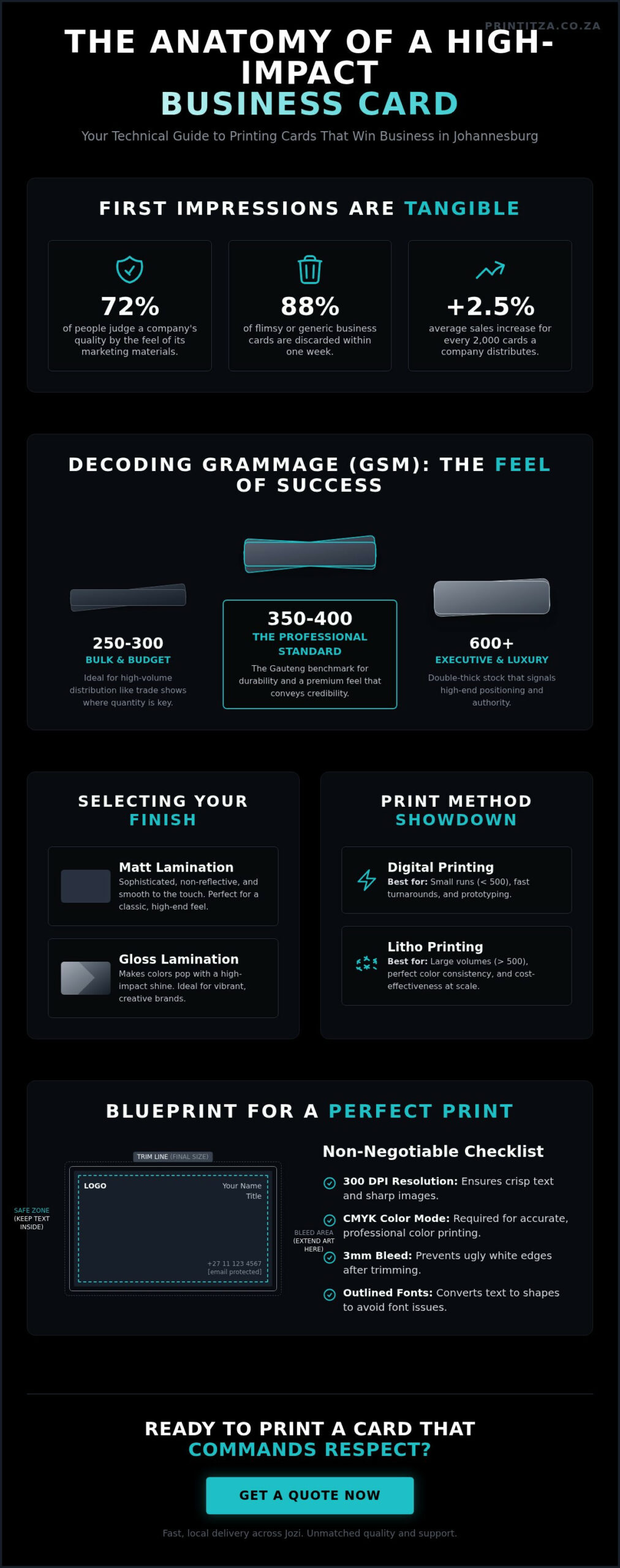
Statistics from 2024 industry studies show that while digital contact sharing is rising, 88% of business cards are discarded within a week if they feel flimsy or generic. However, for every 2,000 cards handed out, a company’s sales typically increase by an average of 2.5%. In the professional services sectors of Gauteng, a physical card acts as a silent brand ambassador that sits on a desk long after a digital notification has been cleared. Savvy Johannesburg professionals who understand the power of tangible marketing often pair their cards with a strong business newsletter printing strategy to maintain ongoing brand presence with their contacts.
Why Quality Matters for Gauteng Professionals
Your card’s texture and weight speak before you do. When you hand over a 400gsm silk-finish card in a boardroom, you’re communicating stability and attention to detail. A poorly printed, thin card can actually damage your corporate reputation, especially in high-stakes sectors like finance or law. We’ve seen this play out at the Gallagher Convention Centre during major trade expos. Professionals with premium, bespoke cards consistently report higher follow-up rates than those using budget alternatives. The psychological impact of “grammage” (paper weight) creates a perception of a “heavyweight” brand that is ready for serious business. For a deeper look at local design trends and technical specs, our 2026 guide to premium business cards in Johannesburg covers everything you need to know about creating cards that open doors.
Business Cards vs. Digital Alternatives in 2026
Digital-only solutions face significant hurdles in South Africa’s unique landscape. NFC and QR-only cards often fail in low-connectivity areas or high-speed networking environments where fumbling with a phone feels awkward. The most successful professionals in 2026 use a hybrid strategy. They choose business card printing that integrates a litho-printed QR code into a premium design. This offers the best of both worlds: a tactile, memorable experience and a seamless link to a digital portfolio. A physical card doesn’t require a battery, a data connection, or a specific app; it just works. That reliability is exactly what Joburg’s top earners value most.
- Reliability: Cards work in any environment, from underground parkades to high-rise offices.
- Tactile Branding: Special finishes like spot UV or foiling create a sensory memory.
- Speed: Handing over a card takes two seconds; syncing phones can take two minutes.
Decoding Printing Specifications: GSM, Finishes, and Stocks
Selecting the right materials for your business card printing project determines how your brand is perceived in a Sandton boardroom or at a busy Maboneng networking event. In the fast-paced Johannesburg business environment, your card needs to survive more than just a quick handshake. It has to withstand high temperatures, friction in wallets, and constant handling. Choosing the correct specifications ensures your first impression isn’t a flimsy or faded one.
Grams per Square Metre (GSM) measures the density and weight of the paper. While 250gsm might work for high-volume flyers, it feels thin and temporary for a professional card. Most Gauteng professionals settle on 350gsm to 400gsm as the local gold standard. This weight provides a rigid, premium feel that doesn’t bend easily. You can explore our full range of premium stocks to find the perfect fit for your business card printing needs.
Choosing the Right Paper Weight (GSM)
Standard 250-300gsm stocks are ideal for bulk distribution at trade shows where quantity matters most. However, the 350-400gsm range is the benchmark for most South African businesses because it offers durability and a professional “snap” when handed over. For executive roles, 600gsm double-thick cards provide a heavy, luxury feel that immediately signals high-end positioning and authority.
Lamination and Protective Finishes
Lamination isn’t just about looks; it’s a protective shield against the Johannesburg sun and daily wear. Matt lamination offers a sophisticated, non-reflective surface that’s smooth to the touch. Gloss lamination makes colors appear more vibrant and provides a high-impact shine for creative sectors. If you want a truly memorable tactile experience, Soft Touch (Suede) lamination creates a velvet-like texture that practically begs to be touched.
Specialty Embellishments
Embellishments transform a standard card into a marketing tool. Spot UV applies a high-gloss coat to specific areas, like your logo, creating a striking contrast against a matt background. Foiling and embossing add a 3D tactile dimension that works exceptionally well for premium brands. You should also consider the shape; rounded corners offer a modern, tech-forward aesthetic, while traditional square edges maintain a classic, corporate look. Beyond standard paper, specialty stocks like linen, recycled kraft, or synthetic waterproof options allow you to align your card with your brand’s specific values and identity.
Litho vs. Digital Business Card Printing: Which is Right for You?
Choosing the right method for your business card printing project depends on your budget, timeline, and brand requirements. Digital printing works like a high-end laser printer, transferring toner directly to the page. Lithographic (litho) printing is a more traditional mechanical process. It uses custom aluminum plates to transfer wet ink onto rubber blankets before pressing it onto your chosen card stock.
The main differences involve setup and scale. Digital has almost zero setup costs, making it the perfect fit for small batches. Litho requires the creation of physical plates, which adds initial time and expense but delivers unmatched quality for high-volume orders. In the fast-paced Johannesburg market, roughly 70% of new businesses choose digital for its immediate availability, while established firms stick to litho for consistent brand identity across thousands of units. When budgeting for either option, it helps to understand how to structure your brief correctly; our guide to accurate printing quotes in South Africa walks you through the exact specifications you need to provide to avoid hidden costs and production delays.
Digital Printing for Short Runs and Speed
Digital printing is the ideal solution for startups and independent creators needing 100 to 250 cards quickly. Because there are no plates to make, we can often turn these orders around in under 24 hours. This method also allows for variable data printing. You can customise individual cards within a single print run, changing names or contact details without stopping the press. It’s the most cost-effective way to handle low-volume, high-frequency updates as your team grows. You don’t have to worry about storing thousands of cards that might become outdated if your office number changes.
Litho Printing for Volume and Precision
For corporate orders exceeding 1,000 cards, litho printing is the superior choice. The unit cost drops significantly as your volume increases, making it a smart move for your marketing budget. Beyond savings, litho offers better ink penetration and crispness. If your design features large areas of dark, solid colour, litho prevents the cracking or streaking sometimes seen in digital toners during the cutting process.
Litho also allows for specific Pantone brand matching. This ensures your corporate colours remain identical across every batch, providing a premium finish that digital processes can’t always replicate. While the setup usually takes 3 to 5 working days, the professional result is worth the wait for high-stakes networking in Gauteng’s competitive business hubs.
- Digital: Best for 50 to 500 cards, 24-hour turnaround, and variable data like individual employee names.
- Litho: Best for 1,000+ cards, exact Pantone matching, and achieving the lowest possible price per card.
Whether you need a quick pack of 100 cards for a last-minute conference in Sandton or a bulk order of 5,000 for a national sales team, we’ll help you pick the process that balances quality and cost. Your choice of business card printing technology says a lot about your brand’s attention to detail.
Designing for Print: Avoiding Common Johannesburg Printing Pitfalls
You’ve spent hours perfecting your brand’s look, but the transition from screen to physical card can be tricky. In the fast-paced Johannesburg business environment, a blurry or poorly cropped card sends the wrong message. High-quality business card printing depends on specific technical standards that ensure your final product looks as sharp as your digital mockup. If you ignore these basics, you risk wasting your budget on materials that don’t reflect your professional standards.
Resolution is your first hurdle. You must set your file to 300 DPI (dots per inch) at the actual size of the card. Screens display images at 72 DPI, which looks fine on a monitor but appears pixelated and “muddy” once printed. Similarly, you must work in the CMYK color space. While RGB colors look vibrant on your phone, they often lose their “pop” during the ink-transfer process. Converting your file to CMYK early helps you manage expectations for color accuracy.
- Typography: Keep your main contact details at a minimum of 8pt font size.
- Legibility: Avoid light-colored text on dark backgrounds if the font is very thin, as the ink can “bleed” into the letters and make them unreadable.
- Contrast: Ensure a high contrast ratio between your text and the card stock to help your details stand out in low-light networking events.
Technical Setup for Print-Ready Files
Bleed is the 3mm margin required for cutting that ensures your background colors or images reach the very edge of the card without leaving white gaps. To prevent technical errors, always convert your fonts to outlines or paths. This “locks” the text shape so the printer doesn’t need to have your specific typeface installed. For the most reliable results, export your work as a PDF/X-1a file. This format is the industry favorite for Gauteng printers because it standardizes color data and embeds all necessary assets, reducing the chance of surprises at the press.
Design Trends for 2026
Modern Johannesburg design is moving toward an architectural, minimalist aesthetic. Inspired by the sleek lines of Sandton’s newest developments, 2026 trends focus on generous white space and premium, heavy-weight stock. Don’t feel pressured to crowd the front of your card. Use the reverse side for functional elements like a quick appointment grid or your primary social media handles. This keeps the front clean and professional while making the card a useful tool for your client. The same principles of clean, impactful design apply when you extend your brand into business newsletter printing in Johannesburg, where well-structured layouts help your message cut through the noise and land on executives’ desks with authority.
QR Code Integration Best Practices
QR codes are now a standard feature in South African networking, but they must be functional. Ensure your code is at least 20mm by 20mm to guarantee quick scannability by all smartphone models. Use dynamic QR codes instead of static ones; this allows you to update the destination link—like a seasonal promotion or a new cell number—without needing a full reprint. Place the code away from the 3mm “safe zone” at the edges to avoid it being clipped during the cutting process.
Ready to turn your vision into a premium physical product? Start your business card printing project with the Print Itza team and get expert guidance on every file setup detail.
Why Print It ZA is the Premier Choice for Gauteng Businesses
Choosing a printing partner defines how the world perceives your brand. We operate with a 24/7 capacity in the heart of Johannesburg, ensuring your deadlines are always met. This round-the-clock commitment provides an unmatched turnaround for every business card printing project. Our facility handles the entire lifecycle of your stationery, moving your project from an initial design concept to final delivery with zero friction. We leverage both high-end litho and rapid digital printing technologies to serve every scale of business. Whether you need a boutique run of 250 premium cards or a massive corporate batch of 20,000, we maintain absolute color consistency and crisp detail.
Our in-house design experts act as your creative consultants. They understand the technical nuances of bleed, margins, and grammage, ensuring your files are production-ready from the start. We take pride in being a hardworking, tech-savvy South African business that prioritizes your vision. Our logistics network covers the entire country, but we maintain a specialized focus on Gauteng, Johannesburg, and Pretoria to provide the fastest local service possible.
End-to-End Printing and Logistics
Our Johannesburg facility is specifically optimized for high-volume corporate distribution. You don’t have to worry about international shipping delays, fluctuating exchange rates, or complex customs clearances. We provide direct local support, meaning you can talk to a real person who understands the South African market. For those with a unique creative vision, we offer bespoke solutions that go beyond standard templates. We provide custom quotes for specialized finishes like matte lamination, spot UV, or metallic foils. Our streamlined logistics ensure that your cards arrive at your office in Sandton, Centurion, or Pretoria East exactly when you need them.
Sustainability in South African Printing
We believe that high-quality business card printing shouldn’t come at the cost of the environment. Our team utilizes eco-friendly paper stocks and responsible ink usage to reduce our carbon footprint. We are a 100% South African owned company, and we remain dedicated to supporting the local Johannesburg industry. By choosing us, you invest back into the local economy while receiving a product that meets global quality standards. We make the world of professional printing accessible, affordable, and sustainable for every professional.
Make Your Mark on the Gauteng Business Landscape
Your business card is more than just a slip of paper; it’s a handshake that stays behind long after you’ve left the room. Selecting the right grammage and finish ensures your first impression carries the weight your brand deserves. Whether you opt for the high-volume precision of litho or the rapid turnaround of digital, getting these technical details right helps you avoid common design pitfalls that can stall your growth. We’ve equipped our facility with state-of-the-art litho and digital technology to ensure every project meets premium standards.
Print It ZA offers 24/7 operational support across Gauteng to keep your business moving at the speed of Johannesburg commerce. We pride ourselves on being a reliable partner that provides seamless service and reliable nationwide delivery for every client. Our team makes professional business card printing simple, efficient, and affordable for everyone from solo entrepreneurs to large corporate firms. Don’t settle for anything less than a card that reflects your true potential.
Order Your Professional Business Cards from Print It ZA
We’re ready to help you create something exceptional that opens doors across South Africa.
Frequently Asked Questions
How long does business card printing take in Johannesburg?
Most business card printing projects in Johannesburg take between 24 and 48 hours for digital runs. If you choose litho printing for larger volumes, expect a turnaround of 3 to 5 working days. We prioritize speed to ensure your networking never stops. Our streamlined process means you get premium quality without the long wait times. Your brand deserves a fast, reliable partner that understands local deadlines.
What is the standard business card size in South Africa?
The standard business card size in South Africa is 90mm x 50mm. Some modern brands opt for the 85mm x 54mm international credit card size to fit perfectly in wallets. Choosing these dimensions ensures your card looks professional and fits into standard card holders. We recommend adding a 3mm bleed to your design to ensure a perfect cut every time. This keeps your layout looking sharp and professional.
Can I print business cards on both sides?
You can definitely print on both sides of your business cards to maximize your brand real estate. Using the back for a QR code, a list of services, or a bold logo creates a high-impact first impression. Double-sided printing is a cost-effective way to provide more value to your contacts. It turns a simple card into a mini brochure for your business. Most clients find this adds significant professional value to their networking.
What is the best paper weight for a professional business card?
A professional business card should have a paper weight, or grammage, of at least 350gsm. For a truly premium feel, many of our clients select 400gsm cardstock. This thickness prevents the card from feeling flimsy or cheap. High-quality paper weight reflects the reliability of your brand and ensures your card survives the bottom of a handbag or pocket. It’s the best way to make a lasting, physical impression on a new lead.
Do I need a professional designer for my business cards?
You don’t need a professional designer if you have a high-resolution PDF, but a pro can help with layout and bleed settings. We offer design assistance to ensure your files meet technical print specifications. This prevents blurry logos or text getting cut off during production. A well-designed card acts as a silent salesman for your brand 24 hours a day. We make the creative process simple and stress-free for every client.
What is the difference between matt and gloss lamination?
Matt lamination offers a smooth, sophisticated finish that’s easy to read under bright lights. Gloss lamination makes colors pop with a high-shine, reflective coating that’s very durable. Matt is currently the choice for 70 percent of our corporate clients in Johannesburg seeking a modern look. Both options provide a protective layer that keeps your cards looking fresh for longer. Choose the finish that best reflects your brand’s unique personality and style.
Can Print It ZA deliver business cards to Pretoria or Midrand?
We deliver business cards to Pretoria, Midrand, and across the Gauteng province daily. Our reliable courier network ensures your order arrives at your doorstep within 24 hours of production finishing. Whether you’re in the heart of Sandton or a home office in Centurion, we’ve got you covered. This seamless delivery service saves you time and keeps your business moving. We take the hassle out of getting your professional print materials.
Is there a minimum order quantity for business card printing?
Our minimum order quantity for digital business card printing is 100 cards. This small batch size is perfect for startups or individual creators testing a new design. For larger corporate teams, we scale up to thousands of units using litho printing to keep costs low. We offer flexible quantities because we believe professional branding should be accessible to everyone. Get exactly what you need without holding unnecessary stock that might go out of date.